Every June, Florida homeowners start watching the tropics again. By the time a named storm shows up in the forecast, it’s too late to change how your house was built. That decision gets made once – at construction – and it’s the single biggest factor in whether your home survives the next Category 3 with a few missing shingles or ends up on the six o’clock news.
Why Steel Homes Are Florida’s Smartest Build for Storm Season
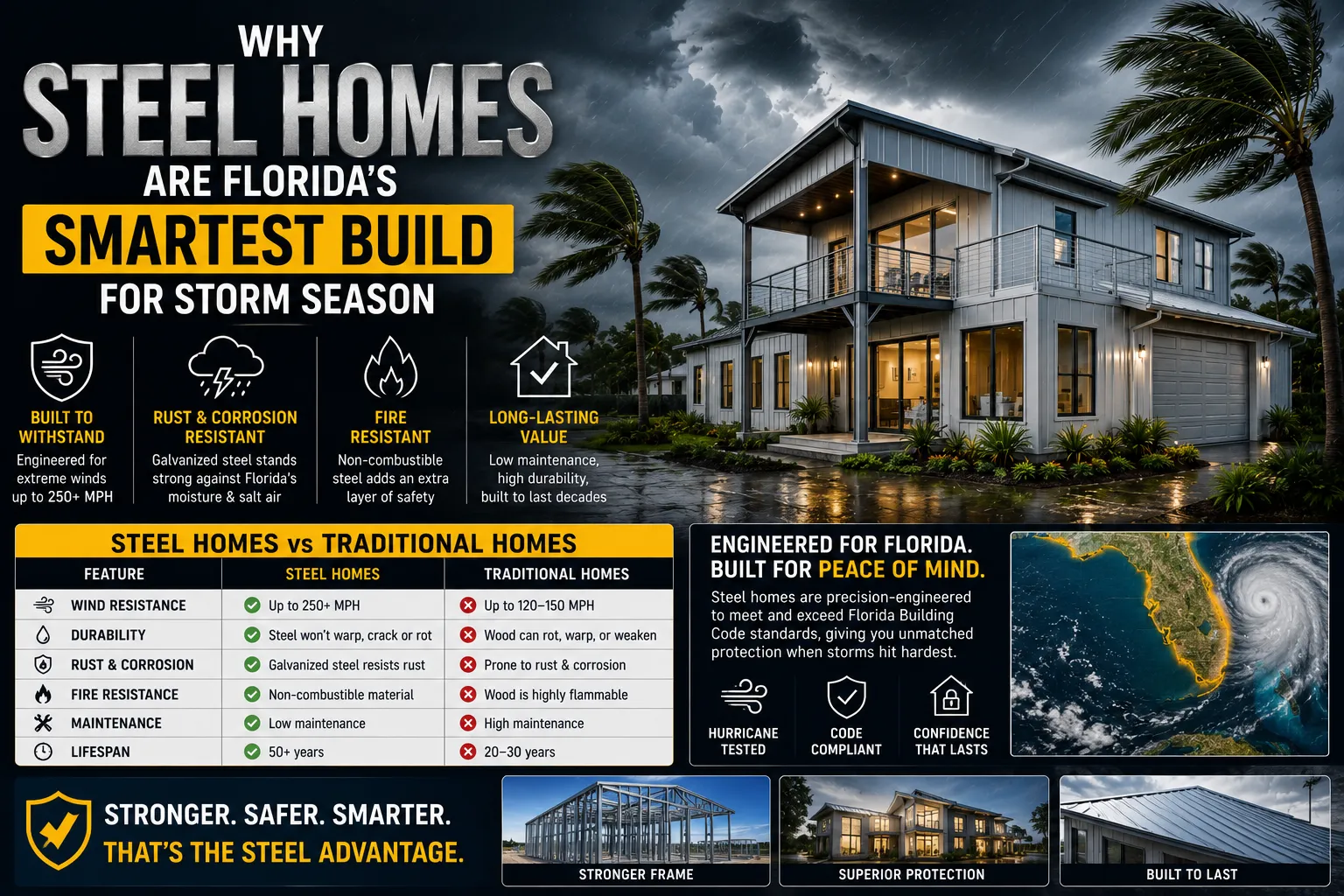
More Florida builders and homeowners are answering that question with steel. Not steel siding over a wood frame — full structural steel framing, from the foundation connections to the roof trusses. Here’s why it’s becoming the default choice in hurricane-prone counties from Tampa to the Keys, and what that means if you’re planning a build.
The Short Answer
Steel-framed homes hold up better in hurricanes because steel doesn’t rot, warp, or lose strength when it gets wet, and steel connections are engineered to resist uplift and lateral wind loads far beyond what standard wood framing can handle. A properly engineered steel home can be built to withstand sustained winds of 170+ mph, compared to the 120–150 mph range typical of code-minimum wood-frame construction in Florida.
Wind Load: Where Steel Actually Wins
Florida Building Code sets minimum wind resistance requirements by county, and coastal zones in South Florida already require some of the strictest wind ratings in the country. Wood-frame homes can meet code, but “meeting code” and “surviving a direct hit” are different standards.
Steel framing changes the physics of the problem in three ways:
- Continuous load path. In a steel structure, every wall, roof truss, and floor connection ties back to the foundation through welded or bolted steel-to-steel joints. Wind uplift has no weak seam to exploit — unlike wood framing, where nailed connections can work loose under repeated gusts.
- No warping under moisture. Florida humidity swells and shrinks wood over time, loosening fasteners years before a storm ever arrives. Steel dimensions don’t move.
- Higher tensile strength per pound. Steel studs and trusses carry significantly more load than dimensional lumber of the same size, which is why steel-framed homes can be engineered for higher wind ratings without oversized members.
Beyond Wind: The Storm Risks People Forget
Hurricane season isn’t just wind. It’s water, humidity, and what comes after the storm passes.
Flood and moisture resistance. Steel doesn’t absorb water, so a home that takes on floodwater during a storm surge won’t develop the structural rot that forces wood-framed homes into costly rebuilds. This matters enormously in coastal and low-lying Florida counties where storm surge, not wind, causes the most expensive damage.
Termites. Florida has some of the heaviest termite pressure in the U.S., and termite damage silently weakens wood framing for years before a storm ever tests it. Steel simply isn’t a food source, which removes an entire category of hidden structural risk.
Mould. Post-storm mould remediation is one of the most common — and expensive — insurance claims in Florida. Steel framing doesn’t provide the organic material mould needs to colonise wall cavities the way wet lumber does.
Fire. Non-combustible steel framing also reduces wildfire and electrical fire risk, an increasingly relevant factor as insurers reassess risk across the state.
The Insurance Angle
Florida homeowners insurance has become one of the biggest line items in owning property here, and insurers price risk based on construction type. Homes built to higher wind-mitigation standards — hip roofs, impact-rated openings, and non-combustible, storm-rated framing — typically qualify for wind mitigation credits that lower annual premiums. Steel construction, paired with impact windows and a properly rated roof system, often qualifies for the strongest tier of these discounts because it directly reduces the insurer’s exposure to total-loss claims.
Over a 20- or 30-year mortgage, those annual discounts add up to real money — often enough to offset any upfront cost difference in framing.
Cost: What It Actually Looks Like Over Time
Steel framing can run comparable to or slightly above wood framing at the outset, depending on market prices for lumber versus steel at the time of build. But the total cost of ownership tells a different story:
- Lower insurance premiums from wind mitigation credits
- No termite treatment contracts or damage repairs
- No warping, cracking, or nail-pop repairs from humidity cycles
- Fewer post-storm repair claims, which also protect your claims history and future premiums
- Longer structural lifespan with lower long-term maintenance costs
For a home you plan to own for decades in a state that averages a direct hurricane threat every few years, the framing material isn’t a cosmetic decision — it’s a financial one.
Is Steel Framing Right for Every Florida Build?
Steel framing is worth the strongest consideration for the following:
- Coastal and barrier-island properties facing the highest wind and surge exposure
- New construction in high-velocity hurricane zones (HVHZ) in Miami-Dade and Broward counties
- Custom homes where owners plan to stay long-term and want to minimize lifetime maintenance
- Rebuilds in areas recently hit by storm damage, where insurers are reassessing risk block by block
It’s a smaller advantage for inland builds far from surge zones, though wind and termite benefits still apply statewide.
Frequently Asked Questions
Are steel-framed homes more expensive than wood-framed homes in Florida? Upfront costs are often comparable and can vary with lumber and steel market prices. Long-term costs tend to favour steel due to lower insurance premiums, no termite damage, and reduced maintenance.
Can steel homes withstand a Category 5 hurricane? A properly engineered steel home can be designed and rated for sustained winds well above 170 mph, which covers Category 5 wind speeds (157+ mph). Actual survivability also depends on roof design, opening protection, and site-specific engineering.
Do steel homes qualify for Florida wind mitigation discounts? Yes. Steel framing combined with impact-rated windows and doors and a wind-rated roof system typically qualifies for wind mitigation credits, which can meaningfully lower homeowners’ insurance premiums.
Do steel-framed homes rust in Florida’s humidity? Structural steel used in residential framing is galvanised to resist corrosion, and manufacturers rate it for coastal and high-humidity environments. Proper installation and coatings are standard practice in Florida steel construction.
Is steel framing termite-proof? Steel is not a food source for termites, eliminating the structural risk that wood framing carries in Florida’s high termite-pressure regions.
The Bottom Line
Florida’s storm season isn’t going away, and neither is the state’s exposure to wind, surge, humidity, and termites — the four forces that quietly determine how long a home actually lasts here. Steel framing addresses all four at once: it holds up to higher wind loads, resists water and moisture damage, keeps termites out, and often earns lower insurance premiums as a result.
If you’re planning a Florida build, the framing decision is the one that’s hardest to change later and easiest to get right now. Steel is worth putting on the table before the plans are finalised.