Every June, Florida homeowners hear the same warning: prepare now, before the next storm makes landfall. And every year, the roofs that fail aren’t necessarily old — many are newer roofs that simply weren’t built to withstand what Florida’s hurricanes actually do to a structure. So what separates a roof that survives a Category 4 hurricane from one that ends up in a neighbor’s yard?
The honest answer is that no roof is literally indestructible. But a properly engineered roofing system — the right materials, correctly installed, with every component working together — can resist sustained winds well above 150 mph and keep a home watertight when it matters most. Here’s what actually makes that possible.
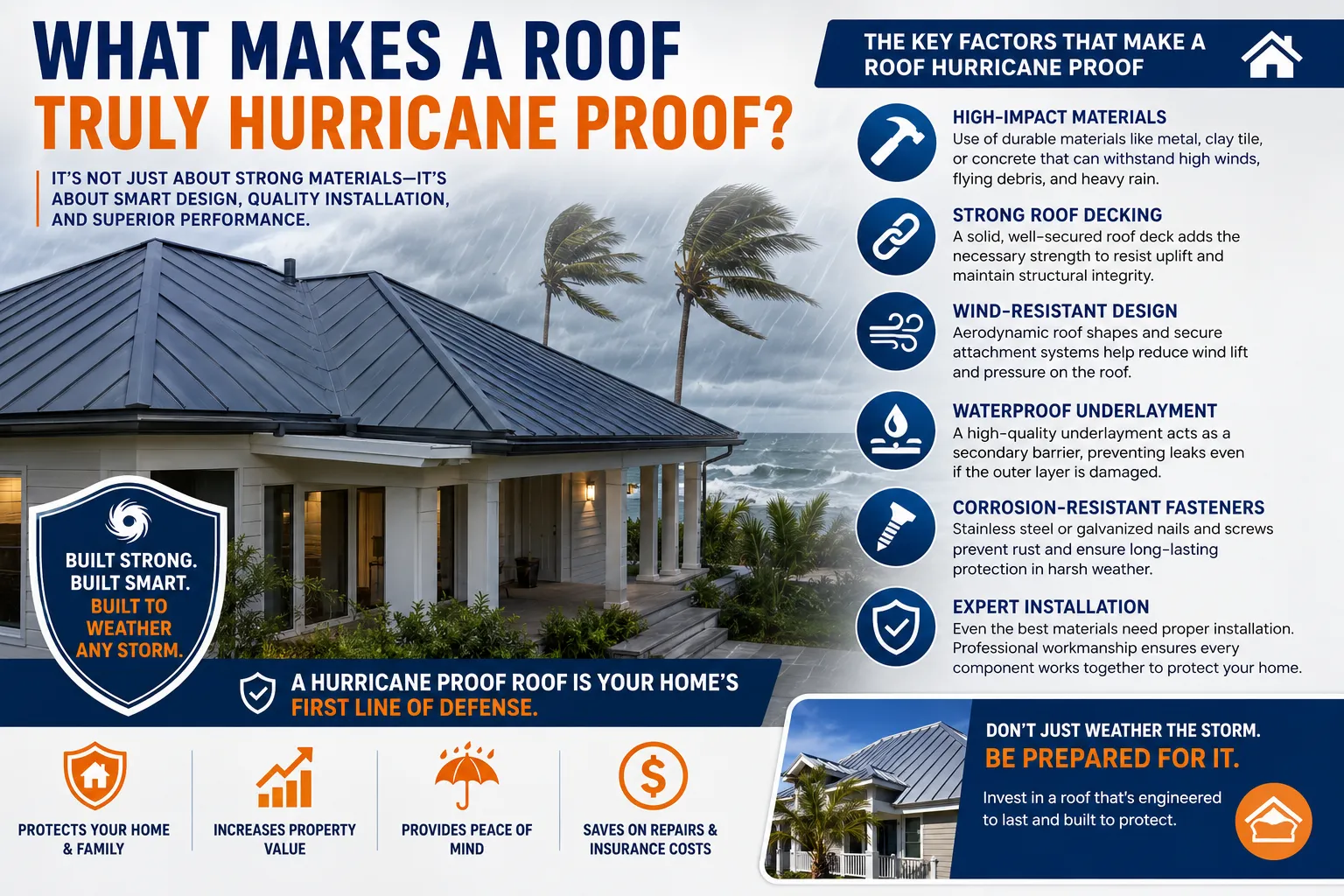
It Starts With Wind Uplift, Not Wind Speed
Most people assume hurricane damage comes from wind simply pushing against a roof. In reality, the bigger threat is uplift — the aerodynamic force that occurs as wind flows over a roof’s surface and creates negative pressure, literally trying to suck the roof off the house from above, the same principle that lifts an airplane wing.
This is why roof shape, pitch, and edge design matter as much as the material itself. Roofs with steep pitches, hip designs (sloped on all four sides rather than gabled), and minimal overhangs perform dramatically better in high winds than low-pitched or gable roofs with long overhangs that catch wind like a sail.
The Material: Why Steel Outperforms Traditional Roofing
Asphalt shingles are rated for wind resistance too, but even premium shingles typically top out around 130 mph before manufacturers’ warranties stop covering wind damage — and that’s under ideal installation conditions. A standing-seam steel roofing system, by contrast, is commonly engineered and tested to withstand winds of 140-180 mph, depending on the panel profile, gauge, and fastening pattern.
Steel earns that performance in a few specific ways:
- Continuous panel strength. Standing-seam steel panels interlock along raised seams that run the full length of the roof, creating a continuous structural skin rather than thousands of individual overlapping pieces, each a potential failure point.
- Concealed, mechanically-fastened attachment. Because the fasteners are hidden within the seam rather than exposed and driven through the panel face, there’s no exposed nail head to loosen, back out, or corrode over time — a common failure mode in shingle roofs after repeated wind cycling.
- Impact resistance. Steel roofing rated Class 4 for impact resistance holds up to wind-driven debris — branches, patio furniture, roofing material from neighboring homes — far better than asphalt or tile, which crack or shatter on impact.
- No granule loss, no curling. Shingles lose protective granules and curl at the edges over time, both of which reduce wind resistance years before a storm arrives. Steel doesn’t degrade the same way, so its hurricane performance doesn’t quietly erode with age.
Installation Is Where Most “Hurricane-Rated” Roofs Actually Fail
Here’s the part manufacturers won’t put on the packaging: a roofing material’s wind rating is only as good as the installation underneath it. Insurance adjusters and forensic roof inspectors consistently find that storm failures trace back to installation shortcuts, not material defects.
A truly hurricane-resistant roofing system requires attention to every layer:
1. The deck. Roof sheathing must be properly fastened to the trusses — Florida Building Code specifies nail spacing and, in high-velocity hurricane zones, often requires ring-shank nails instead of smooth ones, which resist pull-out under uplift far better.
2. The secondary water barrier. A self-adhering, sealed underlayment (not just felt paper) keeps water out even if wind-driven rain gets past the roof covering — a requirement under Florida’s building code for a reason: it’s what keeps a home dry when shingles or panels are compromised.
3. The fastening pattern. For steel roofing specifically, panel clip spacing and screw pattern have to match the wind zone and building height, calculated per ASCE 7 wind load standards, not applied as a one-size-fits-all default.
4. The edges and penetrations. Drip edges, ridge caps, and any roof penetration (vents, chimneys, skylights) are the most common starting points for wind and water intrusion. Hurricane-grade installation seals and mechanically secures every one of these transition points.
5. Compliance with Florida Building Code and Miami-Dade NOA. Products with a Notice of Acceptance (NOA) from Miami-Dade County have passed some of the most rigorous wind and impact testing in the country — including large-missile impact testing simulating storm debris. Choosing NOA-approved steel roofing systems means the product has already proven itself under conditions far more extreme than standard building code testing requires.
Why Steel Roofing Is Increasingly the Standard for Florida Homes
Florida’s combination of hurricane exposure, high humidity, salt air in coastal areas, and intense UV exposure is uniquely hard on roofing materials. Steel roofing systems handle this environment well for reasons beyond wind resistance alone:
- Longevity. A properly coated steel roof commonly lasts 40-70 years, compared to 15-20 years for asphalt shingles in Florida’s climate — meaning it’s rated for, and likely to actually experience, multiple hurricane seasons at full strength rather than degraded strength.
- Corrosion resistance. Modern steel roofing uses coatings like Galvalume or aluminum-zinc alloys specifically formulated to resist coastal salt corrosion.
- Fire resistance. Steel carries a Class A fire rating, an added safety benefit that has nothing to do with hurricanes but matters for overall home protection and, in many cases, insurance pricing.
- Insurance incentives. Florida’s mitigation credit system rewards hurricane-resistant roofing — impact-rated, high-wind-rated steel roofs frequently qualify homeowners for meaningful reductions in windstorm insurance premiums, sometimes enough to offset a significant portion of the material’s higher upfront cost over time.
The Real Checklist: How to Know If a Roof Is Actually Hurricane Ready
If you’re evaluating a roof — your own or one on a home you’re buying — these are the questions that actually matter:
- Does the roofing product carry a Miami-Dade NOA or Florida Product Approval for the specific wind zone the home is in?
- Is the installation documented to meet current Florida Building Code, not code from whenever the home was originally built?
- Was a secondary water barrier installed, and is it sealed at every seam?
- Are fasteners matched to the wind zone and roof height, per an engineer’s or manufacturer’s specification — not a generic fastening schedule?
- Has the roof been inspected for wear — loose panels, corroded fasteners, compromised sealant — within the last year, especially before hurricane season?
A roof that checks all five isn’t just “hurricane-rated” on paper. It’s actually built to perform when a real storm arrives.
“Hurricane proof” is a bit of a misnomer — no roof is entirely immune to a storm’s power. But there’s a real, measurable difference between a roof that’s marginally compliant and one engineered from the deck up to resist uplift, shed wind-driven rain, and stay intact under debris impact. For Florida homeowners, that difference usually comes down to three things: a wind-resistant material like standing-seam steel, installation that follows Florida Building Code and NOA specifications to the letter, and a fastening and sealing system designed for the specific wind zone the home sits in.
Get all three right, and a roof stops being the weak point in a hurricane — and becomes the reason the rest of the house stays standing.