Florida Steel Homes

Tornado-Proof House Designs: How Homes Are Engineered to Survive Extreme Winds

For many American homeowners, severe storms are a seasonal concern. But in tornado-prone regions, they’re a life-safety threat. Tornadoes produce the most violent winds on Earth — often exceeding 200 mph, with rapidly changing pressure and airborne debris capable of penetrating standard homes.

After major tornado events across the U.S., investigators consistently observe the same pattern: conventional wood-frame houses are destroyed, while reinforced or engineered structures remain standing or partially intact.

This has led to growing interest in tornado-proof house designs — homes engineered specifically to resist extreme wind loads, debris impact, and structural collapse.

If you’re building in a high-wind region or want maximum structural safety, understanding tornado-resistant design strategies can help you create a far more resilient home.

Tornado-Proof House Designs That Survive
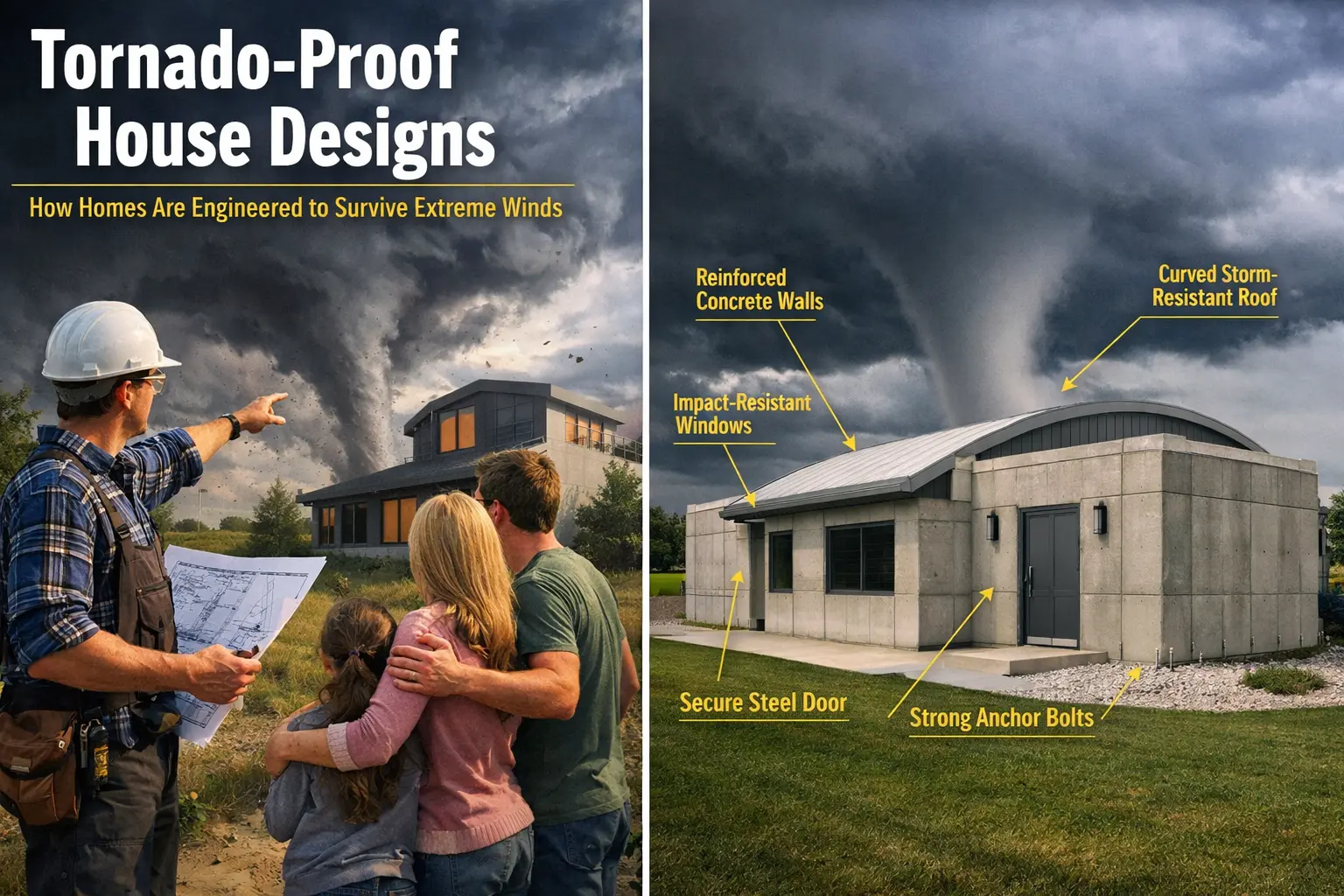
Tornado-Proof House Designs How Homes Are Engineered to Survive Extreme Winds


Why Standard Homes Fail in Tornadoes

Typical U.S. houses use wood framing, which performs adequately in normal storms but fails under tornado forces.

Common tornado failure mechanisms:

  • Roof uplift and separation

  • Wall collapse from lateral pressure

  • Debris penetration

  • Progressive structural failure

  • Foundation anchoring failure

Once the roof lifts, walls lose lateral support and collapse quickly.

Tornado-resistant homes instead focus on:

  • Continuous structural shell

  • Reinforced materials

  • Aerodynamic geometry

  • Strong anchoring

  • Debris-resistant openings

1. Reinforced Concrete Dome Homes

Concrete dome homes are among the most tornado-resistant structures ever built. Their curved shape allows wind to flow around rather than push against flat walls.

Why domes survive tornadoes

  • Aerodynamic shape reduces wind pressure

  • Reinforced concrete shell

  • No roof edges to lift

  • Even load distribution

  • Extreme debris resistance

Many dome homes have survived direct tornado strikes with minimal damage.

Key advantage

Wind cannot “grab” the structure — a major reason flat-walled homes fail.

2. Steel-Frame Tornado-Resistant Homes

Steel framing offers exceptional strength and flexibility under extreme wind loads. When engineered correctly, steel homes can resist forces far beyond wood framing limits.

Tornado resistance benefits

  • High strength-to-weight ratio

  • Flexible energy absorption

  • Strong mechanical connections

  • Anchored to the foundation

  • Resistant to debris penetration

Steel homes are commonly used in hurricane and tornado-resistant construction for this reason.

Real-world performance

Post-tornado damage surveys often show steel-framed structures still standing while nearby wood homes are destroyed.

3. Insulated Concrete Form (ICF) Homes

ICF homes use reinforced concrete cores inside insulating foam forms, creating thick, solid walls with exceptional strength.

Tornado-resistant properties

  • Reinforced concrete structural core

  • High impact resistance

  • Continuous load path

  • Strong roof anchoring

  • Heavy mass resists wind

ICF walls can resist both wind pressure and flying debris far better than wood framing.

4. Earth-Sheltered and Berm Homes

Earth-sheltered homes are built partially or fully below ground level, with soil covering walls and roof areas.

Tornado survival advantage

  • Minimal wind exposure

  • Soil shields structure

  • Debris protection

  • Thermal stability

  • Low profile

Because tornado winds act mainly above ground, earth-covered structures avoid direct wind forces.

5. Reinforced Safe-Room Integrated Homes

Even tornado-resistant homes often include a hardened safe room designed to survive direct EF-5 tornado impact.

Safe rooms are typically:

  • Reinforced concrete or steel

  • Anchored to the foundation

  • Debris-impact rated

  • Pressure resistant

  • Windowless

They provide life safety even if the rest of the home is damaged.

Key Design Principles of Tornado-Proof Homes

Regardless of construction type, tornado-resistant houses share critical features.

1. Continuous Load Path

Every component is tied together:

  • Roof → walls → foundation

  • Steel straps and anchors

  • Engineered fasteners

This prevents structural separation.

2. Aerodynamic Shape

Wind-resistant forms include:

  • Domes

  • Rounded corners

  • Hip roofs

  • Low slopes

Sharp edges and gables increase uplift risk.

3. Reinforced Connections

Most failures occur at joints:

  • Roof-to-wall

  • Wall-to-foundation

  • Opening frames

Tornado-resistant homes use engineered connectors.

4. Debris-Resistant Openings

Flying debris causes major damage.

Solutions:

  • Impact windows

  • Reinforced shutters

  • Protected openings

  • Minimal glazing

5. Strong Foundation Anchoring

Tornado winds create uplift forces that can pull homes off their foundations.

Resistant homes use:

  • Anchor bolts

  • Reinforced slabs

  • Deep footings

  • Steel tie-downs

Which Tornado-Proof Design Is Strongest?

Performance ranking typically:

  1. Reinforced concrete dome

  2. Earth-sheltered home

  3. Reinforced concrete / ICF home

  4. Engineered steel frame home

  5. Wood frame with a safe room

Each step adds significant survivability.

Tornado-Resistant vs Hurricane-Resistant Design

There is overlap between both:

Shared features:

  • Reinforced structure

  • Continuous load path

  • Impact protection

  • Strong anchoring

But tornado design often requires:

  • Higher wind tolerance

  • Debris penetration resistance

  • Safe room inclusion

Is a Fully Tornado-Proof House Possible?

Absolute tornado proofing is difficult because EF-5 tornado forces are extreme and unpredictable.

However, properly engineered reinforced homes can:

  • Remain standing

  • Prevent collapse

  • Protect occupants

  • Survive a direct strike

This is the practical goal of tornado-resistant design.

Final Thoughts

Tornadoes are among the most destructive natural forces affecting U.S. homes. Yet structural engineering advances now allow houses to be built far stronger than traditional wood-frame construction.

Reinforced concrete, steel framing, aerodynamic shapes, and integrated safe rooms dramatically improve survival during extreme wind events. For homeowners in storm-prone regions, tornado-resistant design can mean the difference between catastrophic loss and structural survival.

Florida Steel Homes
High-Strength Storm-Resistant Home Specialists

📞 786-610-6398
📧 info@FloridaSteelHomes.com
📍 16104 4th St E, Redington Beach, FL 33708

About Del Malam

Picture of Del Malam

Del Malam

Experience

Del Malam co-founded Florida Steel Homes after personally losing his home to hurricane flooding. His firsthand experience navigating the rebuilding process, dealing with government red tape, and collaborating with Florida contractors has shaped his mission to help others build hurricane-resilient homes. His family-run company has over 20 years of construction experience, with a strong focus on storm-resistant building methods.

Expertise

Del Malam – Facebook
Co-founder of Florida Steel Homes – Specializing in steel-frame construction, hurricane-proof home design, and residential project management. Del & his team have 20+ years working with licensed Florida contractors and builders.

Authoritativeness

Featured in Florida community publications for hurricane recovery support.
Speaker at local home safety events and hurricane-preparedness expos. Recognized for leadership in resilient homebuilding practices across coastal Florida communities.

Trustworthiness

About Us
Family-owned.  Extensive experience working Licensed Florida Builders who have transparent practices.