Hurricane protection starts long before a storm is named. The homes that survive aren’t lucky — they’re prepared. Here’s exactly what works, what doesn’t, and what to do before this season.
Protect Your House From a Hurricane
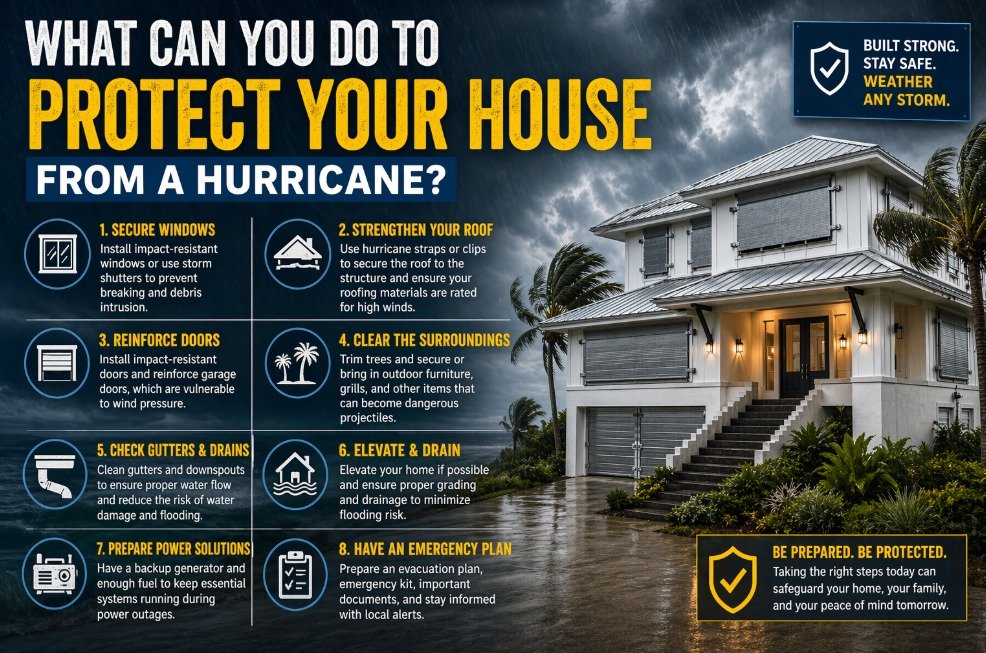
Your House Can Survive a Hurricane — If You Do These Things First
The week before Hurricane Ian made landfall, thousands of Southwest Florida homeowners were doing the same thing: scrambling. Taping windows. I grabbed whatever plywood was left at Home Depot. Filling bathtubs with water at midnight. Some of those homes made it through. A lot didn’t. The difference, in almost every case, wasn’t the storm’s path—it was what had been done to those homes months and years before the forecast ever appeared.
Hurricane protection isn’t a 48-hour project. It’s a set of decisions you make about your home while the sky is still blue and the hardware stores still have stock. The good news is that most of these steps are practical, affordable, and genuinely effective. The hard truth is that most Florida homeowners skip them until it’s too late.
📞 Want a home built to survive from the ground up? Call Florida Steel Homes: 786-610-6398 Email: info@FloridaSteelHomes.com Visit: 16104 4th St E, Redington Beach, FL 33708
Why Buyers Are Paying Attention to Hurricane Protection Right Now
Florida homeowners are more anxious about storm season than at any point in the last decade. Insurance premiums have surged across coastal counties, with some Pinellas and Lee County residents seeing rates double or triple since 2021. Several major carriers have exited the state entirely. And after Ian, Idalia, and Helene left their marks, the emotional reality has shifted—people aren’t just worried about property damage anymore. They’re worried about losing everything they’ve built.
That anxiety is driving real behavior changes. More buyers are asking about impact windows before they ask about granite countertops. More homeowners are investing in whole-house storm retrofits before selling. And a growing number are skipping traditional wood-frame construction entirely and moving toward steel-frame or concrete prefab homes that are engineered to take a direct hit. The psychology here is simple: once you’ve watched a neighborhood disappear under storm surge, the question stops being “is this worth the money?” and starts being, “How did I not do this sooner?”
Start With Your Roof—It’s Your Home’s First Line of Defense
If a hurricane takes your roof, it takes everything. The roof is where most structural failures begin, which is why it deserves the most attention and investment. If your roof was installed before 2002—before Florida’s post-Andrew building codes took full effect — it may not meet current wind-resistance standards. A roofing inspection by a licensed Florida contractor can tell you exactly where you stand and what it would cost to bring it up to spec.
For existing roofs, secondary water barriers and hurricane straps make a significant difference. Hurricane straps are metal connectors that tie your roof trusses directly to your wall framing, preventing the roof from lifting off the structure under wind pressure. They cost relatively little to install during a re-roof and can be the single factor that keeps your home intact when a neighbor’s roof is in the next county.
Windows and Doors: Close the Gaps Before the Wind Does
Standard windows and hollow-core doors are essentially weak points waiting to be exploited by hurricane-force winds. Once a window fails, internal pressure builds rapidly inside the home and can blow out walls or lift the roof from the inside. This is not a slow process — it happens in seconds.
Impact-resistant windows and doors are the most reliable long-term solution. They’re laminated to resist shattering and rated for specific wind speeds and debris impact levels. Yes, they cost more upfront — typically $800 to $1,500 per window installed — but they eliminate the annual scramble for shutters, require no storage space, and are recognized by most Florida insurers for premium discounts. If full window replacement isn’t in the budget right now, accordion shutters or properly anchored aluminum panels are the next best option.
Hurricane Protection Comparison: What Works and What Doesn’t
| Protection Method | Effectiveness | Avg. Cost | Ease of Use |
|---|---|---|---|
| Impact Windows & Doors | ⭐⭐⭐⭐⭐ Excellent | $800–$1,500/window | Permanent — no action needed |
| Accordion Shutters | ⭐⭐⭐⭐ Very Good | $15–$25/sq ft | Close manually before the storm. |
| Aluminum Storm Panels | ⭐⭐⭐ Good | $7–$15/sq ft | Must install each storm |
| Plywood Boards | ⭐⭐ Fair | $1–$3/sq ft | Labor-intensive, inconsistent |
| Window Film Only | ⭐ Poor | $5–$10/sq ft | Minimal structural value |
| Hurricane Roof Straps | ⭐⭐⭐⭐⭐ Excellent | $500–$1,500 total | Permanent structural fix |
| Steel Frame Construction | ⭐⭐⭐⭐⭐ Excellent | See builder quote | Built-in — no add-ons needed |
Garage Doors, Entry Points, and the Spots Most People Forget
The garage door is the largest and most vulnerable opening on most Florida homes, yet it’s the one homeowners think about last. Standard garage doors fail under relatively modest wind loads — and when they go, the pressure change inside the home is immediate and catastrophic. A hurricane-rated garage door or a bracing kit specifically designed for your existing door is not optional in a coastal Florida home. It’s essential.
Beyond the garage, check every exterior door for proper deadbolts and reinforced frames. Sliding glass doors should have a secondary locking bar at the base and top track. Any door that feels flimsy when you push on it is a liability. Walk your home’s perimeter and ask yourself honestly: which of these openings would I bet my house on in a 130-mph wind? Reinforce every question you can’t confidently answer “yes” to.
Common Mistakes Florida Homeowners Make Before a Hurricane
The most dangerous mistake is waiting until a named storm starts to prepare. By the time a hurricane is 72 hours from landfall, building supply stores are empty, contractors are unavailable, and anything you do is rushed and unreliable. Real preparation happens in April and May — before the season begins.
Second, don’t rely on window film or standard storm tape as meaningful protection. These products offer minimal structural resistance and give homeowners a false sense of security that can lead to staying when they should evacuate. Third, ignoring your yard is a serious oversight. Outdoor furniture, grills, unsecured fencing, and dead tree limbs become airborne projectiles within minutes of tropical-storm-force winds arriving. Clear your yard completely — not as an afterthought, but as a deliberate safety step every season.
What About Building New? This Is Where It Gets Interesting
If you’re building or buying new in Florida, this conversation changes significantly. A home built from the ground up with hurricane resistance as a core design principle — not an afterthought — performs in a completely different category than a retrofitted older home. Steel-frame modular construction and ICF (insulated concrete form) homes are engineered to Miami-Dade wind standards, meaning they’re rated to withstand 175–185 mph sustained winds before the engineering team considers the job done.
The long-term math is compelling. A steel-frame prefab home in coastal Florida typically carries insurance premiums 20–40% lower than a comparable wood-frame home. It requires fewer post-storm repairs. It holds its value better in a market where buyers are increasingly storm-aware. And it gives you the one thing no retrofit can fully replicate — a structure that was built right from the first day.
Your Next Step Before Storm Season Hits
Start with what you can control this week. Schedule a roof inspection. Walk around your home and identify every weak opening. Get a quote on impact windows for your most exposed elevations. Clear your yard and document your belongings for insurance purposes. These aren’t dramatic gestures — they’re the quiet, practical decisions that determine which houses are standing the week after a storm.
And if you’re at the stage where you’re thinking about building new or replacing a home that’s taken too many hits, talk to a builder who specializes in exactly this problem.
Florida Steel Homes builds steel-frame, hurricane-engineered homes for Florida’s real conditions—not average weather assumptions. Their team can walk you through what a storm-ready build actually costs and what it protects you from.
📞 786-610-6398 📧 info@FloridaSteelHomes.com 📍 16104 4th St E, Redington Beach, FL 33708. Call today for a free consultation—before the season decides for you.