Florida homeowners have a simple problem: every June through November, the state sits in the crosshairs of hurricane season. The solution more people are choosing isn’t a bigger insurance policy — it’s a home built to actually survive the storm. That’s where prefab hurricane-proof homes come in, and specifically, steel-framed prefab construction built for Florida’s wind and flood codes.
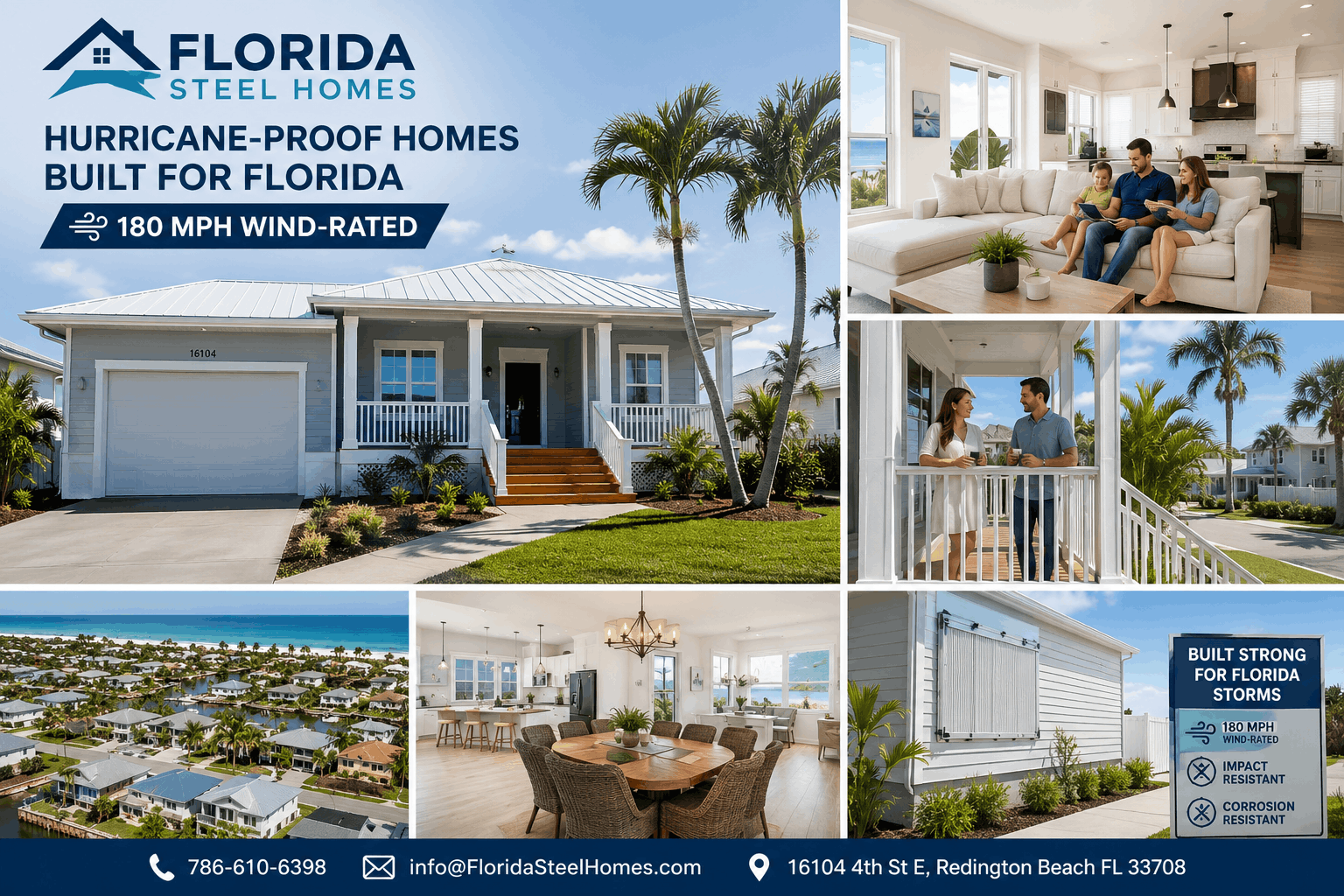
If you’re researching prefab hurricane-proof homes in Florida, here’s everything you need to know — how they’re built, what makes them different from stick-built houses, what they cost, and how to get started.
Building or replacing a home this year? Florida Steel Homes designs and delivers engineered steel prefab homes rated for Florida’s toughest wind zones. Call 786-610-6398 or email info@FloridaSteelHomes.com to talk through your lot and timeline.
What Makes a Prefab Home “Hurricane-Proof”?
No home is 100% indestructible, but a properly engineered prefab steel home is built to a completely different standard than a typical wood-frame house. The difference comes down to three things:
- Structural steel framing — resists wind uplift and lateral loads far better than wood or standard modular framing
- Wind ratings up to 180+ mph — engineered to meet or exceed Florida Building Code (FBC) High-Velocity Hurricane Zone (HVHZ) requirements for counties like Miami-Dade and Broward
- Impact-rated windows and doors — certified to withstand wind-borne debris without shattering
- Elevated or reinforced foundations — designed for flood zones common along Florida’s coastline
Because these homes are manufactured in a controlled factory setting and assembled on-site, quality control is tighter than traditional construction, and build times are dramatically shorter.
Why Floridians Are Switching to Prefab Steel Construction
- Lower insurance premiums — many insurers offer meaningful discounts for homes with steel framing and hurricane-rated components.
- Faster build times — prefab components are manufactured off-site while permitting and foundation work happen in parallel, cutting overall build time significantly compared to traditional construction.
- Termite and mould resistance — steel doesn’t rot, warp, or attract termites, a major advantage in Florida’s humidity.
- Long-term durability — steel-framed homes generally require less maintenance over their lifespan than wood-framed equivalents.
- Design flexibility — from compact layouts to full-size family homes, steel framing adapts to a wide range of floor plans.
Thinking about which option fits your property and budget? Reach out to Florida Steel Homes at 786-610-6398—we’ll walk you through wind zone requirements for your specific address before you commit to a design.
Hurricane-Proof Tiny Homes in Florida
Not every buyer needs a 2,500 sq ft house. There’s growing demand for hurricane-proof tiny homes in Florida — compact, engineered steel units used as:
- Backyard ADUs (accessory dwelling units) and guest houses
- Rental income properties
- Coastal getaway or vacation homes
- Downsized retirement homes
- Fast, storm-resilient rebuilds after hurricane damage
Tiny doesn’t mean fragile. A well-engineered steel tiny home carries the same wind-rated framing, impact windows, and reinforced connections as a full-size prefab — just in a smaller, more affordable footprint. For many Florida buyers, a hurricane-proof tiny home is the fastest way to get a permanent, code-compliant structure on their land without a multi-year build timeline.
How Prefab Hurricane-Proof Homes Are Built: Step by Step
- Site evaluation & wind zone assessment — engineers review your county’s wind speed and flood zone requirements.
- Custom design & engineering stamp — floor plans are finalised and stamped by a licensed Florida engineer.
- Off-site steel fabrication — the frame and panel components are manufactured in a factory, protected from weather delays.
- Foundation & site prep — happens in parallel with fabrication, saving weeks of build time.
- On-site assembly — the prefab structure is erected, sealed, and finished.
- Final inspection & hurricane certification — the home is inspected against FBC/HVHZ standards before handoff.
This parallel-track process is the biggest reason prefab homes get families back into a safe, code-compliant house faster than traditional rebuilds — something especially valuable for owners recovering from storm damage.
Prefab Hurricane-Proof Homes vs. Traditional Construction
| Feature | Prefab Steel Home | Traditional Wood-Frame Home |
|---|---|---|
| Wind resistance | Engineered up to 180+ mph | Typically lower unless heavily retrofitted |
| Build timeline | Faster factory and site work in parallel | Slower, sequential on-site construction |
| Termite/mould risk | Low (steel frame) | Higher |
| Insurance impact | Often qualifies for discounts | Varies, usually higher premiums |
| Maintenance | Lower long-term upkeep | Higher long-term upkeep |
Frequently Asked Questions
Are prefab homes actually safe in a hurricane? Yes, when engineered and certified to Florida Building Code standards. Steel-framed prefab homes with impact-rated windows and reinforced foundations are built specifically to withstand hurricane-force winds and flying debris.
How much does a hurricane-proof prefab home cost in Florida? Costs vary based on size, wind zone, foundation type, and finish level. Tiny homes and ADUs start at a lower price point, while full-size family homes cost more depending on square footage and site conditions. Contact Florida Steel Homes for a quote based on your specific plot.
Can a prefab home withstand a Category 5 hurricane? Homes engineered to Florida’s High-Velocity Hurricane Zone (HVHZ) standards are built for extreme wind speeds, but no structure can be guaranteed damage-proof in every scenario. Proper engineering, certified materials, and code compliance dramatically reduce risk.
How long does it take to build a prefab hurricane-proof home? Because fabrication and site prep happen simultaneously, prefab builds are typically much faster than traditional stick-built homes — especially useful for owners rebuilding after storm damage.
Do hurricane-proof tiny homes qualify for the same wind ratings as full-size homes? Yes. Wind rating depends on engineering and materials, not square footage. A properly built tiny home can carry the same HVHZ-compliant rating as a larger structure.
Ready to Build a Home That Can Actually Take the Storm?
Florida Steel Homes designs, engineers, and delivers wind-rated prefab and tiny homes across Florida — from Miami-Dade to the Panhandle. Whether you’re planning a new build, a coastal ADU, or a fast rebuild after storm damage, our team handles the engineering, permitting guidance, and on-site assembly.
Florida Steel Homes
📍 16104 4th St E, Redington Beach, FL 33708
Call or email today to get a wind-zone assessment and build estimate for your property.