If you’re rebuilding after a storm, buying land in coastal Florida, or just tired of watching your insurance premium climb every renewal, you’ve probably come across prefab hurricane-resistant homes in your research. The pitch is appealing: a factory-built home engineered to withstand 150+ mph winds, delivered faster and often cheaper than traditional construction.
Prefab Hurricane Proof Homes
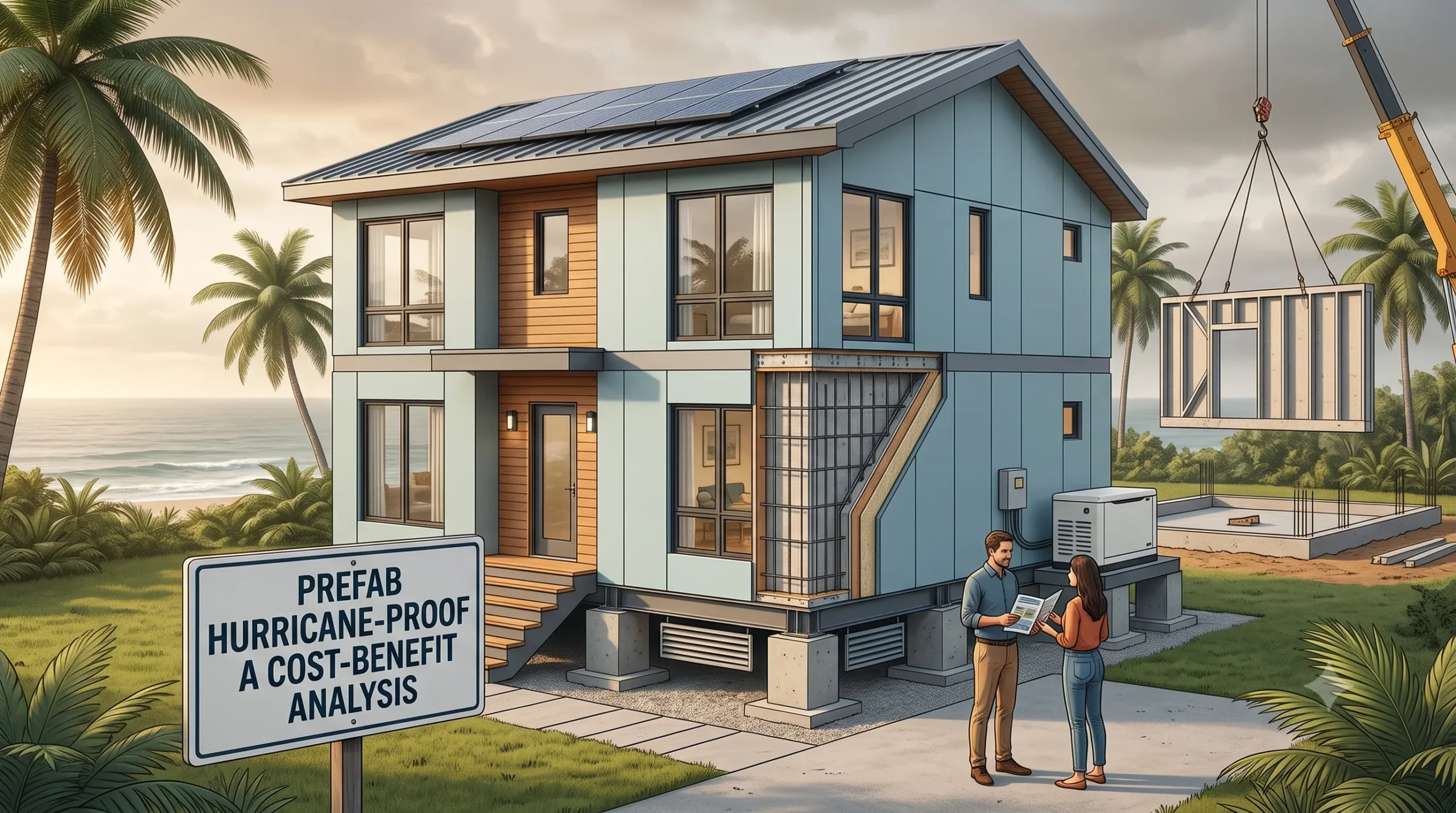
But “hurricane-proof” gets thrown around loosely in marketing, and prefab construction isn’t automatically stronger than site-built—it depends entirely on how and where the home is built. Here’s an honest look at what prefab hurricane-resistant homes actually offer, what they cost in Florida specifically, and where the tradeoffs are.
What “Prefab Hurricane-Proof” Actually Means
No home is truly hurricane-proof—that’s a marketing term, not an engineering one. What these homes actually are is prefabricated or modular construction built to meet or exceed high-velocity hurricane zone (HVHZ) codes, the strictest building standards in the country, used throughout South Florida, including Miami-Dade and Broward counties.
Prefab hurricane homes generally fall into three categories:
- Modular homes — built in large sections in a factory, then trucked to the site and assembled on a permanent foundation. Structurally, these are held to the same Florida Building Code as site-built homes.
- Panelized homes — walls, floors, and roof panels are pre-manufactured (often using insulated concrete forms or structural insulated panels) and assembled on-site.
- Steel or concrete kit homes — pre-engineered steel frames or precast concrete systems designed specifically for extreme wind resistance, popular in coastal Gulf and Atlantic markets.
The key point: prefab doesn’t mean lower quality. In fact, factory-controlled construction often produces tighter tolerances than a job site exposed to weather, subcontractor turnover, and rushed timelines.
Why Prefab Can Actually Outperform Site-Built in Wind Zones
This surprises a lot of Florida homeowners, but it holds up under scrutiny:
- Climate-controlled factory assembly means materials aren’t exposed to humidity and rain during construction, which reduces the risk of wood deterioration and fastener corrosion over time.
- Consistent, machine-driven fastening (screws, nails, structural connectors) reduces the human-error gap that causes many real-world hurricane strap and connection failures.
- Engineered-for-transport structural integrity. Modular sections have to survive being lifted, trucked, and craned into place—which means they’re often built stronger than code minimums just to hold together during shipping.
- A faster construction timeline means less time the structure sits exposed mid-build during hurricane season, a real risk with site-built homes that get delayed into July through November.
Where Prefab Falls Short (Or Just Depends)
To be fair, prefab isn’t a universal upgrade:
- Foundation and site work are still traditional. The strongest modular home in the world is only as good as the foundation and anchoring done on-site — and that part isn’t prefabricated.
- Transportation limits size and shape. Complex architectural designs, large open-span rooms, and custom layouts are harder to achieve with modular construction.
- Not all “prefab” is HVHZ-rated. Some manufacturers sell the same base model nationally and only optionally upgrade to hurricane-rated specs—always confirm Florida Building Code HVHZ compliance specifically, not just “storm-resistant” language.
- Financing can be trickier. Some lenders still treat modular homes differently from traditional site-built ones for appraisal and mortgage purposes, though this has improved significantly in the last decade.
What It Costs in Florida
Pricing varies by region, but general ranges for HVHZ-compliant prefab homes in Florida markets (Tampa, Fort Myers, Naples, the Panhandle, and South Florida) run as follows:
- Modular homes: roughly $150–$250 per square foot for hurricane-rated specifications, compared to $180–$300+ per square foot for comparable site-built custom homes
- Panelized/ICF systems: often priced closer to $200–$300 per square foot, given the concrete material costs, but with long-term energy savings that offset some of that premium
- Steel-frame kit homes: can start lower per square foot but vary widely based on finish level and site conditions
The bigger savings usually aren’t in the base construction cost—they show up in build time (weeks to months faster) and long-term insurance premiums, which bring us to the number that matters most to most Florida buyers.
The Insurance Angle (This Is Where It Often Pays Off)
Florida’s property insurance market has been brutal for homeowners over the past several years, and wind mitigation features directly affect premiums. Homes built to HVHZ standards—which most hurricane-rated prefab homes meet or exceed—typically qualify for:
- Wind mitigation credits, sometimes reducing premiums by 20-40% depending on the carrier and specific features (roof shape, opening protection, roof-to-wall connections)
- Lower deductibles or better coverage terms from carriers that have become increasingly selective about which homes they’ll insure at all in high-risk counties
- Easier access to Citizens Property Insurance alternatives, as more private carriers are willing to write policies on newer, code-compliant construction
For many Florida buyers, these insurance savings are what tip the “worth it” calculation—a prefab home with strong wind mitigation features can pay back its cost premium over the same site-built alternative within several years just through lower annual premiums.
Is It Worth It? Here’s the Honest Answer
Prefab hurricane-resistant homes are worth serious consideration in Florida if:
- You’re building in an HVHZ county (Miami-Dade, Broward, or coastal zones with similar requirements) and want certainty around code compliance
- You value faster build timelines, especially if you’re rebuilding after storm damage and need to be back in a home quickly
- Long-term insurance savings matter more to you than maximum architectural customization
- You’re working with a reputable manufacturer who can document HVHZ certification, not just generic “storm-resistant” marketing
They’re less compelling if you want a highly custom architectural design, are building in a lower-risk inland area where the wind mitigation premium matters less, or you’ve found a site-built contractor with proven hurricane-code experience at a comparable price.
Bottom Line
Prefab hurricane-resistant homes in Florida aren’t a gimmick — the factory-controlled construction process genuinely produces tighter, more consistent builds in many cases, and the insurance savings alone can justify the investment in high-risk coastal counties. But “prefab” and “hurricane-proof” aren’t interchangeable terms. The deciding factor isn’t whether a home is prefabricated — it’s whether it’s actually certified to Florida’s High-Velocity Hurricane Zone standards, with documentation to prove it before you sign anything.