If you’re building or rebuilding in Florida, you’ve probably asked yourself this exact question: should my next home be steel or concrete? Both materials are marketed as “hurricane-proof,” but they don’t behave the same way when 150+ mph winds and flying debris hit a structure.
Metal vs Concrete Homes
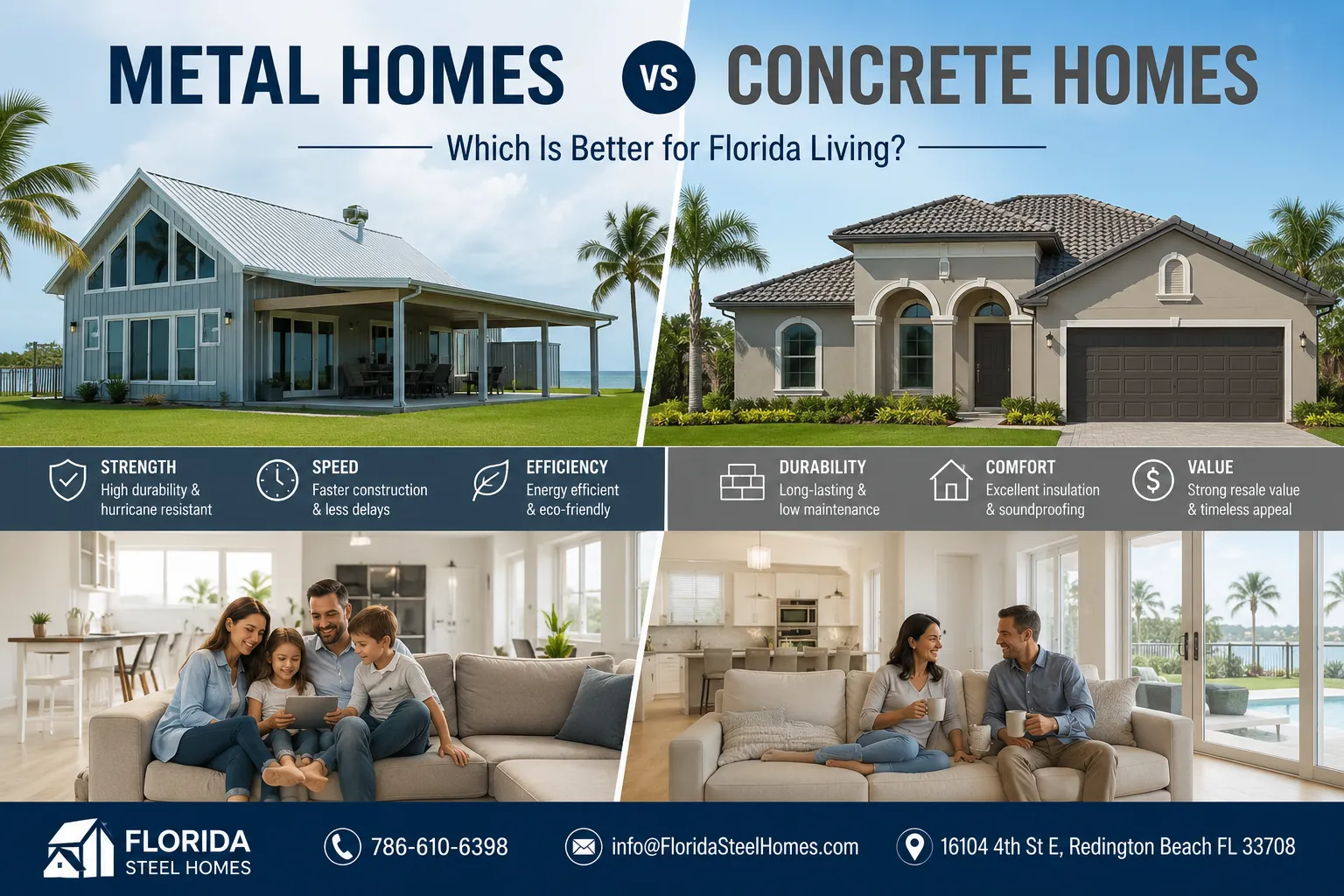
This guide breaks down how metal homes and concrete homes actually perform in a hurricane—structurally, financially, and long-term — so you can make a decision based on facts, not marketing copy.
Quick answer for anyone in a hurry: Properly engineered steel-frame homes generally outperform concrete in wind resistance, flexibility during seismic/wind stress, corrosion-resistant coastal durability, and speed of construction — while costing less per square foot than poured concrete or ICF construction. Concrete has advantages in mass and impact resistance but is heavier, slower to build, and more prone to cracking under sustained wind flex.
📞 Want a real answer for your specific lot and budget? Florida Steel Homes will walk you through it for free. Call 786-610-6398 or email info@FloridaSteelHomes.com — no pressure, just straight answers from people who build hurricane-rated steel homes every day in Redington Beach and across the Tampa Bay area.
Why This Question Matters More Than Ever in Florida
Florida’s building code (FBC) already requires wind-load ratings; most other states don’t. But after storms like Ian, Idalia, and Milton, homeowners are no longer just asking “is it code compliant?” — they’re asking, “Will it still be standing?”
That shift matters. Code-minimum construction is designed to protect life safety, not necessarily to keep your home fully intact. If you want a home that survives and remains livable after a major hurricane, you need to understand how your structural material actually performs.
How Metal (Steel) Homes Perform in a Hurricane
Steel-framed and steel-panel homes have become one of the fastest-growing categories of hurricane-resistant construction in Florida, and for good engineering reasons:
- Wind ratings: Engineered steel structures are commonly rated for 170–200+ mph winds when properly anchored and connected.
- Flexibility, not brittleness: Steel flexes slightly under extreme wind load and returns to shape, rather than cracking. Concrete, by contrast, is rigid and can develop stress fractures under repeated flex cycles.
- Continuous load path: A well-designed steel frame ties roof, walls, and foundation into one continuous, bolted/welded system — critical for resisting uplift, which is what actually tears roofs off during hurricanes.
- No moisture absorption: Steel doesn’t absorb water or swell, which matters enormously in Florida’s humidity and flood-prone areas.
- Termite- and rot-proof: Unlike wood-frame homes, steel has zero organic material for pests or rot to attack.
- Lighter, faster construction: Steel structures typically go up 30–50% faster than concrete, which matters if you’re racing a construction season or an insurance deadline.
The trade-off: Steel must be properly coated and detailed for coastal salt air, and it requires an experienced hurricane-zone builder to get the connections and anchoring right. This is exactly where Florida Steel Homes specialises — Gulf-front steel construction engineered for Pinellas County wind zones.
How Concrete Homes Perform in a Hurricane
Concrete — whether poured, block (CMU), or Insulated Concrete Form (ICF) — has a long track record in Florida and genuinely performs well in several areas:
- Mass and inertia: Concrete’s sheer weight resists movement and can absorb high-velocity debris impact well, especially ICF systems with rebar reinforcement.
- Fire resistance: Concrete doesn’t burn, a real advantage in wildfire-adjacent inland areas.
- Familiar to local inspectors and insurers: Concrete is the historical Florida standard, so permitting and insurance underwriting are well-established.
The trade-offs that matter in a hurricane:
- Cracking under wind flex and settling: Concrete is rigid, not flexible. Repeated hurricane-season wind loading, ground movement, or foundation settling can cause hairline cracks that widen over years — a slow structural weak point.
- Heavier foundation demands: More weight means more foundation cost, especially on coastal or fill-heavy lots.
- Rebar corrosion risk: Steel rebar inside concrete can corrode from salt air infiltration over decades, expanding and cracking the concrete from the inside — a well-documented issue in older Florida coastal concrete construction.
- Slower, weather-dependent build: Pouring and curing concrete is highly sensitive to Florida’s rain patterns, which can add months to a build.
- Higher cost per square foot for ICF or reinforced poured systems versus engineered steel.
Metal vs Concrete: Side-by-Side Hurricane Comparison
| Factor | Steel Homes | Concrete Homes |
|---|---|---|
| Typical engineered wind rating | 170–200+ mph | 150–180 mph (varies by system) |
| Behavior under wind load | Flexes and recovers | Rigid, can crack/fracture |
| Coastal corrosion risk | Low (with proper coating) | Moderate–high (rebar corrosion over time) |
| Moisture/mold resistance | Excellent | Good, but block cores can trap moisture |
| Construction speed | Fast (weeks) | Slow (months, weather-dependent) |
| Termite/pest/rot risk | None | None (but adjacent wood trim may be at risk) |
| Cost per sq ft (typical FL build) | Lower–moderate | Moderate–higher |
| Repair after storm damage | Easier, modular repairs | Harder, often requires demolition of section |
Neither material is “bad”—but for Florida’s specific combination of high wind, salt air, humidity, and storm frequency, engineered steel construction consistently comes out ahead on the metrics that determine whether your home survives intact.
🏗️ Curious how this comparison applies to your actual property? Every lot, elevation, and flood zone is different. Florida Steel Homes offers free consultations for Pinellas County and Tampa Bay homeowners — call 786-610-6398 or email info@FloridaSteelHomes.com and we’ll walk your site with you.
What Actually Determines Hurricane Survival (It’s Not Just the Material)
A crucial point most articles skip: the material is only part of the equation. Homes fail in hurricanes because of weak connections, not weak materials. The most common hurricane failure points are:
- Roof-to-wall connections — this is where most catastrophic failures start, regardless of material.
- Foundation anchoring — how the structure is tied down.
- Window and door openings — the #1 entry point for wind pressure once breached.
- Garage doors — a frequently overlooked structural weak point.
This is why an engineered, code-plus steel system with proper connections will consistently outperform a “standard” concrete build with average detailing — and why choosing an experienced hurricane-zone builder matters as much as the material itself.
Why Florida Steel Homes Builds in Steel
Florida Steel Homes is based right on the Gulf, in Redington Beach, FL — we’re not designing for a hypothetical storm, we’re designing for the storms that hit our own street. Our steel homes are engineered specifically for:
- High-velocity hurricane zones (HVHZ) and standard wind-borne debris regions
- Coastal salt-air corrosion resistance
- Fast rebuild timelines for storm-damaged properties
- FEMA and local flood-zone elevation requirements
Whether you’re rebuilding after storm damage, building new construction, or comparing quotes before you commit to a concrete build, it’s worth getting a second opinion from a team that specializes in hurricane-engineered steel.
Frequently Asked Questions
Is a steel home really stronger than a concrete home in a hurricane? For wind resistance specifically, yes — a properly engineered steel frame with a continuous load path typically outperforms standard concrete construction in category 4–5 hurricane winds, because steel flexes and redistributes load instead of cracking.
Do steel homes rust in Florida’s coastal air? Not when properly coated and detailed. Florida Steel Homes uses coastal-grade corrosion-resistant coatings and detailing specifically for Gulf-front and salt-air environments.
Are steel homes more expensive than concrete homes? Generally, no — engineered steel construction typically costs less per square foot than reinforced concrete or ICF systems, and builds faster, which also reduces labor and financing costs.
Can a steel home get hurricane insurance discounts in Florida? Many insurers offer wind-mitigation discounts for homes with documented hurricane-rated construction, impact openings, and proper roof-to-wall connections — steel-framed homes built to these specs often qualify.
What wind speed can a steel home in Florida withstand? Engineered steel homes from Florida Steel Homes are designed to meet or exceed Florida Building Code wind requirements for the specific zone, commonly rated up to 170–200+ mph depending on design and location.
Get a Straight Answer for Your Property
Reading about wind ratings online is useful — but the real answer depends on your lot, your flood zone, and your budget. If you’re weighing metal vs. concrete for a rebuild or new build in Florida, talk to a builder who specializes in hurricane-engineered steel construction.
Florida Steel Homes
📍 16104 4th St E, Redington Beach, FL 33708
📞 786-610-6398
✉️ info@FloridaSteelHomes.com
Call or email us today for a free consultation — we’ll give you an honest comparison for your specific property, not a sales pitch.