A Florida Steel Homes Guide to Storm Protection
If you own a home in Florida, “hurricane season” isn’t an abstract idea — it’s a line item in your budget and a recurring entry on your calendar. Every year between June and November, homeowners face the same question: is it time to finally protect these windows?
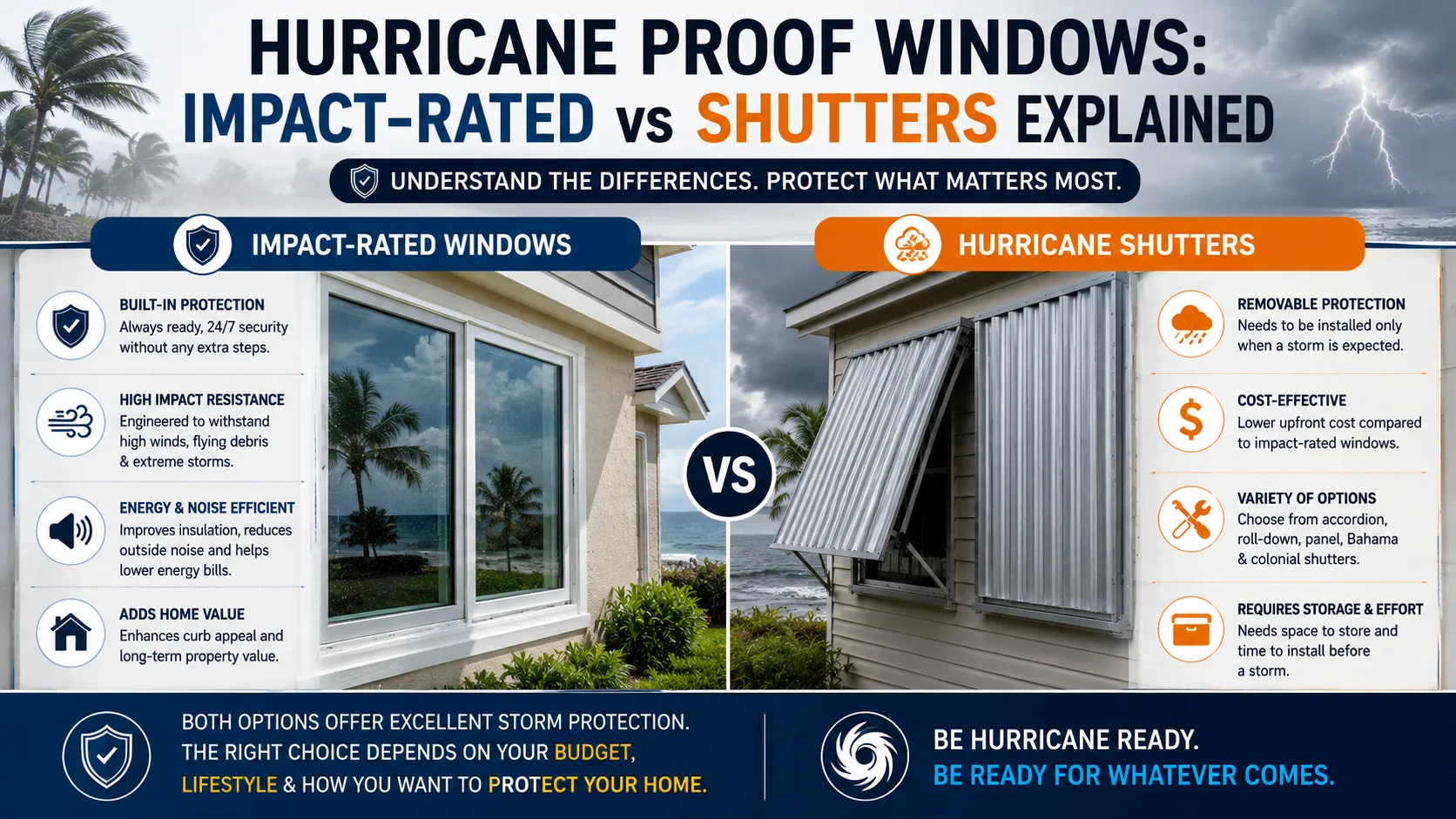
The two real contenders are impact-rated windows and hurricane shutters. Both are code-approved. Both can save your home. But they work in completely different ways, cost different amounts, and suit different homeowners. This guide breaks down exactly how each system works, what Florida law actually requires, and how to decide which one — or which combination — is right for your house.
Hurricane Proof Windows vs Shutters: Which Wins in FL?
Why This Decision Matters More in Florida Than Almost Anywhere Else
Florida’s building code isn’t just strict — it’s written specifically around wind-borne debris. In every county designated as a “wind-borne debris region” (essentially the entire coastline and most of the peninsula), the Florida Building Code (FBC) requires that every window, door, skylight, and garage door either:
- Be impact-resistant (rated to resist a 9-lb 2×4 fired at 34 mph, plus cyclic wind-pressure testing), or
- Be protected by an approved impact-resistant covering, such as code-compliant shutters.
There is no third option. An unprotected window is a liability twice over — once when it fails and pressurizes your home from the inside (the leading cause of catastrophic roof loss in hurricanes), and again when insurers assess your policy. This is why the choice between impact windows and shutters isn’t cosmetic. It’s structural, financial, and — in the wrong scenario — a matter of safety.
How Impact-Rated Windows Work
Impact windows look like ordinary windows, but the construction is fundamentally different:
- Laminated glass: two or more panes bonded to an interlayer of PVB (polyvinyl butyral) or SentryGlas. When struck, the glass can crack, but the interlayer holds the shards together, preventing a breach.
- Reinforced frames: heavy-gauge aluminum, vinyl, or — in the case of Florida Steel Homes installations — steel-reinforced framing designed to keep the glazing anchored under repeated wind-pressure cycling, not just a single impact.
- Engineered anchoring: impact windows are tested and installed as a complete assembly, anchored per Miami-Dade County Notice of Acceptance (NOA) or Florida Product Approval standards — the two toughest certification systems in the country.
What this means day to day: the windows stay in place, closed, and doing their job whether or not you’re home. There’s no pre-storm scramble, no ladder, no plywood run to the hardware store.
Pros of Impact-Rated Windows
- Zero prep time. Protection is permanent and passive — critical if a storm intensifies faster than forecast or you’re traveling when a watch is issued.
- Daily livability. Full light, clear views, and usable windows 365 days a year — unlike shutters, which block light and access when deployed.
- Noise and UV reduction. The laminated glass and multi-pane construction cut outside noise significantly and block most UV transmission, protecting flooring and furniture.
- Energy efficiency. Impact windows typically outperform single-pane originals on insulation, often lowering cooling costs in Florida’s climate.
- Insurance credits. Most carriers offer meaningful windstorm mitigation discounts for opening protection that doesn’t require manual deployment.
- Home value. Appraisers and buyers increasingly treat impact windows as a permanent capital improvement, not an accessory.
Cons of Impact-Rated Windows
- Higher upfront cost than shutters, especially for whole-home replacement.
- Installation is a renovation project, not a bolt-on addition — it involves removing existing windows and re-flashing openings.
- Replacement glass, if damaged, is specialized and typically not a same-day fix like standard glazing.
How Hurricane Shutters Work
Shutters leave your existing windows untouched and add a removable or fixed barrier in front of them. Florida homeowners generally choose from five main types:
| Shutter Type | How It Works | Typical Use Case |
|---|---|---|
| Accordion shutters | Permanently mounted, folded to the side; slide closed and lock | Homeowners wanting fast deployment without storage |
| Roll-down shutters | Motorized or hand-crank housing above the window rolls the shutter down | High-end retrofit, frequent storm exposure, rental properties |
| Colonial/Bahama shutters | Hinged, decorative, closes flat against the opening | Historic or architectural-style homes wanting curb appeal |
| Storm panels | Corrugated aluminum or steel panels bolted into pre-installed track anchors | Budget-conscious homeowners, seasonal residents |
| Fabric/mesh hurricane screens | High-tensile woven fabric anchored to a frame track | Lightweight, easy to store, growing in popularity for lanais and porches |
Pros of Hurricane Shutters
- Lower upfront investment, especially storm panels and fabric screens.
- Doesn’t require replacing existing windows — ideal for historic homes or recent window upgrades that don’t yet need replacing.
- Retrofit flexibility — can be added incrementally, room by room, or budget permitting.
- Accordion and roll-down types deploy quickly once installed, some in minutes.
Cons of Hurricane Shutters
- Manual deployment is required for most types — and someone has to be home, physically able, and aware of the approaching storm in time to close them.
- Blocks natural light and exterior visibility for the entire duration a storm threat exists, which in an evacuation-advisory scenario can mean days.
- Storm panels require storage space and a two-person job to install correctly under time pressure.
- Ongoing maintenance — tracks, hinges, and motors need annual inspection or they can fail exactly when needed most.
- Insurance credits are typically smaller than for impact windows, since underwriters weight “passive” protection more heavily than protection requiring human action.
Impact Windows vs. Shutters: Side-by-Side
| Factor | Impact-Rated Windows | Hurricane Shutters |
|---|---|---|
| Protection type | Passive (always on) | Active (must be deployed) |
| Deployment time | None | Minutes to hours |
| Upfront cost | Higher | Lower (varies widely by type) |
| Daily light/view | Unaffected | Unaffected until deployed |
| Energy efficiency | Improves year-round | No effect |
| Noise reduction | Significant | None |
| Maintenance | Minimal | Moderate to high |
| Typical insurance discount | Higher | Lower to moderate |
| Best for | Full-time residents, rental/seasonal homes, long-term value | Budget-phased upgrades, architecturally sensitive homes |
What Florida Building Code Actually Requires
A common misconception is that shutters are a “lesser” or non-compliant option. That’s not true — both systems, properly certified, satisfy the Florida Building Code’s opening-protection requirement. What matters legally is documentation:
- The product must carry a valid Florida Product Approval number or Miami-Dade NOA, appropriate to your wind zone (standard, High-Velocity Hurricane Zone, or coastal).
- Installation must match the tested assembly — the exact anchoring pattern, spacing, and substrate the product was certified with. A correctly-rated shutter installed incorrectly is not code-compliant, and neither is a correctly-rated window installed with the wrong anchors.
- Permits are required for both systems in nearly every Florida municipality.
This is where a lot of DIY and low-bid installations fail homeowners — the product rating is only as good as the installation behind it.
Cost Considerations
Pricing varies significantly by county, home size, and product tier, but as a general framework:
- Storm panels: the lowest cost per opening, but require labor (or self-installation) every single storm.
- Accordion/roll-down shutters: mid-to-upper cost, amortized over many storm seasons with minimal per-event labor.
- Impact windows: the highest upfront cost per opening, but they replace an aging window at the same time, meaning part of the cost is really a window-replacement expense you’d eventually incur anyway.
When homeowners compare shutters to impact windows purely on sticker price, they’re often comparing a protection accessory to a full building-envelope upgrade. The fairer comparison is: shutters + your current windows’ remaining lifespan, versus impact windows replacing both the protection and the windows in one project.
Which One Should You Choose?
A few honest rules of thumb:
- If you live in the home full-time and want to stop thinking about storm prep entirely, impact windows are the stronger long-term investment — protection, energy savings, and noise reduction operate every day, not just during a named storm.
- If your home is a seasonal or rental property, impact windows remove the risk of nobody being present to deploy shutters before a storm arrives.
- If your windows are already newer and in good shape, and budget is the primary constraint, quality accordion or roll-down shutters are a legitimate, code-compliant path — especially if phased in alongside a future window upgrade.
- If your home has architectural or historic character, Bahama or colonial shutters can satisfy code while adding curb appeal rather than detracting from it.
- Many Florida homeowners land on a hybrid approach — impact windows on the most vulnerable or hardest-to-access openings (second story, rear elevations, large picture windows), and shutters on lower-priority openings, phased over a few budget cycles.
Frequently Asked Questions
Do impact windows really eliminate the need for shutters? Yes — a properly rated and installed impact window is itself the code-compliant opening protection. No additional shutter is required on that opening.
Are hurricane shutters cheaper than impact windows? Per opening, yes, in most cases — but shutters don’t replace aging glass or improve daily energy performance, so the long-run value comparison depends on your existing windows’ condition.
Can I mix impact windows and shutters on the same house? Yes. This is common and fully code-compliant, as long as every opening individually meets the wind-borne debris protection requirement.
Do impact windows increase home value? Generally yes — they’re viewed by appraisers and buyers as a permanent structural upgrade rather than a removable accessory.
Will my insurance premium actually go down? Most Florida insurers offer a windstorm mitigation credit for verified opening protection, typically larger for impact windows than for manually-deployed shutters. Ask your carrier for a wind mitigation inspection to confirm your specific discount.
The Florida Steel Homes Approach
At Florida Steel Homes, we install both systems — but we start every consultation the same way: by assessing your home’s exposure, your windows’ current condition, your budget timeline, and how you actually live in the house. A snowbird’s second home has different priorities than a full-time family residence three blocks from the coast.
Every product we install carries current Florida Product Approval or Miami-Dade NOA certification, and every installation is permitted and inspected to match the tested assembly — not a shortcut version of it. Whether that means steel-reinforced impact windows across the whole home, a phased shutter plan, or a hybrid of both, the goal is the same: a home that’s protected before the next storm forms, not scrambling when it does.
Ready to find out which option fits your home? Contact Florida Steel Homes for a free wind-protection assessment and a straight answer on what your house actually needs.