Florida buyers are no longer looking at prefab homes as a cheap shortcut. In 2026, the conversation is completely different. People want a home that can go up faster, survive stronger storms, control insurance headaches, and still feel like a proper Florida home—not a box dropped on a lot.
That is exactly why hurricane-proof prefab homes are getting so much attention across Florida right now.
From Tampa Bay and Clearwater to Sarasota, Fort Myers, Cape Coral, and the Panhandle, more homeowners are asking the same questions: How much does a hurricane-proof prefab home cost in Florida in 2026? What actually makes one storm-resistant? Is steel better than wood? And where do the hidden costs show up?
This guide breaks it down in plain English.
If you’re planning to build in a hurricane-prone area, this article will help you understand realistic 2026 pricing, what features matter most, and how to avoid the common mistakes that push prefab buyers over budget.
2026 Florida Hurricane-Proof Prefab Home Prices
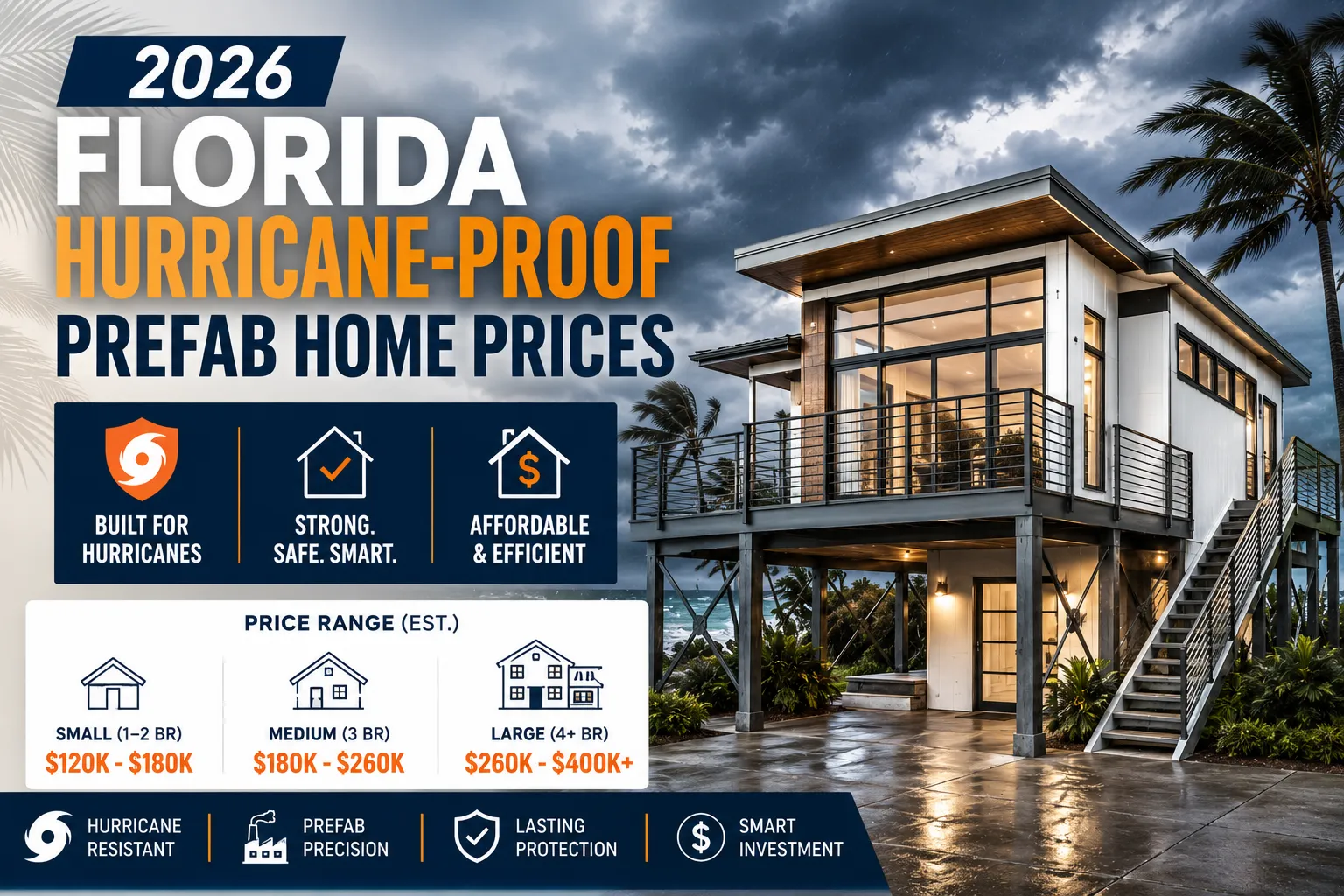
If you just want the short version, here it is:
- Entry-level hurricane-proof prefab homes in Florida usually start around $350,000 to $420,000
- Mid-size 3-bedroom prefab homes often land between $420,000 and $575,000
- Larger luxury prefab homes can range from $600,000 to $800,000+
- Florida Steel Homes currently lists models such as Breeze from $388,500, Sunrise from $518,000, and Oceancrest from $647,500 on its Florida pricing pages
- A realistic turnkey budget must include more than the home shell: site prep, foundation, delivery, installation, permits, utility hook-ups, and coastal upgrades can materially change the final number
The important part: the cheapest prefab home is rarely the smartest hurricane home. In Florida, structure matters more than sticker price.
Why Hurricane-Proof Prefab Homes Are Growing in Florida
Florida’s housing conversation has changed because storms have changed.
For years, many buyers focused mainly on location, layout, and finishes. Now, storm resilience is one of the first questions people ask—especially in coastal counties and flood-prone areas. Homeowners want to know whether the roof system is tied down properly, whether the windows are impact-rated, whether the foundation can handle flood-zone requirements, and whether the structure is actually engineered for Florida wind loads.
That shift is pushing more buyers toward prefab and modular construction.
A well-designed prefab home can offer three things Florida buyers care about:
1) Faster build timelines
Prefab homes are partially or largely built in controlled factory environments. That reduces weather delays, material waste, and on-site chaos. In a state where labor delays and permit timelines can drag projects out, faster construction is a serious advantage.
2) Better cost control
Traditional custom builds often start with one number and end with another. Prefab homes are not magically cheap, but they are usually more predictable because the structural package, floor plan, and manufacturing process are standardized.
3) Stronger storm-focused engineering
The big draw is not just speed. It is the ability to buy a home designed around wind resistance, impact protection, moisture control, and long-term durability. That is where steel prefab homes and other hurricane-focused systems stand out.
What Does “Hurricane-Proof Prefab Home” Actually Mean?
Let’s be practical here: no home is literally indestructible. “Hurricane-proof” is really shorthand for hurricane-resistant, storm-hardened, code-compliant construction designed to perform far better than standard housing in severe wind and rain conditions.
A real hurricane-ready prefab home in Florida should be designed around the following:
Engineered wind resistance
The home should be engineered for Florida wind loads, especially if it’s in a coastal or high-velocity hurricane zone. Many storm-focused prefab homes are marketed with wind resistance in the 150–180+ mph range, depending on design, engineering, and location-specific requirements
Impact-rated windows and doors
Flying debris is one of the biggest causes of storm damage. Hurricane-rated impact glass and reinforced exterior doors are not optional upgrades if your goal is serious resilience.
Reinforced roof connections
A strong wall system is not enough if the roof fails first. Roof uplift protection, tie-down systems, clips, fasteners, and connection details matter a lot.
Moisture and corrosion protection
Florida is not just a wind problem. It is also a humidity, salt air, mold, and water intrusion problem. Coastal prefab homes need proper coatings, flashing, drainage strategy, and water-managed envelope details.
Elevated or flood-aware foundations
In many Florida lots, flood elevation matters almost as much as wind rating. A home that survives the wind but sits too low for surge or flood risk is not properly planned.
2026 Price Guide: How Much Do Hurricane-Proof Prefab Homes Cost in Florida?
Now let’s get into the part most buyers actually care about: price.
There is no single statewide number because the final cost depends on size, location, flood zone, structure type, finish level, and site conditions. But based on current Florida storm-home pricing examples and modular home cost ranges, here is a realistic 2026 guide.
Entry-Level Hurricane-Proof Prefab Homes: $350,000–$420,000
This range usually covers smaller or more efficient layouts, often around 1,200 to 1,600 square feet.
These homes are typically a good fit for:
- retirees downsizing in Florida
- couples building a storm-ready primary home
- small families wanting a safer alternative to older wood construction
- buyers who want a coastal-capable home without jumping into the luxury bracket
A good example from a Florida builder’s pricing pages is the Breeze model at 1,500 sq. ft., starting from $388,500
In this bracket, buyers can often expect:
- 2–3 bedrooms
- compact rectangular layouts that are structurally efficient
- hurricane-rated windows and doors
- steel or reinforced structural systems, depending on the builder
- a cleaner, faster prefab timeline than a custom site-built home
The catch: once you start adding premium finishes, flood-elevation upgrades, larger patios, upgraded roof packages, or difficult site work, this “under $400k” category can move upward fast.
Mid-Range Hurricane-Proof Prefab Homes: $420,000–$575,000
This is probably the sweet spot for many Florida buyers in 2026.
In this range, you’re usually looking at 1,700 to 2,300 square feet, better bedroom counts, more flexible layouts, and more comfortable family living without jumping to a fully custom luxury build.
This category is attractive because it balances the following:
- real storm resilience
- enough square footage for a family
- stronger finish packages
- room for customization
- better resale appeal in Florida markets, where storm-ready construction is becoming a premium feature
Florida Steel Homes’ Sunrise model is listed from $518,000 for 2,000 sq. ft., which fits squarely into this band
What pushes homes into this range?
- larger footprints
- more bathrooms
- upgraded kitchens and bathrooms
- more glass and larger openings
- engineered roof systems for tougher wind zones
- enhanced insulation and energy packages
- flood-zone foundation work
If someone asks me where the “value zone” is for a Florida hurricane-proof prefab home, this is usually it. You get enough space to live comfortably without drifting too far into luxury pricing.
Luxury Hurricane-Proof Prefab Homes: $600,000–$800,000+
This category is for buyers who want storm resilience without giving up a premium coastal-home feel.
Think:
- 2,400+ sq. ft.
- 4 bedrooms
- elevated foundations in coastal areas
- large open-plan kitchens
- designer finish packages
- oversized impact glass
- covered outdoor living
- custom facade treatments
- upgraded solar, smart-home, or garage packages
A Florida pricing example here is the Oceancrest model from $647,500 for 2,500 sq. ft.
Luxury hurricane-proof prefab homes can absolutely make sense in Florida—especially for buyers rebuilding after storm loss, relocating from another state, or building a long-term coastal residence where durability matters as much as aesthetics.
But this is also where people lose budget discipline. The shell price may look manageable, but outdoor kitchens, upgraded cladding, custom stairs, taller ceilings, and high-end finish selections quietly add tens of thousands.
Real 2026 Cost Breakdown: What You’re Actually Paying For
This is where buyers often get tripped up. They see a model price online and assume that is the whole project cost.
It usually isn’t.
A hurricane-proof prefab home budget in Florida should be split into several parts.
1) Home structure/prefab package
This is the factory-built or modular portion of the house: walls, framing, roof system, layout package, and, depending on the builder, some combination of windows, doors, insulation, interior finishes, and mechanical rough-ins.
For Florida storm-focused prefab homes, this is usually the biggest cost bucket.
2) Site preparation
This includes clearing, grading, driveway access, soil prep, and making the lot ready for the home.
A flat, easy inland lot is one thing. A coastal lot with access issues, fill requirements, drainage work, or elevation challenges is another.
3) Foundation and elevation work
One of the most overlooked budget items in Florida.
If your lot is in or near a flood-prone zone, you may need the following:
- raised slab systems
- piers or piles
- additional structural engineering
- flood-compliant elevation design
That can change the cost substantially.
4) Delivery and crane/installation logistics
Prefab doesn’t teleport onto the lot. Delivery, transportation, staging, setting the modules, and installation all cost money. Tight coastal lots or hard-to-access locations can increase the bill.
5) Permits, engineering, and utility connections
Permit fees, engineering review, utility setup, water/sewer or septic, electrical tie-in, and inspections all belong in the budget.
6) Hurricane upgrades and coastal durability features
Some homes include these from the start; others price them separately. That may include:
- impact glass upgrades
- reinforced roof package
- corrosion-resistant coatings
- stronger fastener systems
- upgraded doors and shutters
- flood-smart detailing
Florida Steel Homes’ published example breakdown shows total project costs spanning from the high $300k range into the $600k+ range depending on model, with line items such as structure, foundation/site prep, installation/delivery, and permits/utilities included in the overall planning picture
Typical Price Per Square Foot in 2026
A lot of buyers ask for a simple price-per-square-foot number, but it can be misleading if you compare homes with very different storm specs.
Still, as a rough planning tool:
Budget / compact storm-ready prefab homes
$230–$280 per sq. ft.
Mid-range hurricane-resistant prefab homes
$250–$320 per sq. ft.
Premium or luxury coastal prefab homes
$300–$400+ per sq. ft.
That number can move up or down depending on the following:
- flood zone requirements
- coastal corrosion exposure
- foundation type
- interior finish level
- glazing package
- roof system
- solar and energy features
- local permitting and site complexity
So yes, price per square foot matters—but in Florida, structural specs matter more.
What Makes Steel Prefab Homes So Popular in Florida?
If you’ve noticed that many Florida storm-home builders lean heavily into steel, there’s a reason.
Steel handles moisture better than wood
Florida humidity is relentless. Wood can warp, swell, rot, or become vulnerable to long-term moisture problems if details are poor. Steel avoids many of those issues when it’s properly protected.
Steel offers strong structural performance
A well-engineered steel frame can create a very strong shell for resisting wind loads, especially when combined with good connection design, impact-rated openings, and roof uplift protection.
Steel doesn’t attract termites
In Florida, that alone gets buyers’ attention.
Steel pairs well with modular manufacturing
Factory-built steel systems can be precise, repeatable, and easier to standardize for storm-focused designs.
That said, steel is not magic by itself. A badly designed steel home is still a bad home. The value comes from the full system: frame, roof, openings, foundation, anchoring, envelope, and installation quality.
Best Buyers for Hurricane-Proof Prefab Homes in Florida
These homes are not just for ultra-wealthy beachfront buyers. In 2026, they will make sense for several types of Florida homeowners.
Coastal homeowners rebuilding after storm damage
Many buyers only start looking at steel or modular hurricane homes after they’ve already dealt with storm repairs, insurance fights, or flood cleanup. Once someone has lived through that once, their priorities change fast.
Retirees moving to Florida
Retirees often want lower maintenance, predictable costs, and peace of mind during hurricane season. A well-built prefab home checks all three boxes.
Families building a long-term primary residence
If you’re building a home where you plan to stay for 10–20 years, spending more on resilience up front can be smarter than paying for repeated repairs later.
Out-of-state buyers relocating to Florida
Buyers coming from other states are often shocked by Florida’s insurance and weather realities. Hurricane-proof prefab homes give them a more structured way to build with resilience in mind from day one.
Common Mistakes Florida Prefab Buyers Make
I’ve seen the same mistakes come up again and again in storm-home planning content, and they’re worth calling out.
Mistake 1: Comparing only base prices
A $350k base model and a $390k base model are not equal if one includes impact windows, stronger roof engineering, and a better structural system.
Mistake 2: Ignoring the lot
The lot can make or break the budget. Flood elevation, access, soil, setbacks, drainage, and local code requirements all matter.
Mistake 3: Spending on aesthetics before structure
Fancy lighting can wait. Hurricane performance cannot.
Mistake 4: Not asking for wind rating and engineering details
If a builder markets a home as hurricane-proof, ask exactly what that means:
- What wind speed is it engineered for?
- What impact rating do the windows meet?
- What roof uplift strategy is used?
- What foundation options are recommended for flood zones?
Mistake 5: Assuming prefab means “cheap”
Prefab can be more efficient and faster, but a true hurricane-resistant Florida prefab home is still a serious construction product, not a bargain-bin house.
How to Choose the Right Hurricane-Proof Prefab Home in Florida
If you’re seriously shopping in 2026, here’s the practical checklist I’d use.
Choose structure before style
Start with the storm package:
- wind resistance
- impact glass
- roof tie-down system
- flood-aware foundation strategy
- corrosion protection
Then look at the finishes and layout.
Match the home to the lot
A home that works beautifully inland may not be the smartest fit for a coastal lot in a flood-prone area.
Ask for a full turnkey estimate
Don’t settle for a shell price. Ask for a realistic estimate, including
- home package
- site prep
- foundation
- delivery
- installation
- permits
- utility connections
- storm upgrades
Think about insurance and maintenance
A stronger home may cost more upfront, but it can help reduce future repair risk and may position you better when you’re shopping for insurance or trying to protect resale value.
Are Hurricane-Proof Prefab Homes Worth It in Florida?
For the right buyer, yes—absolutely.
Not because they are trendy. Not because prefab sounds modern. And not because every builder uses the same marketing language.
They’re worth it because Florida has changed the math of homebuilding.
If you’re building in a state where wind, rain, humidity, flood risk, insurance stress, and storm recovery are all part of the reality, then a stronger shell is not a luxury feature. It’s part of the core buying decision.
A hurricane-proof prefab home gives you the chance to build with that reality in mind from the beginning.
And in 2026, that is exactly why more Florida buyers are moving toward steel modular homes, storm-rated prefab systems, elevated foundations, and smarter coastal construction choices.
Final Thoughts
If you’re researching hurricane-proof prefab homes in Florida in 2026, the biggest takeaway is simple:
Do not shop by brochure price alone. Shop by storm performance, full installed cost, and long-term durability.
A realistic starting budget today is often around the high $300,000s for compact storm-ready models, while family-sized homes and premium coastal builds can rise into the $500,000–$700,000+ range depending on size, location, and finish level
The smartest Florida prefab buyers are not asking, “What is the cheapest house I can get?”
They’re asking, “What home gives me the best chance of riding out Florida’s next decade of storms with the fewest regrets?”
That is the right question.
FAQ: Hurricane-Proof Prefab Homes in Florida
How much do hurricane-proof prefab homes cost in Florida in 2026?
Most buyers should budget roughly $350,000 to $800,000+ depending on square footage, location, flood-zone requirements, structural system, and finish level. Entry models can start in the high $300k range, while larger luxury homes can exceed $600k.
Are prefab homes safe during hurricanes?
They can be—if they are properly engineered for Florida wind loads and built with the right storm-resistant features such as impact windows, reinforced roof connections, strong anchoring, and a suitable foundation system.
Are steel prefab homes better for Florida?
For many buyers, yes. Steel can offer better resistance to termites, moisture-related damage, and structural stress when compared with conventional wood framing. But the full system design still matters more than material alone.
What is included in the price of a prefab hurricane home?
That depends on the builder. Some prices cover mainly the home package, while others include more turnkey elements. Always ask whether pricing includes site prep, foundation, delivery, installation, permits, and utility hookups.
Can I build a hurricane-proof prefab home near the Florida coast?
Yes, but coastal lots often require stricter engineering, elevation planning, corrosion protection, and flood-aware foundation design. Those factors can increase the total project budget.
Is a prefab home cheaper than a traditional custom home in Florida?
Sometimes, yes, especially in terms of time savings, material efficiency, and cost predictability. But a high-quality hurricane-resistant prefab home is still a premium product, not a bargain build.