Hurricane-proof prefab homes in the Caribbean are no longer a niche option — they’re becoming the only smart one. Steel frame and ICF construction built to Category 5 standards outperform traditional masonry and wood builds when real storms arrive. Here’s the full picture.
Hurricane-Proof Prefab Homes in the Caribbean
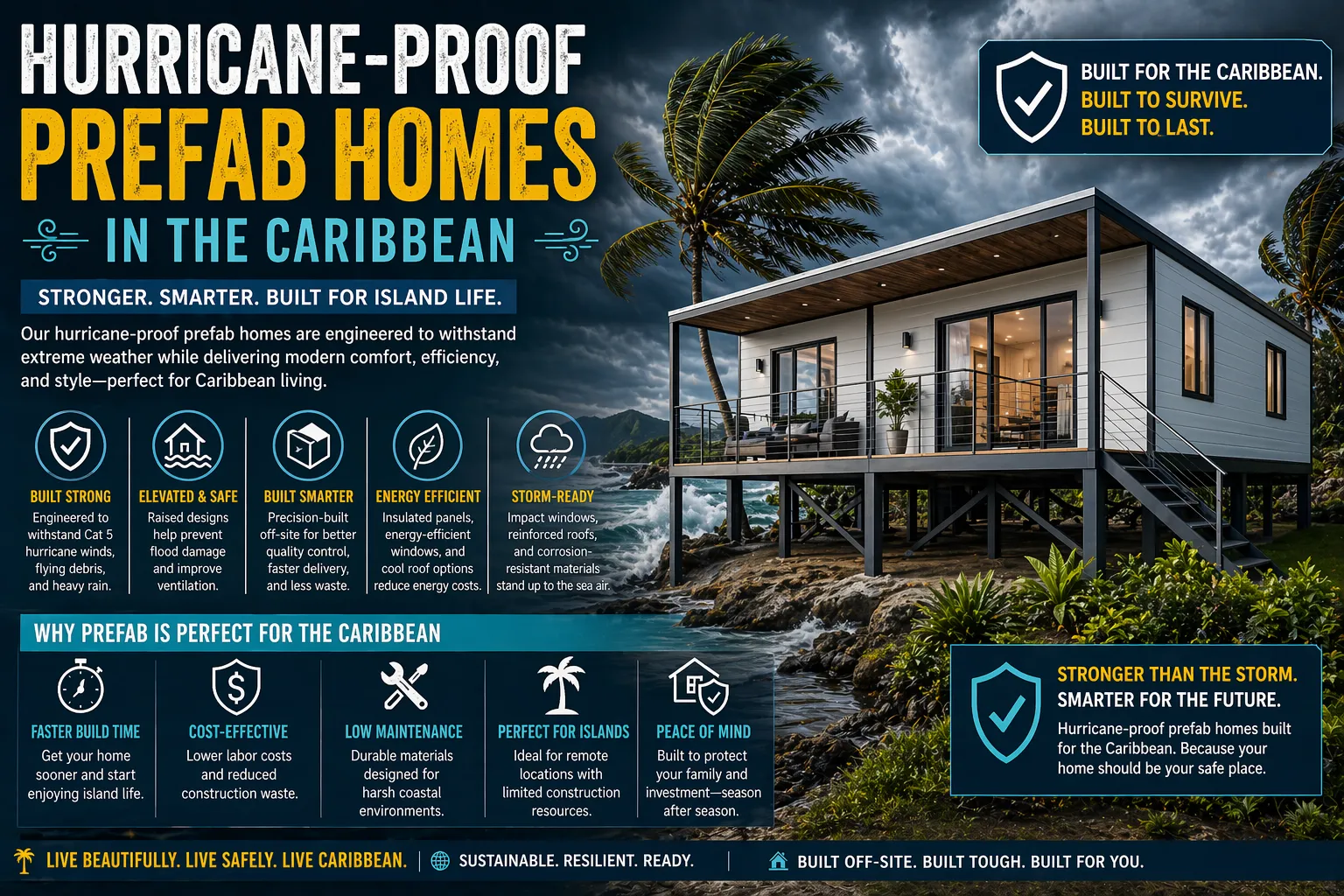
When Hurricane Maria tore through Puerto Rico in 2017, it didn’t just damage homes — it erased them. Entire hillside communities in Utuado and Yabucoa were stripped down to their foundations in hours. But scattered across that same devastation, a small number of homes stood. Roofs intact. Walls solid. Some with barely a cracked window. Engineers who surveyed the aftermath pointed to the same factors repeatedly — these homes were built differently, from different materials, to a different standard. The storm didn’t spare them by accident.
That image resonates across the entire Caribbean basin, from the Virgin Islands to Barbados to the Cayman Islands. Every island has its version of that story — the neighborhood that disappeared and the one house that didn’t. And now, as climate patterns push storm intensity higher and insurance markets become increasingly unpredictable across the region, more Caribbean homeowners and expats are asking a question that would have seemed extreme a decade ago: why build anything that isn’t designed to survive a direct hit?
📞 Building in the Caribbean and want storm-engineered construction advice? Call Florida Steel Homes: 786-610-6398 Email: info@FloridaSteelHomes.com Visit: 16104 4th St E, Redington Beach, FL 33708
Why Caribbean Buyers Are Choosing Hurricane-Proof Prefab Homes Now
The emotional driver here is exhaustion. Caribbean homeowners — local families, retirees, expats, and investors alike — are tired of rebuilding. Tired of the insurance uncertainty. Tired of watching a lifetime of investment disappear in a single September night. That exhaustion has created a buyer who is more informed, more demanding, and far less willing to accept “this is how we build here” as a sufficient answer from a contractor.
The financial reality is reinforcing that shift. Property insurance across the Caribbean has become dramatically harder to obtain and more expensive to maintain after successive active hurricane seasons. Several international insurers have tightened underwriting criteria for Caribbean properties, requiring wind mitigation documentation that older masonry and wood-frame homes simply cannot produce. A hurricane-proof prefab home — with certified wind ratings, engineered connection details, and documented construction standards — gives buyers a paper trail that insurers can actually work with. That documentation alone can mean the difference between getting coverage and being denied entirely.
What “Hurricane-Proof” Means in a Caribbean Context
The Caribbean sits inside one of the most active hurricane corridors on the planet. Islands from the Lesser Antilles through the Greater Antilles and into the Bahamas face storms that have intensified more rapidly in recent decades, with Category 4 and 5 systems becoming increasingly common. Building to a genuine hurricane-resistant standard in this environment means engineering for sustained winds of at least 175 mph, with gust resistance extending beyond that. It also means accounting for storm surge, saltwater corrosion, high humidity, and seismic activity in certain subregions — challenges that Florida construction standards address partially but that Caribbean-specific engineering must handle more completely.
The best hurricane-proof prefab homes for Caribbean deployment are built using the same core structural systems that perform in coastal Florida — steel frame, ICF, and SIP panel construction — but specified with Caribbean conditions in mind. This means marine-grade coatings on steel components, waterproofing membranes rated for tropical humidity, and foundation systems designed for the specific soil and flood exposure of the site. A home shipped and installed without these regional adaptations will underperform regardless of its wind rating on paper.
Best Hurricane-Proof Prefab Construction Types for the Caribbean
Steel Frame Modular
Steel frame modular construction is the most practical and cost-accessible hurricane-resistant option for most Caribbean applications. The structural system ships in modular sections, can be erected quickly with a relatively small local crew, and achieves wind ratings of 160 to 185 mph when properly engineered. Steel’s primary advantage in the Caribbean beyond wind resistance is dimensional stability — it doesn’t swell, warp, or degrade in high-humidity tropical environments the way wood does over time. The critical specification for Caribbean deployment is corrosion protection: hot-dip galvanized, or epoxy-coated steel with additional marine-grade finish is non-negotiable within a few miles of saltwater.
Insulated Concrete Form (ICF)
ICF homes are the gold standard for Caribbean hurricane resistance. Reinforced concrete walls, continuous from foundation to roof plate, create a structural monolith that wind and water pressure struggle to penetrate. Post-Maria engineering assessments in Puerto Rico consistently identified ICF and reinforced concrete construction as the top-performing home types — not just surviving but sustaining minimal damage in areas where everything around them failed. ICF also provides exceptional thermal mass, keeping interiors cooler in tropical heat without heavy air conditioning loads. The tradeoff is cost and the need for skilled local labor to pour and finish the concrete correctly.
SIP Panel Homes
SIP construction offers a strong middle ground — faster to erect than poured concrete, stronger than conventional wood frame, and more design-flexible than modular steel. Panels are factory-manufactured to precise specifications, which reduces on-site variability and produces more consistent structural performance than hand-framed construction. For Caribbean islands with limited local construction labor or remote locations accessible only by boat or small aircraft, SIP’s compact shipping profile and fast assembly timeline are significant practical advantages.
Hurricane-Proof Prefab Homes: Caribbean Comparison Guide
| Construction Type | Wind Rating | Cost Range (USD/sq ft) | Caribbean Suitability | Build Time |
|---|---|---|---|---|
| Steel Frame Modular | 160–185 mph | $140–$200 | ⭐⭐⭐⭐⭐ Excellent | 90–120 days |
| ICF Concrete | 175–185 mph+ | $160–$240 | ⭐⭐⭐⭐⭐ Excellent | 120–180 days |
| SIP Panel | 160–180 mph | $150–$210 | ⭐⭐⭐⭐ Very Good | 90–150 days |
| Traditional Masonry | 120–150 mph | $100–$160 | ⭐⭐ Fair | 180–240 days |
| Wood Frame (Standard) | 100–130 mph | $90–$140 | ⭐ Poor | 150–210 days |
Island-by-Island Considerations: What Changes by Location
Caribbean islands are not a single market — they’re dozens of distinct regulatory, logistical, and climatic environments stacked within a few hundred miles of each other. What works seamlessly in the Cayman Islands requires a completely different approach in rural Haiti or a mountainous interior parish in Jamaica.
In the US Virgin Islands and Puerto Rico, building codes align closely with Florida’s standards, making American prefab manufacturers a natural fit. Import logistics are relatively straightforward, permitting frameworks are familiar, and wind zone classifications follow ASCE 7 standards that most US-based prefab engineers already design to. In the British Virgin Islands, Cayman Islands, and Turks and Caicos, building codes are rigorous and well-enforced, and there is a strong existing precedent for importing prefab and modular construction from North American manufacturers.
In the Eastern Caribbean — Barbados, St. Lucia, Antigua, and Grenada — local building codes vary in their enforcement, and import logistics add meaningful cost and complexity. Shipping a full modular home to Barbados from a Florida manufacturer involves container freight, customs duties, port handling, and inland transport that can add 15 to 25 percent to the base home cost. Buyers in these markets need to factor logistics as carefully as construction type.
Common Mistakes Caribbean Buyers Make With Hurricane-Proof Prefabs
The single most expensive mistake is treating a home’s wind rating as a complete guarantee without verifying installation quality. A steel-frame home rated for 185 mph that is anchored to its foundation with substandard bolts, or assembled by a crew unfamiliar with the manufacturer’s connection specifications will not perform to its rated capacity. The rating describes what the system can do when installed correctly — it is not a promise that survives poor execution on-site.
Second, buyers frequently underestimate the corrosion timeline in Caribbean saltwater environments. Standard steel components that perform perfectly in inland Florida can show significant corrosion within three to five years on a beachfront Caribbean site without proper marine-grade specification and regular maintenance. Ask your manufacturer specifically what corrosion protection package they recommend for your island location and get it in writing before the order is placed.
Third, skipping local engineering review is a risk that costs people dearly. Even the best American prefab home needs review by an engineer familiar with your specific island’s wind exposure category, seismic zone, if applicable, and local soil conditions. This review is not expensive relative to the total project cost — and it’s the step that connects the manufacturer’s rated performance to your actual site conditions.
What to Ask a Prefab Builder Before Shipping to the Caribbean
Before committing to any manufacturer, get clear answers to these questions. What corrosion protection package do they offer for marine environments, and what maintenance does it require? Have they shipped to your specific island or region before, and can they connect you with a buyer who has gone through that process? What does their wind rating certification cover — the wall system only, or the complete assembled structure, including roof, openings, and foundation connections? And critically, do they have a relationship with a local engineer or installation crew on your island, or will you be managing that entirely yourself?
A manufacturer who hesitates on any of these questions is telling you something important. The Caribbean is a demanding environment, and the builders who do this well know exactly what it requires.
Build Once. Build Right. Build to Survive.
The Caribbean is one of the most beautiful places on earth to own a home. It is also one of the most demanding environments any structure can face. The buyers who get this right — who end up with a home still standing after the next major storm while their neighbors are starting over — are the ones who made the decision to build to a genuine standard before the season began, not after it ended.
Florida Steel Homes builds hurricane-engineered, steel-frame homes designed for exactly these conditions. Their team understands coastal and island environments, marine-grade specification requirements, and what it takes to deliver a genuinely storm-resistant structure — whether on the Florida Gulf Coast or beyond it.
📞 786-610-6398 📧 info@FloridaSteelHomes.com 📍 16104 4th St E, Redington Beach, FL 33708
Call today for a free consultation. The next storm season is closer than it feels — and the time to build the right home is always before it arrives.