Picture this: turquoise water outside your window, a light trade wind coming through the louvers, and the kind of quiet that only exists when you’re somewhere genuinely beautiful. Now picture that same house still standing three days after a Category 4 hurricane rolled through the island. That’s not a fantasy — that’s what the right prefab home, built to the right spec, actually delivers in the Caribbean today.
Hurricane Proof Prefab Homes in the Caribbean: Honest Guide
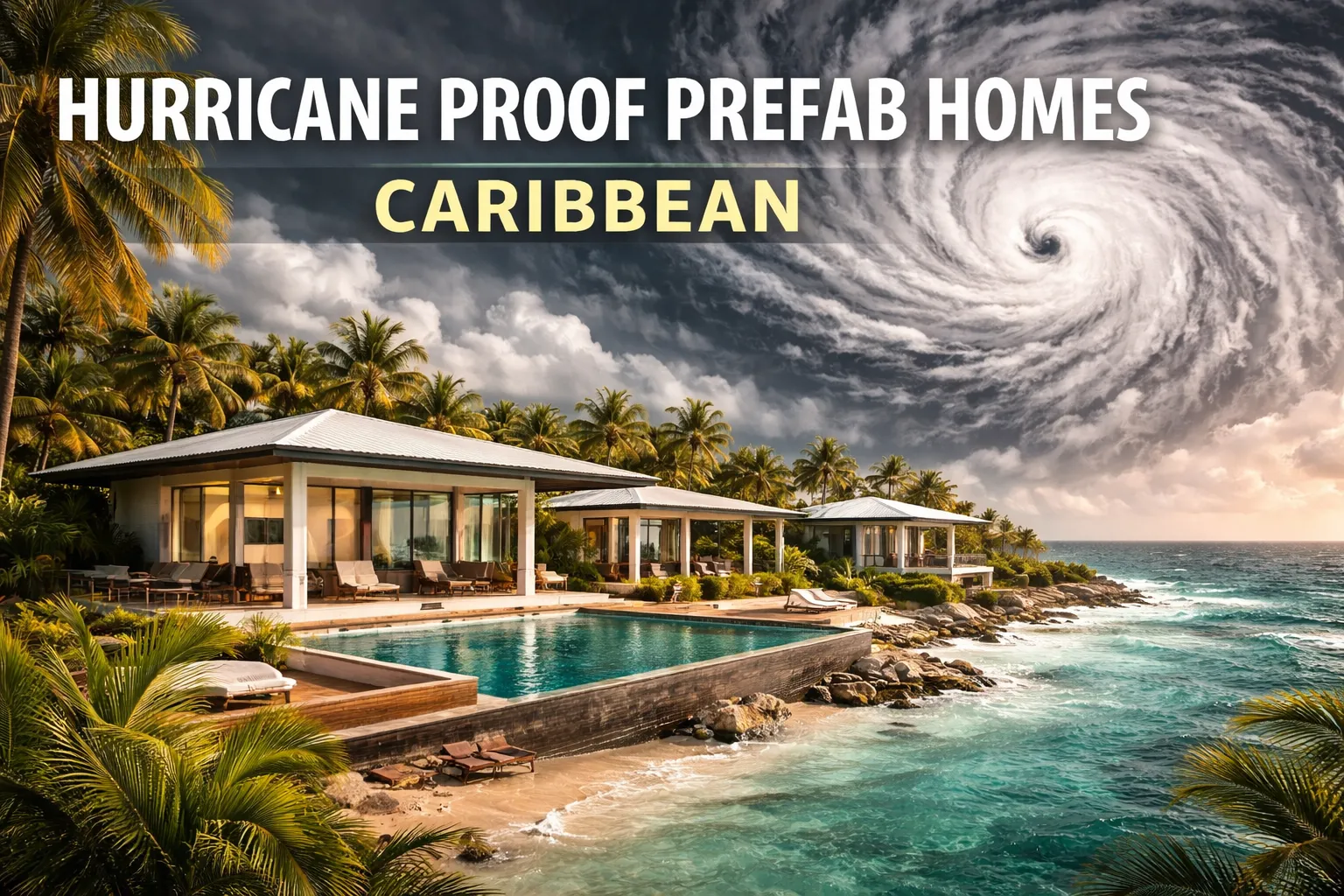
Most buyers who start looking at Caribbean real estate think about the sunsets first and the storms second. That’s a completely human response. But anyone who’s spent real time in the islands—or watched the news after Maria, Dorian, or Ian—knows that storm season isn’t a footnote. It’s the defining fact of island living. The good news is that the prefab home industry has caught up to that reality in a serious way, and there are now purpose-built options that don’t ask you to choose between beauty and safety.
Why Buyers Are Excited About Prefab Homes in the Caribbean Right Now
There’s a real shift happening in how people approach Caribbean homeownership, and it’s not just driven by cost. Buyers who’ve done their homework are realizing that site-built concrete block construction — the traditional Caribbean standard — has a surprisingly mixed track record in major storms. Post-hurricane engineering surveys after Maria in Puerto Rico and Dorian in the Bahamas documented widespread failure even in homes that looked structurally solid before the event. Steel-frame prefab construction, by contrast, has a documented record of surviving winds above 180 mph with structural integrity intact.
That performance data matters emotionally, not just practically. There’s something deeply reassuring about knowing your home was engineered specifically for the conditions you’re moving into, tested against those conditions, and delivered with a certification number you can look up. First-time buyers especially are gravitating toward this approach because they’re not inheriting someone else’s construction decisions—they’re starting fresh, with a system designed to protect them from day one.
The financial case has gotten compelling, too. Insurance premiums on certified hurricane-resistant homes in Florida and the broader Caribbean basin can run 20 to 40 percent lower than on equivalent conventionally built properties. Over a 30-year mortgage, that delta adds up to real money — sometimes six figures — and it makes the slightly higher upfront cost of quality prefab construction look very different on a spreadsheet.
What “Hurricane Proof” Actually Means (And What It Doesn’t)
Expert Insight: No home is literally indestructible in a direct major hurricane hit. What “hurricane proof” means in certified construction is that the structure is engineered and tested to remain standing and habitable through sustained winds at a defined rating — typically Category 5, meaning 157 mph or higher. The difference between a home that survives and one that doesn’t often comes down to three things: the connection points between structural members, the wind-load rating of windows and doors, and the anchor system connecting the structure to its foundation. A steel-frame home with properly rated impact glass and a deep concrete anchor system genuinely performs differently than anything built to minimum code.
When you’re evaluating prefab homes for Caribbean use, the spec sheet matters more than the marketing. You want to see a documented wind-load certification—specifically, what speed was it tested or engineered to withstand? You want to know the glazing rating on every window and door. And you want to understand the foundation system, because in storm surge zones, elevation above base flood elevation can be the single most important factor in whether your home is habitable after a major event.
Step-by-Step: How to Buy a Hurricane Proof Prefab Home in the Caribbean
Step 1: Determine your island’s specific building codes and zoning rules. Each Caribbean territory has its own requirements, and they vary significantly. Puerto Rico follows US building codes. The Cayman Islands has its own framework. The BVI, Turks and Caicos, and the USVI all have different requirements. Before you fall in love with a floor plan, confirm that the manufacturer you’re considering has built on your target island or can certify compliance with local codes.
Step 2: Identify your flood zone and elevation requirement. FEMA flood maps cover US territories, and most Caribbean islands have their own flood risk mapping. Your lot’s base flood elevation determines how high your home needs to be raised above grade. This affects your foundation cost significantly, and it should factor into your site selection before you buy land.
Step 3: Choose a manufacturer with documented Caribbean or Florida hurricane experience. Florida-based steel-frame manufacturers are a strong starting point because the Florida building code is among the most stringent hurricane construction standards in the world. A builder certified to Florida’s codes is already meeting or exceeding most Caribbean requirements. Florida Steel Homes, for example, builds to Category 5 certification with steel-frame systems designed for exactly this climate profile.
Step 4: Lock your budget before finalizing your design. This is the step most buyers skip, and it’s the one that causes the most expensive surprises. Get real numbers — not estimates, not ballparks — before your design team finalizes drawings. A reputable builder will do this with you in an initial consultation. If a builder won’t commit to real budget numbers before you’ve invested in design work, that’s a sign.
Step 5: Factor in site preparation, permitting, and shipping costs. Prefab doesn’t mean plug-and-play on a Caribbean island. You’ll have shipping costs from the manufacturer’s facility to the port, unloading and transport to your site, foundation work, and local permitting. Budget these as real line items, not afterthoughts. On a remote island, site logistics can add 15 to 25 percent to your total project cost.
Step 6: Understand the construction timeline realistically. Quality hurricane-resistant prefab construction typically runs 4 to 6 months from permit approval to move-in. Add time for shipping and island-side site work, and a realistic total timeline is often 8 to 12 months from contract to keys. Any builder promising significantly less than that for a full custom build deserves a follow-up question.
Cost Breakdown: What to Budget For
| Item | Estimated Cost Range |
|---|---|
| Home package (1,200–1,500 sq ft, steel-frame, Cat 5) | $180,000 – $280,000 |
| Shipping to a Caribbean island | $8,000 – $20,000 |
| Foundation (standard) | $15,000 – $35,000 |
| Foundation (elevated/flood zone) | $30,000 – $65,000 |
| Local permitting and inspections | $3,000 – $10,000 |
| Site prep and utilities connection | $10,000 – $30,000 |
| Impact windows/doors upgrade (if not included) | $8,000 – $18,000 |
| Solar panel system (if not bundled) | $12,000 – $22,000 |
| Total realistic range | $236,000 – $445,000 |
These numbers are ranges, not quotes. Your actual cost depends heavily on your specific island, lot conditions, and design choices. The point of this table is to make sure you’re not planning around the low end of one line item and the high end of another.
Pros and Cons: The Honest Trade-offs
The real advantages:
- Certified Category 5 wind resistance gives you documented, testable protection—not a promise
- Steel construction doesn’t rot, doesn’t feed termites, and doesn’t warp in tropical humidity
- Insurance premium savings over time can genuinely offset higher upfront construction costs
- Factory-built components mean more consistent quality control than site-built construction in remote areas
- Faster construction timeline than traditional site-built in most Caribbean markets
- Pairing with solar can drop your monthly electricity costs dramatically—some buyers report bills under $50/month
The honest trade-offs:
- Higher initial cost than minimum-code local construction, though often comparable to quality site-built
- Shipping adds real cost and logistical complexity to island projects
- Not every manufacturer understands Caribbean-specific requirements—due diligence matters
- Some island communities have aesthetic preferences or HOA rules that may affect design choices
- Permitting timelines on some islands can extend your project beyond your control
Area Spotlight: Where Caribbean Buyers Are Looking
The US Virgin Islands and Puerto Rico attract buyers who want US jurisdiction, US building codes, and US mortgage financing, which makes the whole transaction simpler and the hurricane certification more standardized. The Florida Keys, while technically part of the mainland US, share the same Caribbean climate profile and are seeing strong demand for certified steel-frame construction after recent storm seasons. For international buyers, the Cayman Islands and Turks and Caicos have relatively mature construction markets with established permitting processes for prefab systems. The BVI and smaller Leeward Islands tend to require more builder-side logistics work but offer some of the most compelling land opportunities for buyers willing to navigate the complexity.
Common Mistakes to Avoid
Buying the cheapest lot and then trying to engineer your way out of a bad flood zone position is the most expensive mistake Caribbean prefab buyers make. The cost of elevating a home in a severe flood zone can exceed the cost of a better-sited lot by a factor of two or more. Choose your site with eyes open.
Skipping the glazing spec on your windows and doors is another one that hurts people. The walls of a steel-frame home can survive 185 mph winds, but if your windows are rated to 140 mph, that’s your weak point. Make sure your entire building envelope—walls, roof, windows, and doors—is certified to the same wind speed.
Assuming the manufacturer handles local permitting is a third mistake. Many prefab companies are excellent at building homes and less experienced in navigating specific island permitting offices. Clarify upfront exactly which party is responsible for which approvals, and build buffer time into your schedule.
Your Next Step Starts With One Conversation
You don’t need to figure out all of this alone before you pick up the phone. The best move you can make right now is to schedule a consultation with a builder who has real experience in hurricane-resistant steel-frame construction—someone who’ll tell you the honest numbers before you’ve invested in drawings and who understands the specific demands of the Caribbean climate and construction.
Florida Steel Homes builds Category 5-certified steel homes designed for exactly this environment, with a budget-first approach that keeps buyers out of the trap of falling in love with a plan they can’t afford to build. Call (786) 610-6398 or visit FloridaSteelHomes.com to schedule your free consultation. Tell them your island, your budget range, and your timeline—and get real answers from people who’ve built in these conditions, not just drawn pretty renderings of them.