Miami’s hurricane proof homes use steel frames, impact glass, and wind-rated roofing to survive Category 4+ storms—increasingly the first choice for families tired of riding out storms with plywood on the windows. This guide breaks down exactly what makes a home genuinely storm-resistant, what it costs, and who builds them right in South Florida.
Picture this: it’s 2 a.m., a Category 4 is closing in on Biscayne Bay, and your neighbors are taping a newspaper over their sliding glass doors while you’re calmly watching the radar from your couch. Not because you’re reckless—but because your home was built for exactly this moment. That peace of mind isn’t luck. It’s engineering. And in Miami, Florida, it’s becoming the baseline expectation for families who’ve lived through one too many close calls with Atlantic storm season.
Hurricane Proof Homes in Miami
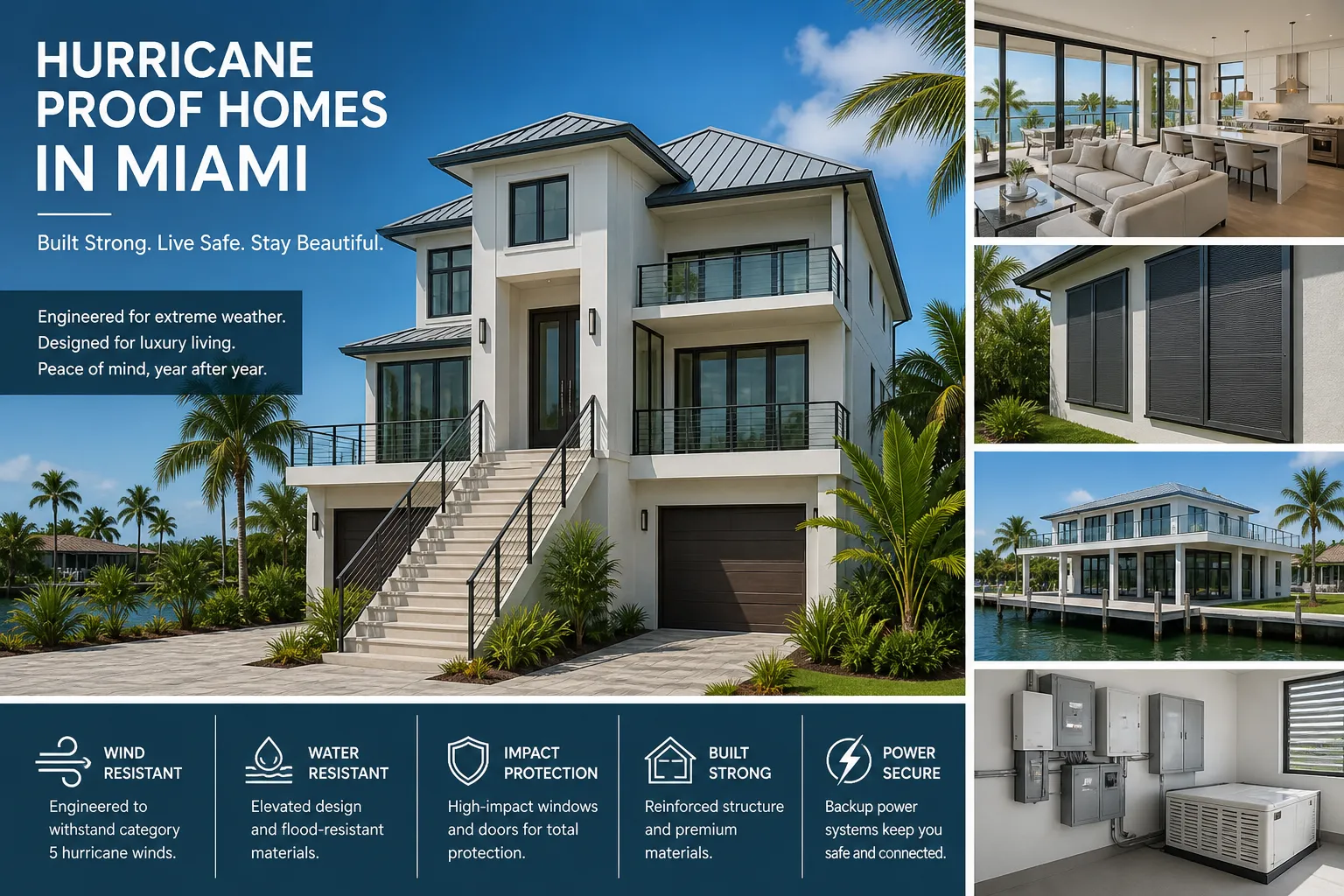
South Florida gets hit harder and more often than almost anywhere else in the continental US. Since 1851, Florida has been struck by more hurricanes than any other state — roughly 40% of all US landfalls. Miami sits at the tip of a peninsula that funnels storm surges and 150+ mph wind gusts with almost no natural buffer. So when people talk about hurricane-proof homes in Miami, they’re not being dramatic. They’re talking about survival architecture in one of America’s most storm-exposed cities.
Ready to build a home that doesn’t flinch at hurricane season?
Florida Steel Homes specializes in steel-frame hurricane-resistant construction across South Florida. Call us or send an email — we’ll walk you through your options at no cost.
☎ Call: 786-610-6398
✉ info@FloridaSteelHomes.com
📍 16104 4th St E, Redington Beach, FL 33708
Why Buyers Are So Excited About Hurricane-Resistant Construction Right Now
There’s a real shift happening in South Florida real estate, and it’s driven by emotion just as much as practicality. For years, the conversation around hurricane prep was about plywood, sandbags, and last-minute evacuations. Now it’s about something different — buyers want homes that make them feel like they can actually stay. Families with young kids, retirees who’ve put their life savings into a property, remote workers who can’t disappear for two weeks during a storm — they’re all asking the same question upfront: how was this house built to handle a direct hit?
There’s also a financial layer that has sharpened buyers’ attention. Florida homeowners’ insurance has gotten brutal. Carriers are pulling out of the state, premiums have tripled for some coastal homeowners, and insurers are scrutinizing construction quality more than ever before. Homes built to current Miami-Dade County hurricane standards — or better — often qualify for significantly lower premiums. Over 10 or 20 years, that difference in insurance costs can more than offset the higher upfront price of storm-hardened construction. Buyers who understand this aren’t just buying peace of mind; they’re making a smart financial play.
Then there’s the emotional reality of riding out storms in a home you’re not sure about. Anyone who’s lived in South Florida for more than five years has at least one story—the night the roof started leaking in three places, the window that cracked under the pressure wave, the garage door that blew in and created a catastrophic pressure differential inside the structure. Once you’ve had that experience, you think about construction very differently. The excitement around hurricane-proof homes isn’t just a trend. It’s a community of people who decided they’re done gambling with their family’s safety.
What “Hurricane Proof” Actually Means in Construction Terms
No home is literally indestructible, and anyone who tells you otherwise is overselling. But there’s a meaningful spectrum between a 1970s wood-frame ranch house and a modern steel-reinforced structure built to exceed Miami-Dade’s stringent codes—and the difference in real-storm outcomes is enormous. When builders and buyers in South Florida talk about hurricane-proof homes, they generally mean homes engineered to withstand sustained winds of 175 mph or more, the threshold for a Category 5 storm, with minimal structural damage and no loss of envelope integrity.
Steel frame construction
Steel framing is the backbone of the most serious hurricane resistant builds in Miami. Unlike wood, which can crack, warp, and pull away from fasteners under intense lateral wind load, structural steel bends before it breaks — and properly engineered steel frames are designed to absorb and redistribute wind forces rather than resist them rigidly. A steel-framed home won’t splinter. Bolted connections maintain integrity even when subjected to the oscillating pressure changes that destroy conventional wood framing. Companies like Florida Steel Homes build with this method specifically because the performance difference in a real storm is not subtle — it’s the difference between structural loss and walking away clean.
Impact-resistant windows and doors
In Miami, building code requires impact-rated glazing in new construction, but the quality of what gets installed varies significantly. True hurricane impact windows use laminated glass — two or more panes bonded to a tough interlayer — that shatters into small, largely harmless fragments and stays in the frame even after the glass cracks. That matters because once a window or door fails in a hurricane, you’ve lost the envelope: interior pressure spikes, the roof becomes vulnerable, and the cascade of damage gets catastrophic fast. High-quality impact glass also blocks 99% of UV and provides meaningful noise reduction—practical day-to-day benefits that make the upgrade even more worthwhile beyond storm season.
Roofing systems and connections
Most hurricane damage doesn’t come from wind ripping walls apart—it comes from roofs lifting off. The weakest link is almost always the connection between the roof deck and the wall framing. Miami-Dade High Velocity Hurricane Zone requirements mandate specific strap connectors at every rafter, hurricane clips at regular intervals, and a minimum nail pattern on the roof deck. Hip roofs — four-sloped designs that distribute wind load more evenly than gabled roofs — consistently outperform in high-wind events. Concrete tile or metal roofing rated for 175 mph wind, properly fastened to a reinforced deck, is the current gold standard in South Florida construction.
Comparing Your Options: Hurricane-Resistant Construction Methods
Not all storm-resistant builds are the same, and the right choice depends on your budget, timeline, lot conditions, and how much protection you actually want. Here’s an honest breakdown of the main construction approaches used in Miami-Dade County today.
| Construction type | Wind rating | Avg cost/sq ft | Maintenance | Insurance impact |
| Wood frame (standard code) | 140 mph | $160–$210 | Moderate — moisture & pest risk | Baseline rates |
| Concrete block (CBS) | 150–160 mph | $190–$250 | Low — durable, mold-resistant | Modest discount possible |
| Insulated concrete forms (ICF) | 200+ mph | $220–$280 | Very low — excellent efficiency | Strong discount, 20–30% |
| Steel frame (engineered) | 175–200+ mph | $230–$300 | Very low — no rot, no termites | Best available discounts |
| Steel + ICF hybrid | 200+ mph | $260–$330 | Minimal — top-tier durability | Maximum possible reduction |
Concrete block—what Floridians call CBS, or concrete block structure—has been the South Florida default for decades, and it’s genuinely solid. Most CBS homes built after 2002, when Miami-Dade significantly tightened its codes following Hurricane Andrew, will perform well in a Category 3 or lower event. The step up to steel or ICF construction is about raising that ceiling: better performance in Category 4 and 5 events, a better long-term maintenance profile, and increasingly, better insurance terms as carriers reward the most resilient builds with their deepest discounts.
Practical Tips: What to Look for Before You Buy or Build
If you’re evaluating an existing home in Miami for hurricane resistance — or preparing to build — there are specific things to look for that go far beyond “built after Hurricane Andrew.” General contractors and real estate agents mean well, but “up to code” is a floor, not a ceiling, and the gap between minimum compliance and genuinely exceptional construction is wide enough to matter in a serious storm.
- Pull the permit history. Miami-Dade’s permit search is public. Look for structural permits, roof permits, and window and door replacements. Homes with documented recent upgrades to storm-rated systems are substantially lower risk than homes relying on original 1990s-era construction.
- Ask for the wind mitigation report. Any home that’s been insured recently should have a wind mitigation inspection on file. This document tells you exactly what hurricane protection features exist—roof shape, strapping type, opening protection, and roof-deck attachment—and it directly determines your insurance rate.
- Check the roof age and type. A flat roof or an older asphalt shingle roof in South Florida is a red flag. Hip roofs with concrete tile or metal roofing, properly maintained, are the baseline for serious storm performance. Factor in a full roof replacement cost if the current roof doesn’t meet this standard.
- Inspect every opening. Windows, doors, and garage doors are where homes fail in hurricanes. Look for the Miami-Dade NOA (Notice of Acceptance) label on impact windows—it means the product passed the county’s rigorous testing protocol. A single non-impact window can compromise your home’s entire envelope protection.
- Understand your flood zone. Wind resistance and flood resistance are separate issues. Miami’s FEMA flood maps have changed significantly in recent years. AE and VE flood zones require elevation certificates and separate flood insurance — factor this in carefully before any purchase decision, especially near the coast.
- Get a structural engineer, not just a home inspector. Standard home inspectors are not trained to evaluate hurricane structural performance in depth. For a high-value purchase in South Florida, a licensed structural engineer’s review is worth every penny — especially for older construction that may not meet current code thresholds.
Common Questions Buyers Ask About Hurricane-Proof Homes
Can a house truly be 100% hurricane proof in Miami? No structure offers a complete guarantee against every possible storm scenario — a direct hit from a Category 5 with 180 mph sustained winds, and a 20-foot storm surge is an extreme event even for the most well-engineered homes. What steel-frame and ICF construction offers is dramatically better performance at every wind speed, meaning structural integrity through most hurricane scenarios and far less interior damage even in the most severe storms. “Hurricane resistant” is the accurate term; “hurricane proof” captures the spirit of what these homes are designed to deliver.
How much does hurricane-proof construction add to the cost? Upgrading from standard wood-frame construction to an engineered steel frame in Miami typically adds 15 to 25 percent to the base construction cost. On a 2,000 square foot home, that’s roughly $50,000 to $80,000 in additional upfront investment. Over a 30-year horizon, the combination of lower insurance premiums — often $3,000 to $8,000 per year in savings for coastal properties — lower maintenance costs, and avoided storm damage repairs frequently makes steel-frame construction the more economical choice, not just the safer one.
What are the best neighborhoods in Miami to find hurricane-resistant homes? Newer construction in Doral, Kendall, and Weston tends to include better storm-hardened features because these areas developed significantly after the post-Andrew code reforms of the mid-1990s. In coastal areas like Coconut Grove, Coral Gables, and South Beach, quality varies enormously — you can find extraordinary hurricane-resistant construction and dangerously outdated housing stock on the same block. In all cases, the construction method and upgrade history matter far more than the neighborhood alone.
The Real Cost of Not Building to Hurricane Standards
Hurricane Andrew in 1992 destroyed or damaged over 125,000 homes and caused what was then the costliest natural disaster in US history. The construction failures weren’t freak accidents — they were systematic. Roofs that should have been strapped weren’t. Windows that weren’t impact-rated blew in. Framing connections that looked fine on paper failed under real storm loads. The aftermath rewrote Florida’s building codes
from the ground up, but it also permanently shifted how serious Miami families think about the homes they live in.
Buying or building a home that meets only the minimum modern code — or that was built before the 2002 code reforms — is a bet that no major storm will hit your block on your watch. Plenty of people have won that bet. Plenty haven’t, and the financial and emotional cost of being in that second group is staggering. The average residential hurricane claim in Florida runs anywhere from $40,000 to over $200,000 for serious structural damage. Beyond the money, there’s the displacement — families in hotels or relatives’ homes for months, insurance disputes, contractor fraud, the slow grind of rebuilding a life.
The families who’ve made the move to genuinely storm-hardened construction consistently describe the same feeling after their first real hurricane season in the new home: calm. Not the anxious, white-knuckle calm of people hoping for the best, but the settled confidence of people who’ve done the math and made the choice. That calm is what steel-frame and hurricane-resistant construction actually sells. The engineering is just how it gets delivered.
Talk to Florida Steel Homes Before Hurricane SeasonIf you’re serious about building or buying a home in South Florida that can handle a real storm, the conversation starts with the right builder. Florida Steel Homes designs and constructs steel-frame hurricane-resistant homes that are built to exceed Miami-Dade standards — and they’ve seen firsthand what the difference looks like after a storm rolls through. Call today for a free consultation. No pressure, no sales pitch — just a straight conversation about what it actually takes to build a safe home in Miami. ☎ 786-610-6398 ✉ info@FloridaSteelHomes.com 📍 16104 4th St E, Redington Beach FL 33708 |