Florida’s housing market is changing fast, and hurricane resistance is no longer a “nice to have” — it’s the single biggest factor buyers ask about before they sign anything. After back-to-back storm seasons and rising insurance premiums, more homebuyers are searching for hurricane proof homes for sale in Florida, and steel-built construction has become the clear winner over traditional wood-frame homes.
Hurricane Proof Homes for Sale in Florida
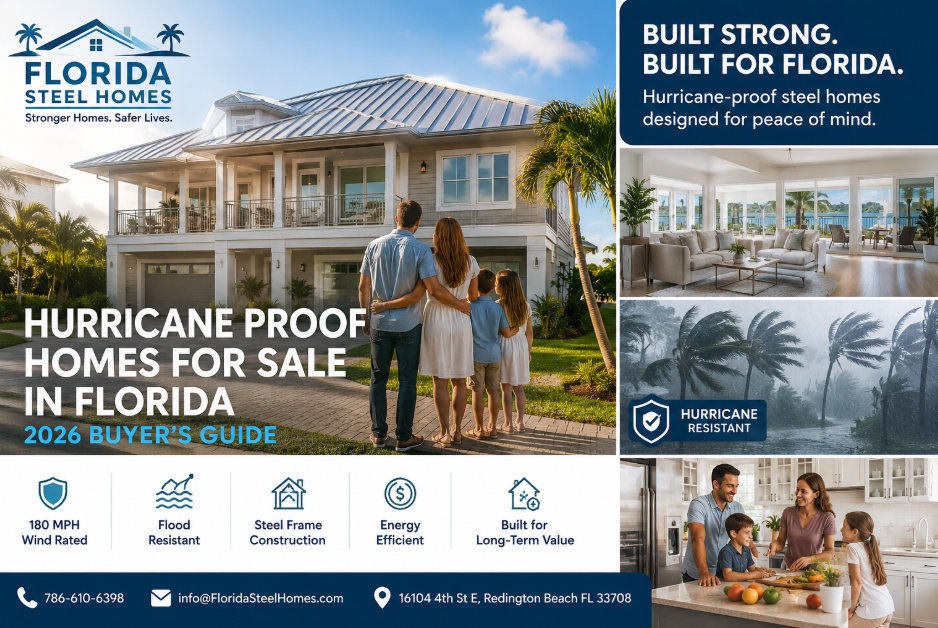
This 2026 guide breaks down what actually makes a home “hurricane proof,” how steel homes compare to conventional builds, what to expect on insurance and cost, and where to find real hurricane-resistant homes in Florida today.
Thinking about a hurricane-proof steel home in Florida?
📞 Call Florida Steel Homes at 786-610-6398
✉️ Email info@FloridaSteelHomes.com
📍 Visit us at 16104 4th St E, Redington Beach, FL 33708
Why “Hurricane Proof” Actually Matters in 2026
No home is 100% indestructible, but there’s a real, measurable difference between homes built to survive a Category 4–5 hurricane and homes that were never designed for one. In 2026, Florida buyers are prioritising:
- Wind resistance up to 180+ mph (steel-frame construction vs. standard wood framing)
- Flood-resistant foundations and elevated designs
- Impact-rated windows and doors
- Lower insurance premiums due to stronger building codes and materials
- Long-term resale value as storm risk becomes a bigger factor in appraisals
If you’re buying in coastal counties like Pinellas, Miami-Dade, Broward, or Lee County, this isn’t optional anymore — it’s the difference between rebuilding every few years and owning a home that actually holds up.
What Makes a Home Truly Hurricane-Proof?
1. Steel Frame Construction
Steel-framed homes are engineered to resist high wind uplift and lateral pressure far better than wood-frame structures. Steel doesn’t warp, rot, or feed termites — three problems that quietly weaken traditional Florida homes over time.
2. Impact-Rated Windows and Doors
The Florida Building Code (FBC) requires impact-rated glazing in wind-borne debris regions, but not all “impact windows” are equal. Look for products tested to Miami-Dade County’s Notice of Acceptance (NOA) standard — the strictest in the country.
3. Reinforced Roofing Systems
Hip roofs, hurricane straps, and metal roofing rated for 150+ mph winds significantly reduce roof failure, which is the #1 cause of catastrophic hurricane damage.
4. Elevated & Flood-Resistant Foundations
In flood zones, elevation isn’t just smart — it’s required by FEMA guidelines and directly affects your flood insurance rate.
5. Continuous Load Path Engineering
This is the design principle that ties your roof, walls, and foundation into a single connected structure so wind forces transfer safely to the ground instead of tearing the home apart piece by piece.
Steel Homes vs. Traditional Wood-Frame Homes
| Feature | Steel Homes | Traditional Wood Frame |
|---|---|---|
| Wind resistance | Up to 180+ mph | Typically 120–150 mph |
| Termite/rot risk | None | High in the Florida climate |
| Insurance premiums | Often 20–40% lower | Higher due to risk rating |
| Lifespan | 50+ years with minimal maintenance | 25–30 years average |
| Fire resistance | Non-combustible | Combustible |
| Long-term cost | Lower total cost of ownership | Higher repair/replacement cost |
This is exactly why Florida Steel Homes builds and sells steel-engineered residences specifically designed for Florida’s climate — not adapted from a generic mainland design.
Want to see steel home floor plans available near you right now? Reach our team directly at 786-610-6398 or info@FloridaSteelHomes.com — we’ll walk you through current inventory and pricing.
Hurricane-Proof Tiny Homes in Florida: The 2026 Trend
One of the fastest-growing segments in Florida real estate right now is hurricane-proof tiny homes. Buyers — from retirees downsizing to young families entering the market to investors building rental units—are choosing compact steel homes for a few clear reasons:
- Lower build and purchase cost compared to full-size hurricane-resistant homes
- Same steel-frame wind and flood resistance as larger homes, just scaled down
- Faster construction timelines, often move-in ready in a fraction of the time
- Lower insurance and property tax burden
- Ideal for ADUs, guest homes, rental income units, or waterfront getaways
A hurricane-proof tiny home isn’t a compromise — it’s the same engineering (steel frame, impact windows, reinforced roofing, elevated foundation) in a smaller, more affordable footprint. For Florida buyers priced out of the traditional market, this is often the most realistic path to owning true storm-resistant property.
Curious what a hurricane-proof tiny home costs in your area? Call 786-610-6398 or email info@FloridaSteelHomes.com — we’ll send you current tiny home pricing and available lots the same day.
What Does a Hurricane-Proof Home Cost in Florida (2026)?
Pricing varies by county, lot, and finish level, but as a general 2026 benchmark:
- Hurricane-resistant steel homes (standard size): typically priced comparably to or slightly above wood-frame homes upfront, but with significantly lower lifetime costs
- Hurricane proof tiny homes: the most budget-friendly entry point into storm-resistant ownership
- Insurance savings: many buyers recoup part of the price difference within 5–8 years through lower premiums
The real number depends on your lot, location, and build size — which is why it’s worth getting a direct quote instead of relying on national averages.
Get an accurate, no-pressure quote for your area:
Where to Buy Hurricane Proof Homes in Florida
Coastal and high-risk counties where demand for steel-built, storm-resistant homes is highest in 2026 include:
- Pinellas County (Redington Beach, St. Petersburg, Clearwater)
- Miami-Dade & Broward County
- Lee County (Fort Myers, Cape Coral)
- Sarasota & Charlotte County
- Tampa Bay Region
Florida Steel Homes is based directly in the Tampa Bay area at 16104 4th St E, Redington Beach, FL 33708, giving us firsthand insight into local flood zones, wind ratings, and permitting requirements across the region — not generic advice from out-of-state builders.
Frequently Asked Questions
Q: Are steel homes actually hurricane proof, or just hurricane resistant? A: No home is 100% hurricane-proof, but steel-frame homes engineered to Florida Building Code high-velocity hurricane zone standards offer dramatically higher survivability — often rated for 180+ mph winds versus 120–150 mph for standard wood-frame construction.
Q: Do hurricane proof homes really lower insurance costs? A: Yes. Homes built with impact-rated windows, reinforced roofing, and steel framing typically qualify for wind mitigation discounts, which can reduce premiums by 20–40% depending on the insurer and location.
Q: Are hurricane proof tiny homes legal to live in full-time in Florida? A: Yes, as long as they meet local zoning, minimum square footage, and Florida Building Code requirements. Requirements vary by county, so it’s worth confirming zoning before purchasing land.
Q: How is a steel home different from a shipping container home? A: Steel-frame homes use engineered structural steel systems built specifically for residential wind and flood loads. Container homes repurpose shipping containers, which weren’t originally engineered for hurricane wind ratings and often need heavy reinforcement to match.
Q: How long does it take to build a hurricane proof home in Florida? A: Standard steel homes typically take a few months longer than wood-frame builds due to precision engineering, while hurricane proof tiny homes can often be completed significantly faster.
Talk to a Florida Steel Homes Specialist Today
Whether you’re comparing full-size hurricane-resistant homes or exploring hurricane proof tiny homes, the fastest way to get real pricing, real floor plans, and real answers is to talk to us directly.
📞 Call: 786-610-6398
✉️ Email: info@FloridaSteelHomes.com
📍 Visit: 16104 4th St E, Redington Beach, FL 33708
Florida Steel Homes — built for Florida’s storms, not just Florida’s weather.