If you’ve priced out a storm-ready home in Florida this year, you’ve probably noticed something frustrating: every website seems to quote a different number. One site says $150 per square foot. Another says $500. So which is it?
The honest answer is that both can be right — they’re just describing different homes. “Hurricane-proof” isn’t one product with one price tag. It’s a spectrum, from a code-compliant house with impact windows bolted on, to a fully engineered steel-frame structure built to shrug off a Category 5. In this guide, we’ll break down what you’re actually paying for at each level, why steel changes the math, and how to avoid overpaying for protection you don’t need — or underpaying for protection you do.
Hurricane-Proof Home Cost Florida 2026 Guide
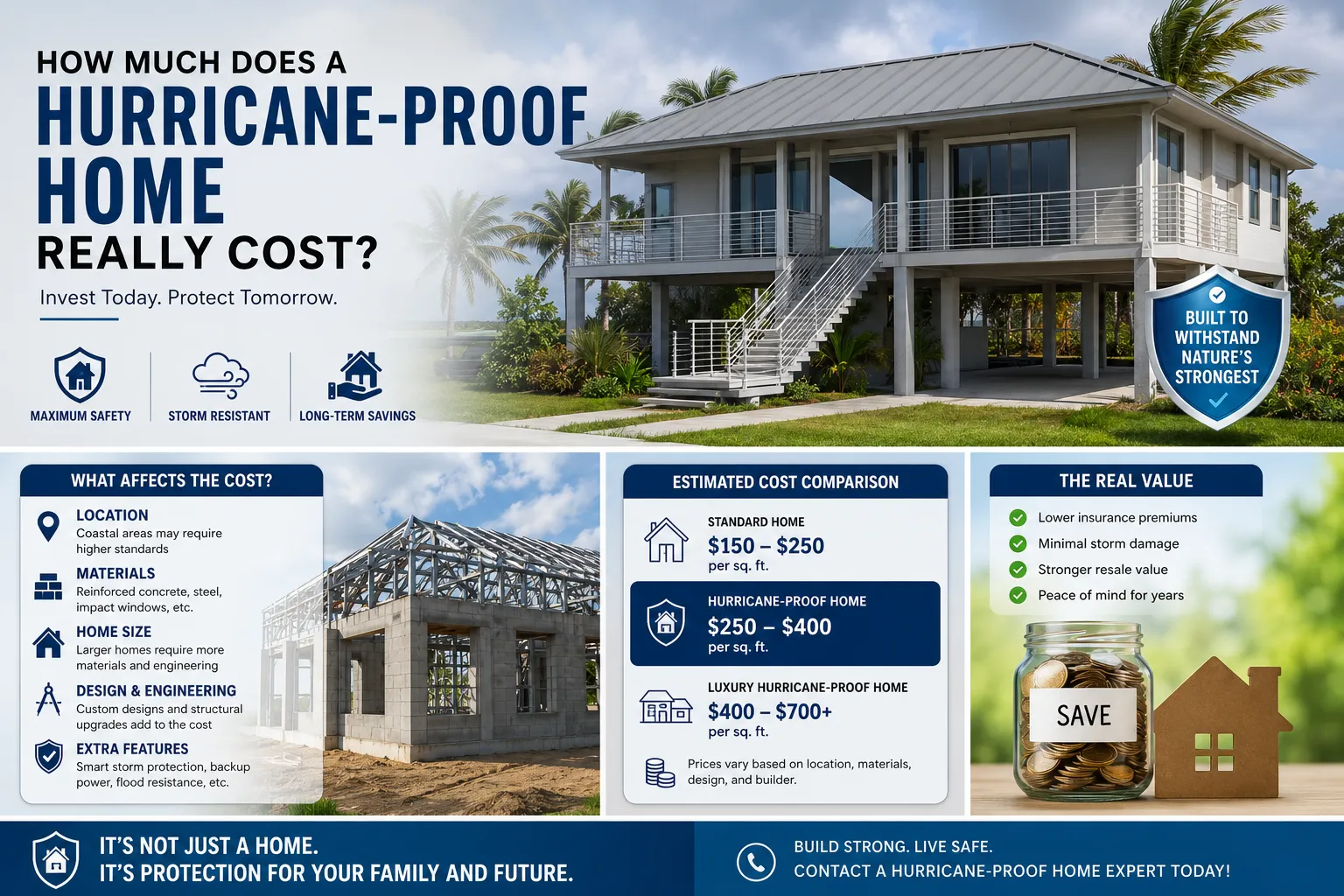
The Short Answer
In 2026, most hurricane-resistant homes in Florida run $150 to $350 per square foot for construction alone, with premium and Category 5-rated builds reaching $350 to $500+ per square foot. Steel-frame construction typically lands in the $150–$250 range — often 10–20% above standard wood-frame building, but with a meaningfully longer lifespan and lower long-term costs.
For context, a 2,000-square-foot home would run roughly:
| Build Level | Cost per Sq Ft | Total (2,000 sq ft) |
|---|---|---|
| Code-minimum, wood frame | $170–$200 | $340,000–$400,000 |
| Steel-frame, hurricane-rated | $150–$250 | $300,000–$500,000 |
| Mid-range, upgraded finishes | $250–$350 | $500,000–$700,000 |
| Category 5-rated, high-end | $350–$500+ | $700,000–$1,000,000+ |
These are construction ranges, not land, permitting, or site prep costs — those add on top and vary heavily by county and lot condition.
Why the Price Range Is So Wide
Three factors drive most of the spread between a $150/sq ft build and a $450/sq ft build:
1. Structural system. Steel framing, insulated concrete forms (ICF), and reinforced concrete block all outperform standard wood framing in wind and moisture resistance, but they price differently. Steel tends to sit at the lower end of the “hurricane-resistant” spectrum while still meeting or exceeding Florida Building Code wind-load requirements for High-Velocity Hurricane Zones.
2. Design wind speed and location. Florida Building Code requires design wind speeds of roughly 150–180 mph depending on where you’re building, with coastal and HVHZ counties (Miami-Dade, Broward) facing the strictest requirements. Building for 180 mph costs more than building for 150 mph — thicker steel, denser fastener patterns, and more testing are all more expensive.
3. Envelope upgrades. This is where costs climb fast:
- Impact-resistant windows: roughly $400–$800 per opening
- Hurricane-rated doors: roughly $1,200–$3,000 each
- Metal roofing systems: roughly $8–$15 per square foot installed, versus $3–$7 for standard asphalt shingle
- Reinforced roof-to-wall connections (hurricane straps and clips vs. standard toe-nailing)
- Elevated or piling foundations for flood-zone and storm-surge protection
Specialized labor adds another 15–25% on top of materials, since hurricane-grade installation isn’t something every crew is certified to do properly — and improperly installed straps or windows won’t hold up when it counts.
Why Steel Changes the Equation
Wood-frame homes built to hurricane code can absolutely meet Florida’s wind standards. But steel framing offers a structural margin that wood struggles to match, for a few concrete reasons:
- It doesn’t rot, warp, or feed termites, which matters over a 30-year ownership horizon in Florida’s humidity.
- It holds a continuous load path — the engineering principle where every connection, from roof to wall to foundation, is tied together to resist uplift as a single system, rather than relying on individual joints.
- It’s dimensionally stable, so window and door seals stay tight for longer, reducing the water intrusion that causes most storm damage — not wind, but water finding its way in.
Modular and prefab steel construction also compresses build timelines. A prefab steel hurricane-resistant home can often be completed in 4–8 months, compared to 8–14 months for a traditional site-built concrete home, which shortens the carrying-cost period (loan interest, temporary housing, storage) that adds real dollars to any build.
The Insurance Math Most People Skip
This is the part of the cost conversation that often gets left out — and it’s the part that changes the return-on-investment picture the most.
Florida insurers offer documented wind-mitigation discounts for homes with hurricane straps, impact windows, reinforced roof-to-wall connections, and other verified upgrades. Depending on your rating, these discounts can meaningfully reduce annual premiums — in some cases by 30–50% relative to a code-minimum home. To actually receive the discount, you’ll need a wind-mitigation inspection after construction; this report is what your insurer uses to calculate your rate, so it’s worth scheduling regardless of who builds your home.
Run the numbers over a 30-year mortgage and the picture looks different than the sticker price alone suggests: a $25,000–$50,000 premium for hurricane-grade upgrades on a 2,000-square-foot home can be substantially offset by insurance savings, reduced storm-damage repairs, and a longer roof and structural lifespan.
A Realistic 2026 Budget by Home Size
If you’re trying to plan rather than just window-shop, here’s a rough starting-point budget for steel-frame construction, all-in (land not included):
- Compact / entry-level (1,200–1,600 sq ft): high $300,000s to low $400,000s
- Family-sized (1,700–2,300 sq ft): roughly $500,000–$700,000
- Premium coastal (2,300–2,800+ sq ft): roughly $650,000–$900,000+
Starting smaller is one of the most effective cost controls available — a well-designed 1,400–1,600 square foot home with a strong structural system will often outperform a larger, code-minimum home in an actual storm, for less money.
What Actually Drives the Bill Up (or Down)
Drives cost up:
- Building in a High-Velocity Hurricane Zone (Miami-Dade, Broward)
- Elevated/piling foundations for flood or storm-surge zones
- Category 5 wind-rating targets (200+ mph uplift resistance)
- Custom architecture vs. modular/prefab floor plans
- Premium finishes layered on top of the structural system
Keeps cost down without cutting corners on safety:
- Choosing a modular or prefab steel model over a fully custom build
- Right-sizing square footage instead of over-building
- Locking in design and materials early to avoid change orders mid-build
- Working with a builder who prices hurricane-rated features as standard, not upsells
Frequently Asked Questions
Is a hurricane-proof home actually “proof,” or just hurricane-resistant? No structure is truly indestructible. “Hurricane-proof” is industry shorthand for a home engineered to Florida’s toughest wind-load and impact standards — designed to remain structurally sound and habitable after a major storm, not merely to survive without damage.
Does steel framing cost more than wood in 2026? Generally yes, by roughly 10–20% upfront. Most of that gap is recovered over time through lower maintenance, lower insurance premiums, and a longer service life before major repairs are needed.
How much does going from code-minimum to fully hurricane-rated add to a build? For a typical 2,000-square-foot Florida home, expect roughly $25,000–$50,000 in additional cost to move from “meets code” to “built tough” — covering impact windows, upgraded roofing, and reinforced connections.
Are prefab steel hurricane-resistant homes cheaper than site-built? Often, yes, and faster too. Factory precision reduces material waste and labor time, and modular builds can cut total construction time by up to 50% compared to traditional site-built concrete homes.
There’s no single correct price for a hurricane-proof home in 2026 — only a range that depends on how much risk you’re building out of the equation. For most Florida homeowners, steel-frame construction in the $150–$250 per square foot range delivers the strongest balance of upfront cost, long-term durability, and insurance savings. Going higher buys you additional margin for the worst-case storm; going lower usually means you’re paying code-minimum wood-frame prices for a home that won’t perform the same way when it matters.
The best next step isn’t picking a number off this page — it’s getting a specific quote for your lot, your flood zone, and your target wind rating, so you’re comparing real costs instead of averages.