If you’re building or buying in Florida right now, you’ve probably asked some version of this question: is a steel hurricane-proof home actually worth the extra money, or is that just a sales pitch?
Hurricane-Proof Home Cost Florida Guide
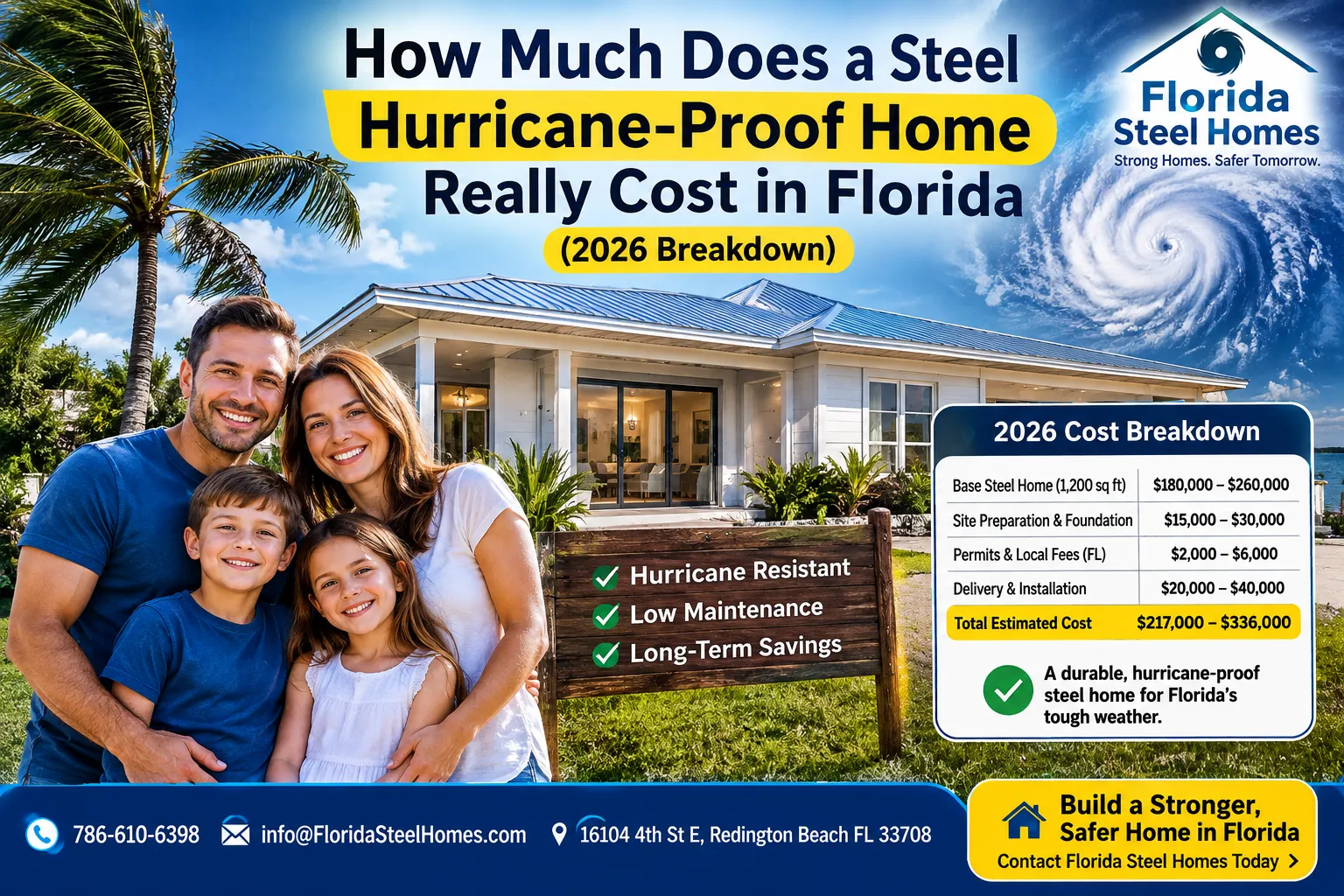
Fair question. Here’s the honest, numbers-first answer for 2026 — what steel hurricane-proof construction actually costs per square foot, where the money goes, how it compares to wood and concrete, and what smaller “hurricane-proof tiny home” builds are running right now.
Quick Answer: 2026 Steel Hurricane-Proof Home Costs in Florida
| Build Tier | Cost per Sq Ft | Typical Total (2,000 sq ft) |
|---|---|---|
| Code-minimum steel frame | $150 – $200 | $300,000 – $400,000 |
| Mid-range hurricane-rated steel home | $200 – $350 | $400,000 – $700,000 |
| High-end, Category 5-rated steel home | $350 – $500+ | $700,000 – $1,000,000+ |
| Hurricane-proof tiny home (300–800 sq ft) | $250 – $450 | $90,000 – $280,000 |
Steel-frame hurricane-resistant construction generally runs 10–20% more upfront than a standard wood-frame building. That premium narrows — and often reverses — once you factor in insurance discounts, fewer repairs after storms, and a structure that simply lasts longer in Florida’s climate.
Turnkey, factory-built steel homes from established Florida builders currently list from roughly $388,500 to $650,000+, depending on model size and finish level, with delivery timelines of about 10–12 months from contract to keys.
Why Steel Costs More Than Wood — And Where the Money Actually Goes
A lot of buyers assume the price gap is just “steel is expensive”. It’s really a handful of specific line items stacking up:
Impact-resistant windows and doors. Budget roughly $400–$800 per window opening and $1,200–$3,000 per hurricane-rated door. A typical home has a dozen or more openings, so this alone can add $10,000–$25,000.
Roofing systems. Metal roofing rated for hurricane uplift runs about $8–$15 per square foot installed, versus $3–$7 for standard asphalt shingles. The roof is the single most failure-prone part of a home in high wind, so this isn’t an area to cut.
Continuous load-path engineering. Hurricane-rated homes need an unbroken structural connection from the roof straps down through the walls to the foundation anchors, engineered to resist uplift forces that can exceed 200 lbs per square foot. This drives up both engineering and labour costs.
Specialised labour. Certified installers for hurricane-rated systems typically add 15–25% to labor costs versus standard framing crews, mostly because the work takes longer to do correctly and gets inspected more closely.
Put together, moving a typical 2,000 sq ft Florida home from “code minimum” to “genuinely built tough” adds roughly $25,000–$50,000 to the total project — not the home’s full price, just the delta for going beyond the bare code requirement.
Steel vs. Concrete Block vs. ICF: 2026 Cost Comparison
| Construction Type | Cost per Sq Ft (2026) | Best For |
|---|---|---|
| Steel-frame | $150 – $250 | Coastal builds, long-term low maintenance, faster prefab timelines |
| ICF (insulated concrete form) | $160 – $270 | Maximum thermal + wind performance, higher upfront cost |
| Reinforced concrete block | $140 – $220 | Traditional Florida builders, widely available labour |
Steel tends to win on long-term value in Florida specifically because it doesn’t rot, warp, or attract termites the way wood does, and it holds up better against the state’s humidity than untreated framing over a 20–30 year horizon.
If you want to see how steel stacks up for your exact lot and square footage, Florida Steel Homes walks through real model pricing over a quick call — (786) 610-6398 or info@FloridaSteelHomes.com — and it’s a genuinely useful 15 minutes even if you’re still just comparing options.
Hurricane-Proof Tiny Homes in Florida: 2026 Pricing
Not everyone needs 2,000+ square feet, and tiny hurricane-proof homes have become a real category in Florida — for ADUs, guest units, rental income properties, and downsized retirement builds.
- Size range: roughly 300–800 sq ft (some go as small as 200 sq ft)
- Cost per sq ft: $250–$450, higher than large homes because fixed costs (foundation, utility hookups, impact windows, permitting) don’t shrink proportionally with size
- Typical total project cost: $90,000–$280,000 depending on finish level and whether it’s on a permanent foundation
- Build time: often 3–6 months for a factory-built steel tiny home, since there’s simply less to assemble on-site
The trade-off with tiny hurricane-proof builds is that you still need full hurricane-rated glazing, roofing, and anchoring — those costs don’t scale down much — so the per-square-foot number looks higher even though the total check is smaller. For a lot of buyers, that’s still the right math: lower total cash outlay, lower insurance premium, and a fully code-compliant, storm-rated structure.
What Actually Drives Your Final Number
A few things move the price more than people expect:
- Flood zone designation. A VE flood zone lot means elevated foundation requirements, which adds real cost before framing even starts. Confirm flood zone status before you fall in love with a lot.
- County and HVHZ requirements. Miami-Dade and Broward’s High-Velocity Hurricane Zone code is stricter (and pricier to meet) than inland counties.
- Roof shape. Hip roofs cost slightly more than gable roofs but can qualify for an additional 5–15% insurance discount — often worth it over time.
- How far past code you go. Code-minimum wind resistance and a genuinely Category 5-rated build are two very different price points, even on paper-identical square footage.
The Insurance Math Nobody Talks About Enough
This is the part that changes the decision for a lot of Florida buyers. Wind mitigation improvements — hurricane straps, impact windows, reinforced roof-to-wall connections — can cut annual homeowners insurance premiums by 10–40%, and a fully certified hurricane-proof steel build can see savings toward the higher end of that range, sometimes reported around 30–50% combined.
Some coastal Florida homeowners on standard wood-frame homes are currently paying $8,000–$15,000 a year in premiums. Cutting that by even $4,000 a year works out to $40,000+ over a 10-year mortgage — money that partially or fully offsets the upfront construction premium for steel. Ask your insurer for a post-construction wind mitigation inspection; that report is what actually triggers the discount.
Realistic 2026 Budget Ranges by Home Size
| Home Size | Basic Steel Build | Mid-Range | High-End / Cat 5 |
|---|---|---|---|
| 1,400 sq ft (2BR) | $210,000 – $280,000 | $280,000 – $490,000 | $490,000 – $700,000 |
| 2,000 sq ft (3BR) | $300,000 – $400,000 | $400,000 – $700,000 | $700,000 – $1,000,000 |
| 2,500 sq ft (4BR) | $375,000 – $500,000 | $500,000 – $875,000 | $875,000 – $1,250,000+ |
For reference, current turnkey steel model pricing from Florida-based builders runs roughly $388,500 for a compact model up to $647,500+ for a 4-bedroom, 2,500 sq ft home — useful anchor points if you’re building a budget from scratch.
Frequently Asked Questions
How much does a hurricane-proof steel home cost per square foot in Florida in 2026? Most steel-frame hurricane-resistant homes run $150–$250 per square foot at the code-compliant end and $350–$500+ per square foot for high-end, Category 5-rated builds with premium finishes.
Is a steel hurricane-proof home actually cheaper long-term than a wood frame? The upfront cost is typically 10–20% higher, but lower insurance premiums, minimal storm-repair costs, and a longer building lifespan often close that gap within 10–15 years.
How long does it take to build a steel hurricane-proof home in Florida? Prefab and modular steel homes typically take 4–8 months to build, versus 8–14 months for traditional site-built concrete construction, though full turnkey delivery, including permitting, often runs closer to 10–12 months.
Are hurricane-proof tiny homes worth it in Florida? For ADUs, rental units, or downsizing, yes — the total cost is much lower even though the per-square-foot price is higher, and you still get full hurricane-rated protection and insurance benefits.
Do steel hurricane-proof homes actually lower insurance premiums? Yes. Florida insurers are required to offer documented wind-mitigation discounts, and steel homes with hurricane straps, impact windows, and rated roofing commonly qualify for 10–40% savings.
Florida Steel Homes builds steel-core, hurricane-rated homes across the Tampa Bay, Sarasota, and Pinellas County coastline, with transparent published pricing and turnkey delivery. If you want real numbers for your lot and square footage, reach the team at (786) 610-6398, info@FloridaSteelHomes.com, or in person at 16104 4th St E, Redington Beach, FL 33708.