If you live in Florida, hurricane season isn’t an abstract risk — it’s a yearly reality that runs from June 1 through November 30. Whether you’re a long-time resident of Tampa, Miami, Orlando, or Jacksonville, or you just moved to the Sunshine State, the question isn’t if a storm will threaten your home; it’s when. The good news: most hurricane damage is preventable with the right preparation, done well before a storm is named.
This guide breaks hurricane-proofing into a clear, actionable checklist you can work through room by room, system by system – no guesswork required.
Hurricane Proof Home: 7 Steps to Storm-Ready Safety
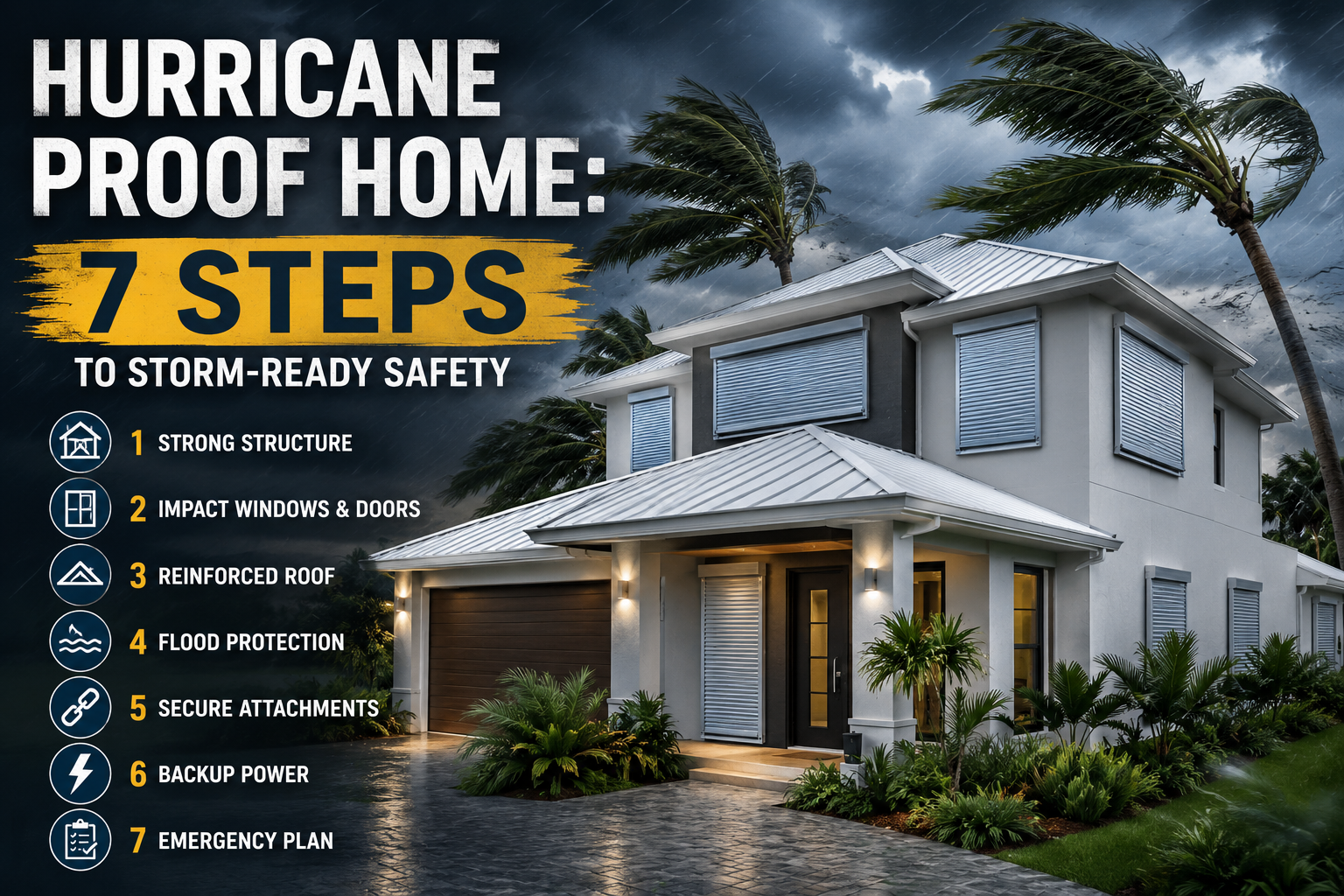
How to “Hurricane-Proof” a Home?
Hurricane-proofing means reducing your home’s vulnerability to high winds, flying debris, water intrusion, and flooding through a combination of structural upgrades, protective materials, and pre-storm preparation. No home is 100% hurricane-proof, but a well-prepared home can withstand Category 1–3 storms with minimal damage and recover faster after a major hit.
Step 1: Reinforce Your Roof
Your roof is your home’s first line of defence, and it’s also the number one source of hurricane damage claims in Florida.
- Check your roof’s age and condition. A licensed contractor should inspect roofs older than 15–20 years before hurricane season.
- Install a secondary water barrier (SWB). This self-adhering membrane under your shingles keeps water out even if shingles are torn off — and it can qualify you for insurance discounts under Florida’s My Safe Florida Home program.
- Upgrade to hurricane straps or clips. These metal connectors tie your roof structure to the walls, preventing wind uplift. This code is required for new construction but is often missing in older homes.
- Trim overhanging branches that could puncture the roof deck during high winds.
Step 2: Protect Windows and Doors
Windows and doors are the second-biggest failure point. Once wind gets inside your home through a broken window, internal pressure can lift the roof off entirely.
- Install impact-resistant windows and doors rated for Florida Building Code (FBC) wind zones. These use laminated glass that stays intact even when cracked.
- Add hurricane shutters as a lower-cost alternative — accordion, roll-down, or removable panel styles all work, as long as every window and glass door is covered.
- Reinforce garage doors. Garage doors are a common failure point because of their large surface area; install a wind-rated garage door or bracing kit.
- Don’t forget skylights and French doors — both need impact protection too.
Step 3: Secure the Exterior
- Anchor or store outdoor furniture, grills, and potted plants before a storm — these become projectiles in high wind.
- Check fence posts and pergolas for stability; reinforce or remove sections that could catch wind like a sail.
- Inspect and seal exterior wall penetrations (cable lines, vents, pipes) with storm-rated caulk to prevent water intrusion.
- Trim trees regularly and remove dead limbs — this is one of the most cost-effective steps homeowners skip.
Step 4: Manage Water and Flooding
Wind gets the headlines, but water causes the majority of hurricane losses in Florida.
- Clean gutters and downspouts before each season so rain drains away from the foundation.
- Install a sump pump with battery backup if you’re in a flood-prone or low-lying area.
- Elevate critical utilities (electrical panels, HVAC units, and water heaters) above expected flood levels if you’re in a FEMA flood zone.
- Check your flood insurance. Standard homeowners insurance does not cover flood damage — Florida homeowners need a separate NFIP or private flood policy, especially in coastal counties.
Step 5: Strengthen the Structure
- Verify wall-to-foundation connections, especially in homes built before Florida adopted stricter building codes in 2002 and again after Hurricane Andrew.
- Reinforce garage and carport structures, which are common collapse points.
- Consider a wind mitigation inspection. This is a state-recognised report that documents your home’s storm-resistant features and can significantly lower your homeowners insurance premium.
Step 6: Build Your Hurricane Preparedness Kit
Structural upgrades protect your house — this step protects your household.
- Water (1 gallon per person, per day, for at least 7 days)
- Non-perishable food for 7+ days
- Battery or hand-crank radio
- Flashlights, batteries, portable phone chargers
- First aid kit and essential medications
- Copies of insurance policies and ID in a waterproof bag
- Cash (ATMs and card readers may be down after a storm)
- Fuel for vehicles and generators was topped off in advance
Step 7: Know Your Evacuation Zone
Florida counties are divided into evacuation zones (A, B, C, etc.), and your zone determines whether — and when — you’re ordered to leave.
- Look up your zone through your county’s emergency management website.
- Have a plan for where you’ll go and how you’ll get there, including pet-friendly options if needed.
- Sign up for local emergency alerts (e.g., Alert Marion, Alert Florida, and county-specific systems).
The Complete Hurricane-Proofing Checklist
| Category | Task | Priority |
|---|---|---|
| Roof | Inspect roof age/condition | High |
| Roof | Install secondary water barrier | High |
| Roof | Confirm hurricane straps/clips | High |
| Windows/Doors | Impact windows or shutters on every opening | Critical |
| Windows/Doors | Reinforce the garage door | Critical |
| Exterior | Secure/store loose outdoor items | High |
| Exterior | Trim trees and dead limbs | Medium |
| Water | Clean gutters and downspouts | High |
| Water | Confirm flood insurance coverage | Critical |
| Structure | Wind mitigation inspection | Medium |
| Preparedness | Assemble a 7-day emergency kit | Critical |
| Planning | Know your evacuation zone | Critical |
Frequently Asked Questions
How much does it cost to hurricane-proof a home in Florida? Costs vary widely by scope. Hurricane shutters can start around $1,500–$3,000 for a whole-home system, while impact windows typically run $800–$2,000 per window installed. A full roof upgrade with a secondary water barrier and strapping can range from $8,000 to $20,000+, depending on home size, but the investment often pays back through lower insurance premiums.
Does hurricane-proofing lower my homeowners insurance in Florida? Yes. A wind mitigation inspection documenting features like impact windows, roof straps, and secondary water barriers can qualify you for significant discounts — sometimes 20% or more — on Florida homeowners insurance premiums.
What’s the difference between hurricane shutters and impact windows? Impact windows are permanently installed laminated glass that stays protective year-round with no setup needed before a storm. Hurricane shutters are lower-cost but must be manually installed before every storm and removed afterward.
Is it worth hurricane-proofing an older Florida home? Yes, especially homes built before 2002, when Florida significantly strengthened its building code after Hurricane Andrew. Older homes often lack roof straps, impact glass, and modern wall connections — retrofitting these is one of the highest-impact investments a Florida homeowner can make.
How far in advance should I hurricane-proof my home? Ideally, before hurricane season begins on June 1. Roofing contractors, window installers, and shutter companies get booked solid once a storm is forecast, so structural work should be scheduled in spring, not after a watch is issued.
Final Thought
Hurricane-proofing isn’t a single project — it’s a layered system of roof, windows, structure, water management, and preparedness that works together. Florida homeowners who tackle this checklist a little at a time each year, rather than scrambling the week before a storm, consistently come out the other side with less damage, faster insurance claims, and far less stress.