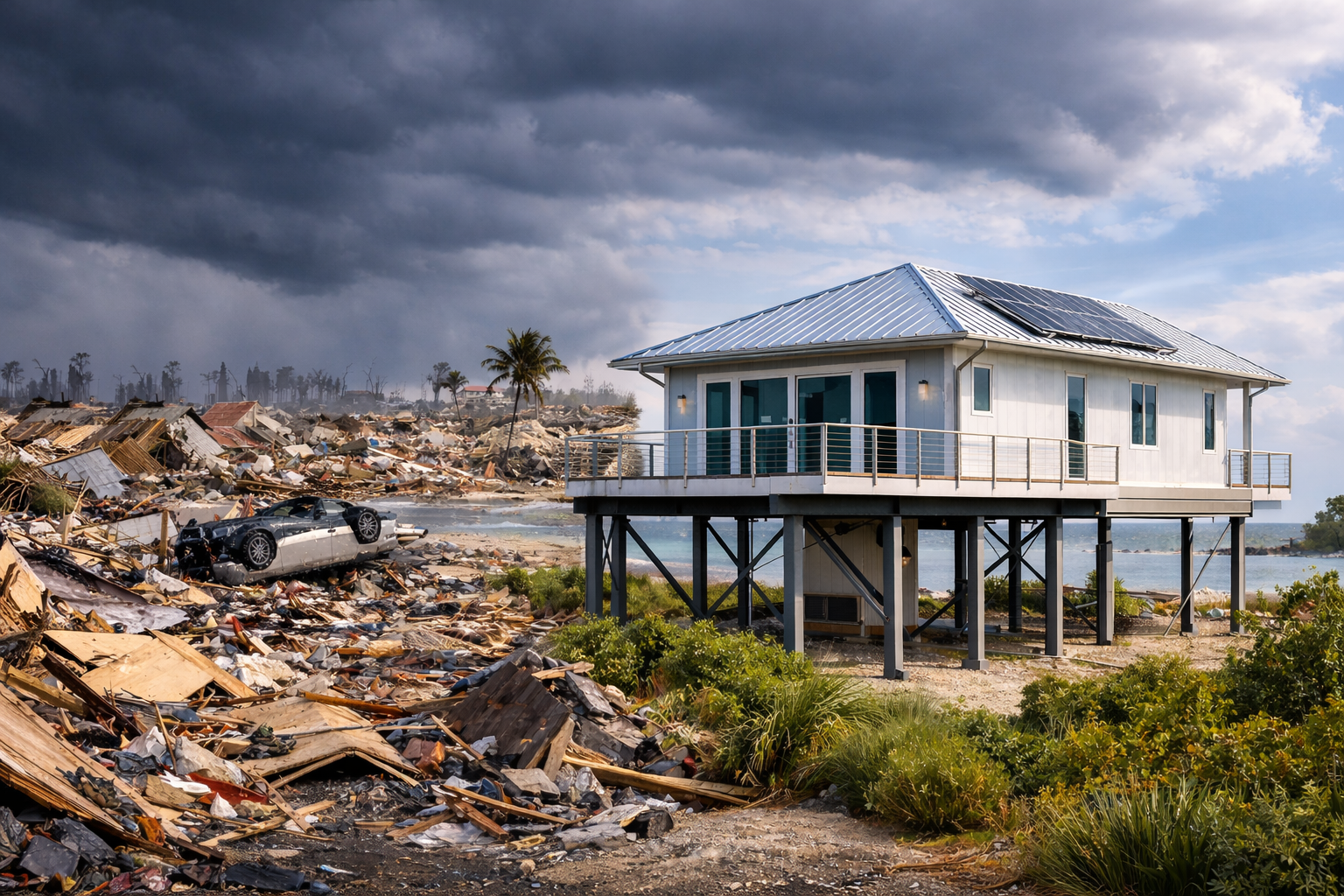
The wind didn’t just howl—it screamed like something alive, tearing roofs apart and flipping cars like toys. Entire neighbourhoods in Florida were flattened within hours, leaving behind nothing but debris and silence. But in the middle of that chaos, a few homes stood untouched—quiet, intact, and almost unbelievable to look at.
Those homes weren’t lucky. They were built differently. And once you understand what made them survive, it completely changes how you think about buying a home in Florida.
These Florida Homes Faced Category 5 Hurricanes & Survived
Why Some Homes Collapse—and Others Don’t
Most traditional homes in Florida still rely on wood framing or basic concrete block construction. On paper, they meet building codes, but real hurricanes don’t care about minimum standards. When wind speeds cross 150 mph, weak points start showing fast—roofs lift, walls crack, and pressure builds inside until the structure gives up.
The problem isn’t just materials—it’s how everything connects. A home is only as strong as its weakest joint. If the roof isn’t anchored properly or the walls can’t distribute wind pressure evenly, failure happens quickly. That’s why entire streets can collapse while one house right next to them remains standing.
The homes that survived Category 5 storms were designed as complete systems, not just assembled parts. Every connection—from foundation to roof—was engineered to work together under extreme stress.
The Hidden Engineering Behind Survivors
When you look closely at homes that survived Category 5 hurricanes, one pattern shows up again and again: steel framing. Unlike wood, steel doesn’t warp, crack, or snap under pressure. It flexes slightly and redistributes force, which is exactly what you need when winds hit 180+ mph.
These homes are also built with continuous load paths, meaning the roof, walls, and foundation are all tied together. So instead of parts failing individually, the structure behaves like one solid unit. That single difference is often what separates destruction from zero damage.
Elevation is another factor most buyers underestimate. Floodwater destroys more homes than wind does. Homes built above base flood levels stay dry even when entire neighborhoods are underwater. That’s not just protection—it’s survival.
Why Buyers Are Excited About These Homes
Something has shifted in how buyers think. It’s no longer just about square footage or kitchen finishes. After seeing what hurricanes can do, people are asking a different question: “Will this home protect my family when it matters most?”
That emotional shift is powerful. Buyers aren’t just investing in property anymore—they’re investing in certainty. The idea of sleeping through a Category 5 storm without fear is something people are willing to pay for.
There’s also a financial angle that’s hard to ignore. Homes built to survive extreme weather often qualify for lower insurance premiums, saving thousands every year. Combine that with energy-efficient designs and solar integration, and suddenly the “stronger home” isn’t just safer—it’s cheaper to live in long-term.
Real Comparison: Traditional vs Hurricane-Proof Homes
| Feature | Traditional Florida Home | Hurricane-Resistant Steel Home |
|---|---|---|
| Wind Resistance | 120–140 mph | 180–200+ mph |
| Structural Material | Wood / Concrete Block | Steel Frame |
| Flood Protection | Limited | Elevated Design Options |
| Maintenance | High (rot, termites) | Low (no rot, no pests) |
| Insurance Costs | Higher | Lower (storm-rated discounts) |
| Lifespan | 30–50 years | 100–150+ years |
This isn’t a small upgrade—it’s a completely different category of home.
The Reality Most People Don’t Talk About
Here’s the uncomfortable truth: building codes are designed to reduce risk, not eliminate it. A code-compliant home can still fail in a major storm. That’s something many buyers don’t realize until it’s too late.
Even concrete block homes, which many assume are “safe,” can suffer catastrophic roof failure. Once the roof goes, everything else follows quickly. Water enters, pressure builds, and structural damage escalates within minutes.
The homes that survived didn’t just meet code—they exceeded it by a wide margin. That difference becomes obvious only after a storm hits.
What Makes a Home Truly “Hurricane-Proof”?
A truly storm-ready home isn’t about one feature—it’s about a combination of systems working together. When you break it down, a few key elements always show up:
1. Steel Frame Structure
Steel provides unmatched strength and consistency. It doesn’t weaken over time like wood, and it handles extreme stress without sudden failure.
2. Continuous Load Path
Every part of the home is tied together, so wind forces travel safely through the structure instead of breaking it apart.
3. Elevated Foundation
Keeping the home above flood levels prevents water damage, mould, and long-term structural issues.
4. Impact-Resistant Openings
Windows and doors are designed to withstand flying debris, which is one of the biggest causes of internal damage during storms.
5. Energy Independence
Solar panels with backup systems keep power running even when the grid fails, which is critical after major hurricanes.
Practical Tips Before You Buy in Florida
If you’re seriously considering buying a home in Florida, these are the things you should check before anything else. Not after. Not later. Before.
- Ask for the wind rating of the home—not just “hurricane resistant,” but actual mph numbers
- Check elevation certificates to understand flood risk clearly
- Look at how the roof is connected to the structure (this is critical)
- Ask about insurance discounts tied to construction type
- Don’t assume newer homes are safer—verify the build method
These small questions can save you from massive regret later.
A New Standard Is Emerging
The market is quietly changing. Builders who focus on durability, not just design, are gaining attention fast. Buyers are starting to recognize that resilience isn’t a luxury—it’s a necessity in Florida.
Homes that can survive Category 5 hurricanes are no longer rare experiments. They’re becoming the benchmark for what a “smart home purchase” actually means in high-risk areas.
And once you see the difference, it’s hard to go back to thinking a regular home is enough.
Final Thought: Safety Is No Longer Optional
If you’ve ever seen what a real hurricane can do, you already know this isn’t about overthinking—it’s about being prepared. The gap between a standard home and a storm-ready home is the gap between rebuilding your life and continuing it without interruption.
The good news is you now have options that didn’t exist before.