Yes, a home can survive a Category 5 hurricane—but only if it’s designed for it from the ground up. Most traditional homes fail at critical points like roofs and foundations. The real solution lies in smarter materials, elevation, and engineering—not luck.
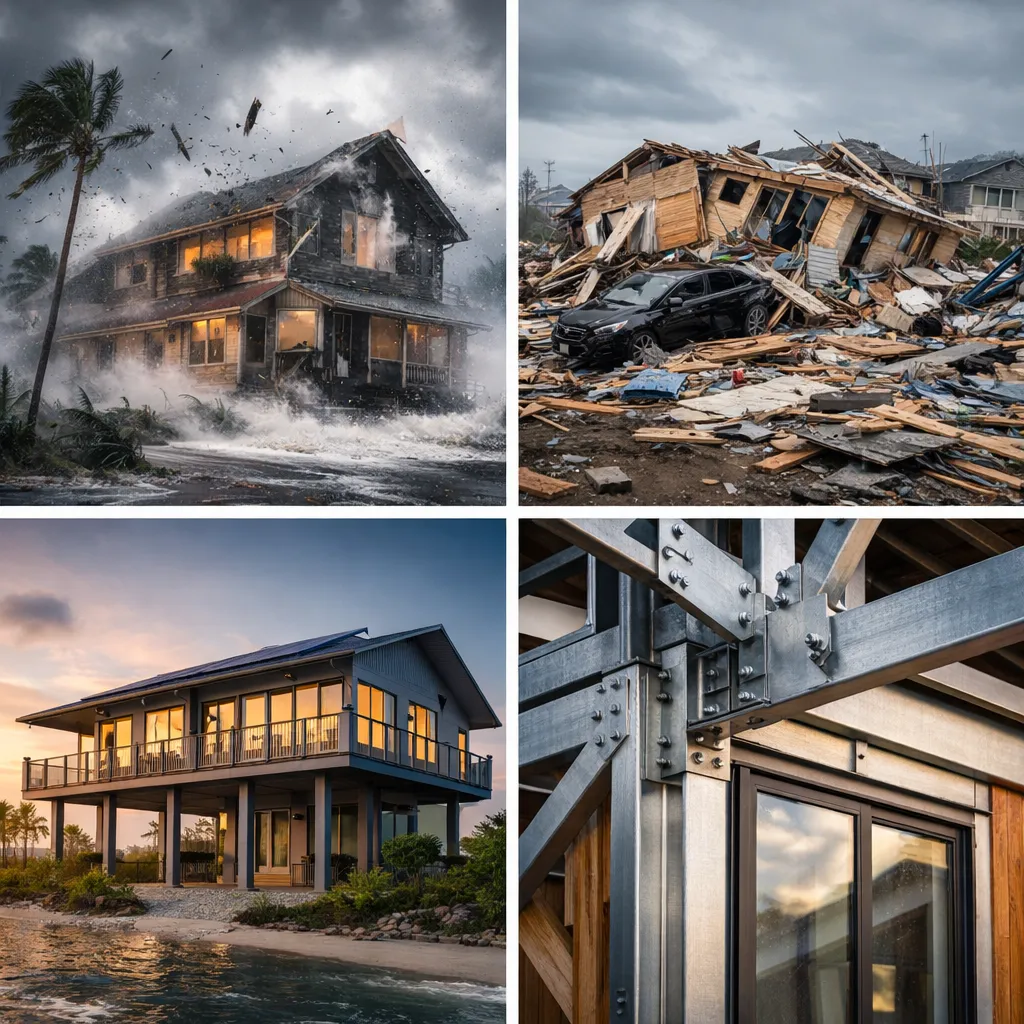
Can a Home Really Survive a Category 5 Hurricane? The Truth Most Builders Won’t Tell You
The wind doesn’t sound like wind anymore. It screams, howls, and shakes the walls like something alive is trying to tear its way in. You’re standing inside your home, hoping it holds, while outside, roofs are flying, windows are shattering, and entire houses are folding like cardboard. That’s what a Category 5 hurricane actually feels like, and once you’ve seen it up close, you stop asking if damage will happen—you start asking what survives.
The idea that a home can survive something this powerful sounds almost unbelievable. But here’s the uncomfortable truth: most homes in Florida are not built to survive a Category 5 storm. They’re built to meet minimum code, not maximum reality. And that gap is exactly where disasters happen.
What Actually Happens to Homes in a Category 5 Hurricane
When wind speeds cross 157 mph and push toward 180+ mph, the rules change completely. This isn’t just about strong winds anymore—it’s about pressure, flying debris, and structural failure happening all at once. A single weak point can trigger a chain reaction that destroys the entire home.
The Real Breaking Points
Most homes don’t fail all at once—they fail in stages. The roof starts lifting, windows break under debris impact, and once wind enters the structure, internal pressure builds fast. That pressure can literally push walls outward, collapsing the home from the inside.
Flooding adds another layer of destruction that people often underestimate. Even if the structure survives the wind, storm surge can ruin everything inside, weaken the foundation, and leave long-term damage that isn’t always visible right away.
Why “Hurricane Resistant” Isn’t Enough
A lot of homes are labeled as hurricane-resistant, but that doesn’t mean they’re hurricane-proof. Resistance just means the home can handle some level of stress—not the worst-case scenario. In a Category 5 storm, “resistant” often translates to partial survival at best.
This is where many buyers get misled. Marketing terms sound reassuring, but unless a home is engineered specifically for extreme conditions, it’s still vulnerable in ways that only become obvious during the storm.
Why Buyers Are Excited About Hurricane-Proof Homes
There’s a noticeable shift happening among Florida homebuyers right now. People are no longer just looking for beautiful kitchens or bigger living spaces—they’re asking one simple question: Will this home protect my family when it matters most? That emotional shift is driving real demand for stronger, smarter construction.
Buyers who have experienced hurricanes—or even watched the aftermath—are done taking chances. The idea of a home that can stand through 180+ mph winds isn’t just impressive; it’s deeply reassuring. It changes how you feel about storm season completely.
There’s also a financial side to this excitement. Homes built to survive extreme weather often come with lower insurance costs, fewer repairs, and long-term savings that traditional homes can’t match. It’s not just about safety anymore—it’s about smarter investment.
The Difference Between Homes That Survive and Homes That Don’t
Not all homes are created equal, especially when it comes to extreme weather. The difference between total loss and full survival often comes down to a few critical design choices that most people never think about during the buying process.
Comparison: Traditional vs Hurricane-Proof Homes
| Feature | Traditional Home | Hurricane-Proof Home |
|---|---|---|
| Frame Material | Wood or concrete block | Reinforced steel frame |
| Wind Resistance | 120–150 mph (approx) | 180+ mph engineered |
| Roof Attachment | Standard fastening | Reinforced continuous system |
| Elevation | Often ground-level | Elevated above flood levels |
| Maintenance | High (rot, termites) | Low (durable materials) |
| Insurance Costs | Higher | Lower (risk reduction) |
| Lifespan | 30–50 years | 100+ years |
This isn’t just a technical difference—it’s a survival difference. Homes that are designed as a complete system, where every part works together, are the ones that actually make it through storms intact.
So What Makes a Home Truly Hurricane-Proof?
A home that survives a Category 5 hurricane isn’t relying on one feature—it’s built with multiple layers of protection working together. Think of it less like a house and more like a system designed to handle extreme stress from every angle.
Strong Structural Frame
Steel framing plays a huge role because it doesn’t warp, crack, or weaken under pressure the way wood can. It provides a rigid skeleton that holds the home together even when external forces are pushing hard against it.
Continuous Load Path
This is something most people never hear about, but it’s critical. A continuous load path means the roof, walls, and foundation are all connected in a way that transfers force safely through the structure. Without it, parts of the home can fail independently.
Impact-Resistant Openings
Windows and doors are common failure points, especially when hit by debris traveling at high speeds. Impact-rated glass and reinforced doors prevent that initial breach that often leads to bigger structural issues.