Meta description: “Category 5 Certified” means a home component — a safe room, window, door, or garage door — has been tested and proven to withstand winds of 157+ mph and large wind-borne debris impacts. Here’s what the certification really covers, who issues it, and how to verify a product is genuinely rated, not just marketed that way.
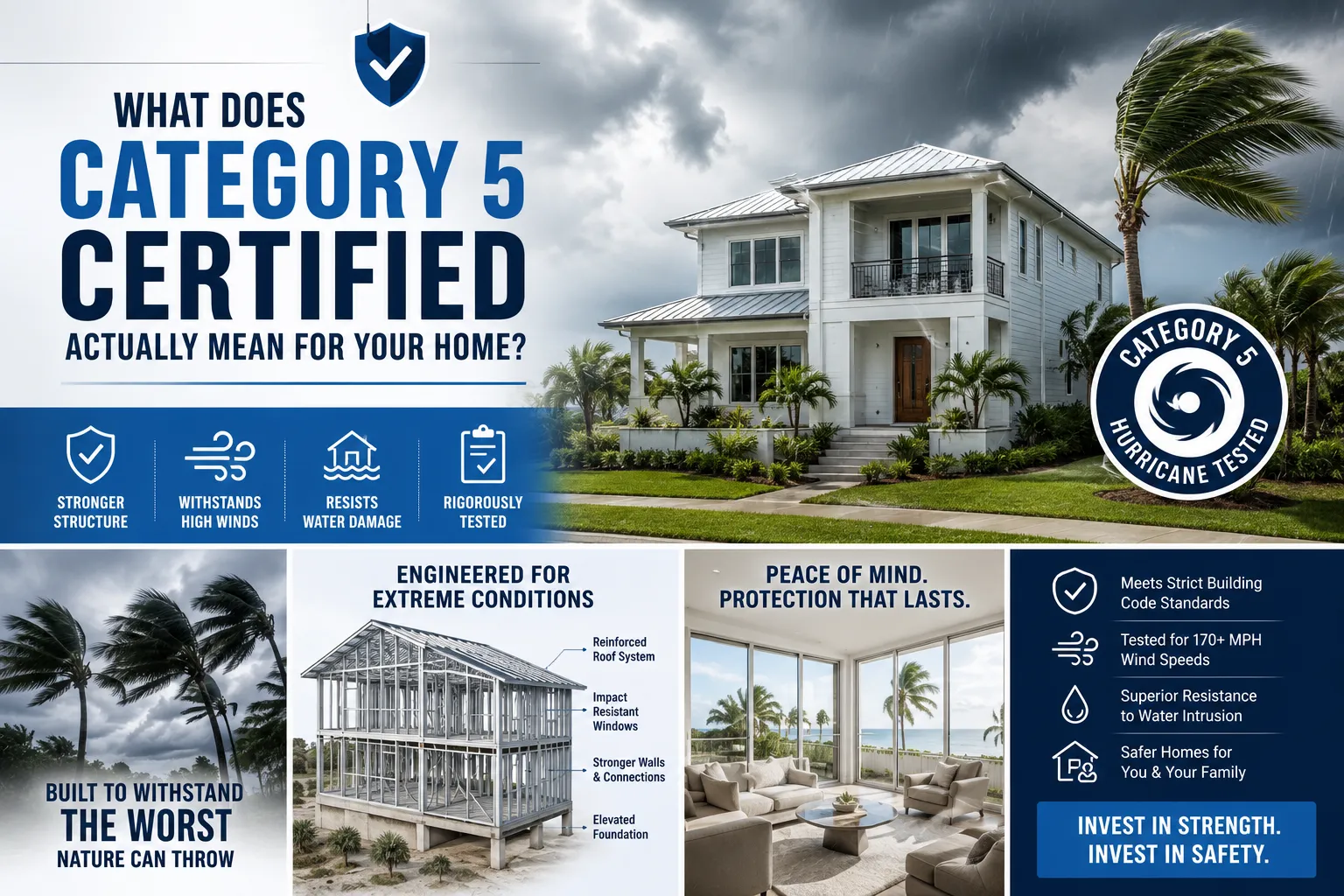
If you’ve shopped for storm shutters, impact windows, a garage door, or a home safe room in a hurricane-prone area, you’ve probably seen the phrase “Category 5 Certified” stamped on a brochure or website. It sounds reassuring. But the term gets used loosely in marketing, and not every product that claims it has actually earned it.
Here’s what the certification really means, who actually issues it, and how to tell a genuinely tested product from a marketing claim.
The Short Answer
“Category 5 Certified” means a specific product or structure—not your entire house—has been independently tested to withstand the following:
- Sustained wind speeds of 157 mph or higher, the threshold for a Category 5 hurricane on the Saffir-Simpson scale
- Large missile impact testing, typically a 9-pound piece of lumber fired at speeds up to 34 mph, simulating wind-borne debris
- Cyclic pressure testing, which simulates the repeated pounding a structure takes over hours of sustained hurricane-force wind
A product earns this rating by passing testing under a recognized standard — not by a manufacturer’s own claim. That distinction matters more than anything else on this list.
Category 5 Certified Doesn’t Mean “Your Whole House Is Hurricane Proof.”
This is the most common misunderstanding. Certification almost always applies to a specific component: a window, a door, a garage door, a shutter system, or a purpose-built safe room. It does not mean your roof, siding, or overall structure has been tested or rated the same way — even if one part of your home carries the label.
A house can have Category 5-rated impact windows and still lose its roof in a Category 3 storm if the roof itself wasn’t built or retrofitted to a comparable standard. When you see the certification, always ask the following: certified for what, specifically?
Who Actually Issues This Certification
Legitimate Category 5 ratings trace back to one of a handful of recognized bodies and standards. If a product’s certification doesn’t reference one of these, treat the claim skeptically.
ICC 500 (ICC/NSSA Standard for the Design and Construction of Storm Shelters). This is the primary standard for storm shelters and safe rooms. It’s published jointly by the International Code Council and the National Storm Shelter Association, and it specifies wind speed and debris impact criteria based on location-specific risk.
FEMA P-361: FEMA’s guidance document for safe rooms, used alongside ICC 500. FEMA doesn’t “certify” products itself, but safe rooms built to FEMA P-361 specifications are designed to provide near-absolute protection in extreme wind events, including EF5 tornadoes and Category 5 hurricanes.
Miami-Dade County Product Approval (NOA): For windows, doors, and garage doors, Miami-Dade County’s Notice of Acceptance is one of the most rigorous impact-testing programs in the U.S., a legacy of Hurricane Andrew. Products with a Miami-Dade NOA have been through some of the toughest large-missile and pressure-cycling tests in the country.
ASTM E1996 and E1886: These are the underlying testing standards most impact-rated windows and doors are measured against, covering missile impact and cyclic pressure loading.
DASMA 108/115: The standards used for garage door wind load and impact testing are maintained by the Door and Access Systems Manufacturers Association.
How to Verify a Product Is Actually Certified
Marketing claims are easy to print; certification numbers are not. Before trusting a “Category 5 Certified” label:
- Ask for the certificate or approval number. A legitimately tested product will have a Miami-Dade NOA number, an ICC 500 compliance document, or a test report from an accredited lab (look for labs accredited by IAS or a similar body).
- Check the wind speed and debris size the test actually covered. Some products are rated for Category 5 wind speeds but only small-missile impact, which is a meaningfully lower bar than large-missile testing.
- Confirm the rating applies to your specific product configuration. Certification testing is done on specific sizes and installation methods. A larger window or a different mounting method than what was tested may not carry the same rating.
- Look up the approval directly. Miami-Dade County publishes an online product approval search. If a product claims an NOA number, you can verify it yourself in a few minutes.
Why This Matters Beyond Storm Season
Category 5-rated components typically also deliver better everyday performance: tighter seals reduce drafts and outside noise, impact-rated glass often improves UV and heat rejection, and many insurers offer premium discounts for verified wind mitigation features. In several Gulf Coast and Atlantic coastal states, insurers require documented, verifiable ratings — not marketing language — before applying any discount.
If protection is the goal, the certification is only useful if it’s real. A correctly documented, moderately priced product with a verifiable NOA number is a better investment than an expensive one with a certification claim that doesn’t trace back to an actual test.
Frequently Asked Questions
Is “Category 5 Certified” a legal or regulatory term? No single agency owns the phrase itself. It’s shorthand the industry uses to describe products tested to standards—like ICC 500 or Miami-Dade NOA—that correspond to Category 5 hurricane conditions. The certification that matters is the underlying standard, not the marketing phrase.
Do I need a Category 5-rated safe room if I don’t live in a hurricane zone? ICC 500-compliant safe rooms are also built to withstand EF5 tornado conditions, so many homeowners in Tornado Alley pursue the same certification even without hurricane exposure.
Does Category 5 certification cost significantly more than lower-rated products? Generally yes, since testing and materials (laminated glass, reinforced framing, thicker steel) cost more to produce. However, insurance discounts and damage avoidance often offset the difference over time, particularly in high-risk coastal counties.
Can I retrofit an existing home to Category 5 standards? Individual components — windows, doors, garage doors, or a dedicated safe room — can be retrofitted and certified. A whole-home retrofit to a single unified rating is far less common and typically cost-prohibitive for older construction.