Building hurricane resistant in Florida isn’t just about thick walls—it’s about smart systems working together: the right roof shape, impact-rated openings, and a foundation built for storm surge. Do it right, and your home can outlast Category 5 winds while your insurance premiums drop significantly.
The summer you watch your neighbor’s roof peel off like a tin can lid while yours stays perfectly intact — that’s the moment you realize this wasn’t luck. It was a decision made three years earlier, when you chose continuous roof-to-wall connectors and a hip roof over the cheapest gable design on the market. Hurricane-proofing isn’t a fantasy anymore in Florida. It’s an engineering checklist, and the families who’ve followed it are living proof that you can build a home that stands through the worst storms the Atlantic can throw at it. Here’s exactly how to do it.
How to Build a Hurricane Proof House in Florida — Build Smart
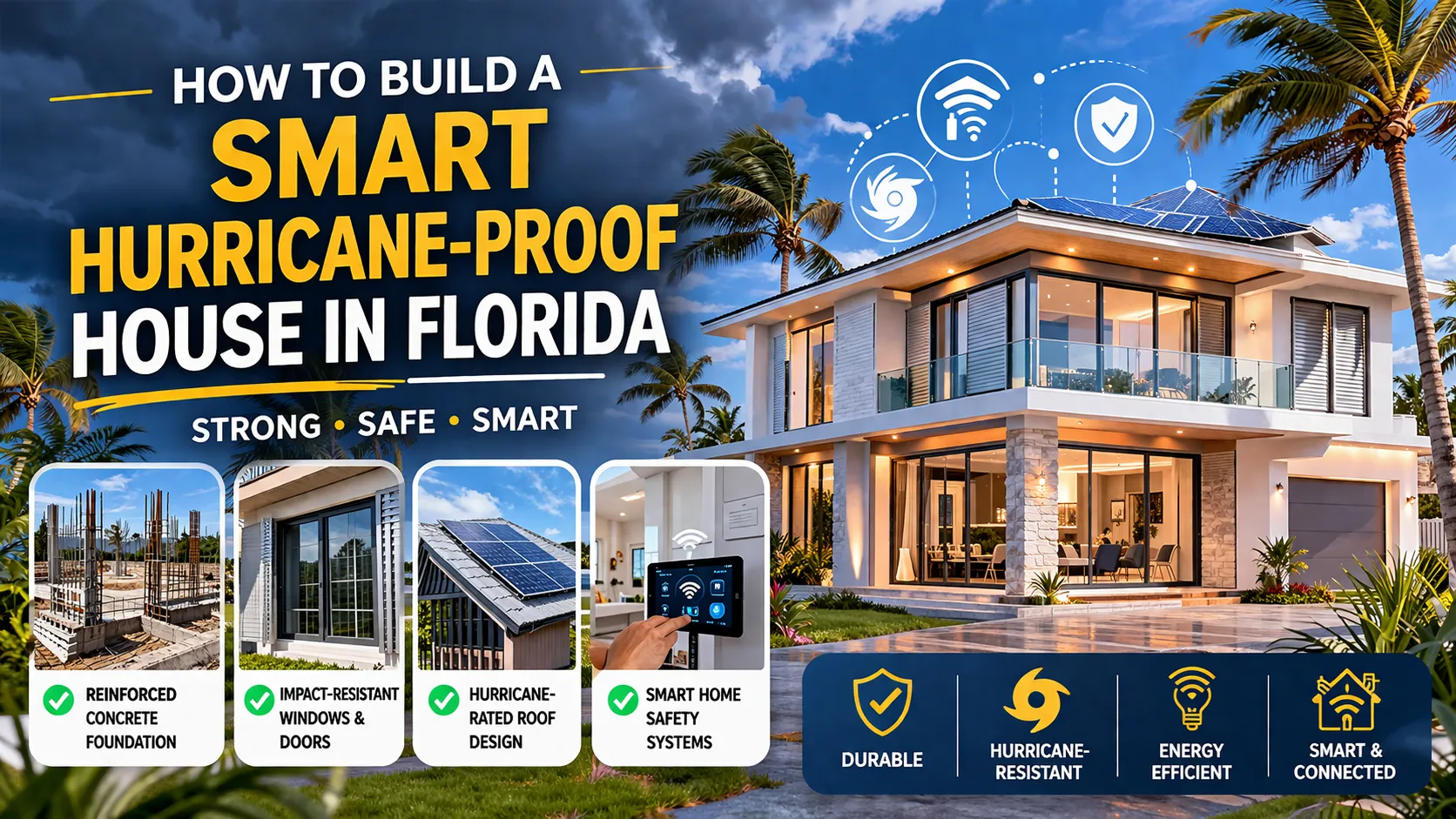
Why Buyers and Builders Are More Excited About This Than Ever
There’s a shift happening in Florida construction that’s genuinely exciting. Homeowners who once accepted storm damage as an annual Florida tax—the broken fence, the lost shingles, the flooded garage—are now building homes specifically designed to take a punch and stand tall. After hurricanes Ian and Idalia left entire neighborhoods in ruins while some newer, well-built homes barely lost a shutter, people started paying attention. The difference between those homes wasn’t luck or location alone. It was a construction methodology.
Beyond safety, there’s a compelling financial story here. Homes built to Miami-Dade hurricane standards—the toughest in the country—routinely see homeowner’s insurance discounts of 25 to 45 percent annually. Over a 20-year mortgage, that’s real money back in your pocket. Add in the fact that hurricane-resistant homes hold their value dramatically better after major storms, and you’re not just protecting your family — you’re making a smart long-term investment.
The Real Foundation: Starting Where Most People Skip
Choose the Right Site Before You Pour a Single Yard of Concrete
Before anything gets built, your lot is doing more work than you think. In Florida, FEMA flood zone designations are everything. Building in an AE or VE coastal zone without accounting for base flood elevation means your ground floor could be underwater before the storm even makes landfall. Work with a licensed surveyor to confirm your property’s base flood elevation, then build your finished floor at least one to two feet above that number. Every extra foot of elevation translates directly to lower flood insurance premiums — usually $500 to $1,200 less per year.
Soil conditions matter just as much. Sandy coastal soils have poor bearing capacity, so your foundation engineer needs to specify the right solution—often deep concrete pilings or reinforced stem walls—rather than a standard slab. This is where cutting corners costs you everything. A home on inadequate pilings doesn’t just flood—it can shift off its foundation entirely in storm surge.
Step-by-Step: How to Build a Hurricane-Proof House in Florida
Step 1 — Design Your Roof Like a Wind Engineer, Not an Architect
The single biggest decision in hurricane-resistant construction is your roof shape. A hip roof — four sloping sides meeting at a central ridge—handles high winds far better than a gable roof, which acts like a sail in a hurricane. Research from the Insurance Institute for Business & Home Safety consistently shows hip roofs sustain 40 percent less damage in storms compared to gable designs. If you love the look of gables, you can use them sparingly with proper bracing and reinforcement, but the primary roof form should be hip.
The roof pitch matters too. Pitches between 4:12 and 6:12 (moderate slope) offer the best aerodynamic performance. Very steep or very flat roofs both create uplift problems in high winds. Get a structural engineer to run uplift calculations specific to your wind zone — Florida is divided into wind zones from 110 mph to 180+ mph, and your roof system needs to be engineered for your exact location.
Step 2 — Lock Down the Roof-to-Wall Connection
This is where most older Florida homes fail catastrophically. The roof doesn’t blow off because the shingles are weak — it blows off because the trusses weren’t properly anchored to the wall framing. Modern best practice uses hurricane straps (also called H-clips or rafter ties) at every single truss-to-wall connection point. The gold standard is double-wrap connectors from companies like Simpson Strong-Tie, rated to resist several thousand pounds of uplift force per connection.
During construction, walk through the framing stage yourself and count the connectors. Inspectors catch a lot, but they don’t catch everything. If you see a truss sitting on a wall plate with a single nail and no strap, that’s the conversation you need to have with your contractor before the roof sheathing goes on. This costs almost nothing to do correctly during framing and costs everything to fix after a storm.
Step 3 — Choose Your Wall System Strategically
Concrete block construction (CBS—Concrete Block Structure) has been the Florida standard for decades, and for good reason. Properly reinforced 8-inch concrete block walls, filled with concrete grout and vertical rebar, can withstand wind pressures that would destroy wood-frame walls. For the strongest builds, consider insulated concrete forms (ICFs) — essentially foam blocks filled with reinforced concrete. ICF homes have tested well past 200 mph wind loads and offer superior insulation as a bonus.
If you’re using wood framing — which is still permitted and done well in many Florida builds — the connections matter even more. Structural sheathing nailed in a tight pattern (every 4 inches at panel edges versus the standard 6) dramatically increases wall racking resistance. Don’t let any framing contractor tell you nailing schedule doesn’t matter. It does, and there are decades of post-storm research to prove it.
Step 4 — Install Impact-Rated Windows and Doors (Every Single One)
Your home’s envelope is only as strong as its weakest opening. Once wind pressure breaches a window or door, it creates a pressure differential inside the structure that can blow the roof off from the inside out. Impact-rated windows and doors — laminated glass bonded to a shatter-resistant interlayer — must meet Florida Building Code Product Approval and carry a Miami-Dade NOA (Notice of Acceptance) if you’re in a High-Velocity Hurricane Zone.
Budget honestly here. Impact windows for a 2,000 sq ft home run $15,000 to $30,000 installed, depending on the product line. That feels steep until you realize hurricane shutters need to be deployed manually before every storm, and impact glass protects you year-round with zero action required. Many homeowners in South Florida have stopped buying hurricane shutters entirely once they’ve experienced the peace of mind that comes with permanent impact protection.
Step 5 — Engineer Your Garage Door
The garage door is statistically one of the most common failure points in hurricane-damaged homes. A standard residential garage door is a large, flexible panel — essentially a big sail — and when it fails, the sudden pressure change can take the entire roof section with it. The Florida Building Code requires garage doors to be wind-load rated for your specific zone, but “code minimum” and “hurricane-proof” aren’t always the same thing.
Specify a door rated for at least 130 to 155 mph (or higher if you’re in a coastal HVHZ zone), with horizontal reinforcing braces and a wind load sticker from the manufacturer. Braced double garage doors with a center post typically outperform single-slab wide doors in high winds. If you’re building in Monroe, Miami-Dade, or Broward counties, your inspector will require Miami-Dade product approval regardless, but even in Central Florida, upgrading to a storm-rated door is worth every dollar.
Area Spotlight: Where Hurricane-Resistant Building Is Already the Norm
Southwest Florida and the Tampa Bay Corridor
If you want to see hurricane-resistant construction done right at scale, look at the post-Ian rebuild happening across Lee and Charlotte counties. Builders here are now routinely specifying ICF walls, hip roofs, and impact glass as baseline—not upgrades—because buyers have seen firsthand what inadequate construction costs them. New communities near Cape Coral, Fort Myers Beach, and Punta Gorda are coming out of the ground with homes engineered for 160+ mph winds as standard practice.
The Tampa Bay area is another fascinating market. Tampa had been considered overdue for a direct major hurricane hit for decades, and that awareness has driven serious investment in resilient construction across Hillsborough, Pasco, and Pinellas counties. Builders like Maronda Homes and local custom builders are integrating continuous load path construction from foundation to roof as standard practice in new subdivisions — the kind of build quality that used to require an expensive custom contract.
Common Mistakes That Undermine Everything You Just Built
The most expensive mistake Florida homebuilders make is treating hurricane resistance as a series of isolated upgrades rather than a connected system. You can have the best roof straps money can buy and still lose your roof if the wall-to-foundation connection isn’t equally strong. Think of it as a chain: the weakest link determines how the whole structure performs under load.
Skipping the continuous load path inspection at each construction phase is the other major error. Once drywall goes up, it’s nearly impossible to verify that every hurricane strap was installed correctly, that every anchor bolt is in place, or that the garage door frame was properly reinforced. The time to verify this is during framing — schedule your own inspection with a licensed structural inspector, separate from the county inspection, if you want genuine peace of mind.
Finally, don’t underestimate landscaping as a safety issue. In major storms, it isn’t just wind pressure damaging homes — it’s wind-borne debris. Large, mature trees planted too close to the structure become projectiles. Florida-Friendly landscaping with properly selected, hurricane-resistant native species planted at safe setbacks can meaningfully reduce debris impact risk.
Your Next Step: Build It Right the First Time
If you’re planning to build in Florida, the time to make these decisions is before you finalize your floor plans — not after your contractor has already priced a gable roof and standard windows. Sit down with a structural engineer who specializes in Florida wind loads before you commit to any design. Ask specifically for a continuous load path analysis and Miami-Dade compliance review, even if you’re not building in HVHZ. The extra engineering cost — typically $1,500 to $3,500 — is the best money you’ll spend on this project.
Talk to your insurance carrier early, too. Many Florida insurers now offer inspection-based premium reductions through the Florida Uniform Mitigation Verification Inspection (WIND MIT) program. A home built to the standards in this guide should qualify for the deepest discount tier, which means your hurricane-proof home starts paying you back from day one. Build smart, build once, and build something that’s still standing when your grandchildren inherit it.