The best hurricane-resistant homes aren’t defined by price—they’re defined by materials, engineering, and wind ratings. Steel frame, ICF, and SIP construction consistently outperform traditional wood-frame builds when a real storm arrives.
Hurricane-Resistant Homes in Florida
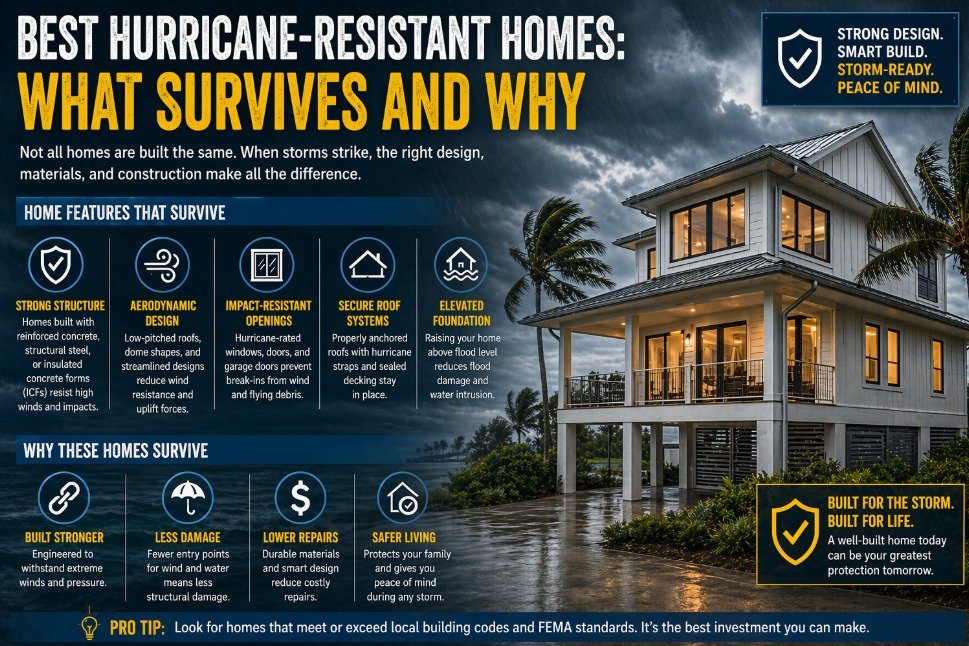
After Hurricane Michael carved through the Florida Panhandle in 2018, a structural engineer walked through the wreckage of Mexico Beach and documented something remarkable. While entire blocks had been reduced to concrete slabs, a handful of homes stood almost completely intact. No missing roofs. No blown-out walls. Neighbors stopped to stare at them like they were miracles. They weren’t miracles — they were just built to a different standard than everything around them.
That image has stayed with a lot of Florida buyers since. It reframes the entire conversation about what a home is supposed to be in this state. Not just a place to live, but a structure engineered to stay standing when the worst happens. The question isn’t whether Florida will get hit again. It’s whether your home will be one of the ones still standing when it does.
📞 Want a home engineered to survive from day one? Call Florida Steel Homes: 786-610-6398 Email: info@FloridaSteelHomes.com Visit: 16104 4th St E, Redington Beach, FL 33708
Why Buyers Are Rethinking What “Home” Means in Florida
Something shifted in the Florida housing market after Ian. Buyers who once prioritized kitchen finishes and pool decks started asking different questions — questions about wind ratings, foundation types, and what the walls were actually made of. Real estate agents in Sarasota, Fort Myers, and the Tampa Bay area reported a measurable uptick in buyers specifically requesting storm-resistant construction, many of them millennials and first-time buyers who had watched older relatives lose homes they’d spent decades paying off.
The financial pressure accelerated that shift. When Citizens Insurance raises rates and private carriers quietly exit the state, the monthly cost of owning a vulnerable home becomes very real, very fast. A wood-frame home in Pinellas County can carry homeowner’s insurance of $4,000 to $8,000 per year in 2026. A comparable steel-frame or concrete home in the same zip code—with proper wind mitigation documentation—can come in significantly lower. Over a 30-year mortgage, that gap funds a college education. Buyers are doing that math now in ways they simply weren’t five years ago.
What Makes a Home Truly Hurricane-Resistant
Before comparing home types, it helps to understand what hurricane resistance actually means structurally. A truly storm-resistant home addresses four failure points that cause most hurricane damage: roof uplift, wall-to-foundation connection, window and door breach, and water intrusion following structural failure. A home that solves all four performs in a fundamentally different category than one that solves only one or two.
Wind rating is the most useful single number to know. Homes built to Miami-Dade County standards — the toughest wind-resistance benchmark in the US — are certified to handle sustained winds of 175 to 185 mph. The Standard Florida Building Code requires resistance to 140 mph in most inland areas and up to 160 mph in high-velocity hurricane zones along the coast. The best hurricane-resistant homes meet or exceed Miami-Dade specs across all four failure points, not just the roof.
The Best Hurricane-Resistant Home Types: A Real Comparison
Steel Frame Modular Homes
Steel frame construction is the most straightforward path to genuine hurricane resistance in a prefab or modular format. Steel doesn’t rot, warp, or lose structural integrity when wet. It flexes under wind load rather than snapping, which is exactly the behavior you want when sustained winds are pushing against your walls for hours. Steel-frame modular homes built to Miami-Dade standards regularly achieve wind ratings of 160 to 185 mph and represent the most cost-accessible entry point into truly storm-resistant construction.
Insulated Concrete Form (ICF) Homes
ICF construction involves pouring reinforced concrete between two layers of insulating foam to create walls that are dense, continuous, and extraordinarily resistant to both wind and water. These homes feel different when you’re inside them—quieter, more solid, more permanent. They perform exceptionally well against wind-driven rain, which causes as much damage as wind itself in many Florida storms. ICF homes consistently earn the highest wind resistance ratings and are the preferred choice for buyers in the highest-risk coastal zones.
Structural Insulated Panel (SIP) Homes
SIP homes use factory-built panels — a rigid foam core bonded between two structural boards — to create walls and roof assemblies that are stronger and more consistent than conventional stick framing. Because panels are manufactured in controlled factory conditions rather than assembled on-site by hand, there are fewer weak points in the structure. SIP homes perform well in hurricane conditions when properly anchored and detailed, though they require careful site assembly to achieve their full rated performance.
Traditional Wood Frame (Upgraded)
A wood-frame home built to the current Florida Building Code with hurricane straps, impact windows, a reinforced garage door, and a secondary water barrier performs meaningfully better than older wood-frame construction. It is not in the same category as steel or concrete, but it is not helpless either. The keyword is “upgraded”—a 1980s wood-frame home with none of these features is a liability in a major storm, regardless of how well it’s maintained.
Best Hurricane-Resistant Homes: Side-by-Side Comparison
| Home Type | Wind Rating | Avg. Cost per Sq Ft | Insurance Advantage | Best For |
|---|---|---|---|---|
| Steel Frame Modular | 160–185 mph | $130–$180 | High — 20–40% savings | Coastal buyers, budget-conscious |
| ICF Concrete | 175–185 mph+ | $150–$220 | Highest — maximum savings | High-risk zones, long-term owners |
| SIP Panel | 160–180 mph | $140–$200 | High | Design flexibility seekers |
| Wood Frame (Upgraded) | 140–160 mph | $120–$170 | Moderate | Inland buyers, lower-risk areas |
| Standard Wood Frame | 110–130 mph | $100–$150 | Low | Not recommended for coastal FL |
How Location Changes Everything in Florida
Not every Florida zip code carries the same storm risk, and where you build or buy should directly influence how much hurricane resistance you prioritize. Coastal properties in Pinellas, Lee, Collier, and Miami-Dade counties face the highest combined risk of wind damage and storm surge. In these areas, ICF or steel-frame construction isn’t a premium upgrade — it’s the baseline decision that makes financial sense. Inland buyers in Orange, Polk, or Alachua counties face lower wind exposure but are not immune, particularly to tornadoes and tropical storm bands that regularly produce damaging gusts well away from the coast.
The Panhandle deserves its own mention. Mexico Beach, Panama City, and the communities hit by Michael in 2018 are now home to some of the most deliberately storm-resistant new construction in the entire state. Buyers who rebuilt after that storm made different choices the second time—and the results in subsequent seasons have been documented and striking.
Common Mistakes Buyers Make When Choosing a Hurricane-Resistant Home
The most costly mistake is selecting a home based on wind rating alone without verifying how that rating was achieved. A wall system can carry a high wind rating while the roof-to-wall connection, anchor bolts, or window specs fall short of the same standard. True hurricane resistance is whole-home — every component needs to be specified and verified, not just the most visible one.
Buyers also frequently underestimate the importance of foundation anchoring. A structurally excellent home that isn’t properly anchored to its foundation will slide or overturn under storm surge conditions regardless of how strong the walls are. In coastal Florida, foundation systems need to address both wind uplift and flood load simultaneously. Ask your builder specifically how the home connects to the foundation and what that connection is rated for. If they can’t answer precisely, keep looking.
What the Best Hurricane-Resistant Homes All Have in Common
Across construction types, the homes that consistently perform best in post-storm engineering assessments share a set of core characteristics. They have continuous load paths — meaning the force of wind transfers cleanly from roof to wall to foundation without interruption. They have impact-rated openings on every exterior window and door. Their roofs use secondary water barriers so that even if surface materials are damaged, the structure underneath stays dry. And they were built by contractors who understand Florida’s specific wind exposure categories and designed accordingly.
The best hurricane-resistant home isn’t necessarily the most expensive one on the block. It’s the one where every decision—from the foundation anchor to the window spec to the roof attachment detail—was made with the storm in mind from the very beginning.