The best hurricane-proof homes in Florida are built with steel or reinforced concrete framing, carry a Miami-Dade HVHZ (High-Velocity Hurricane Zone) product approval, use impact-rated windows and doors, and are constructed by a licensed Florida builder with documented wind-mitigation results. When comparing builders, ask for the specific wind rating, engineering documentation, and a completed wind mitigation inspection—not just the phrase “hurricane proof” on a brochure.
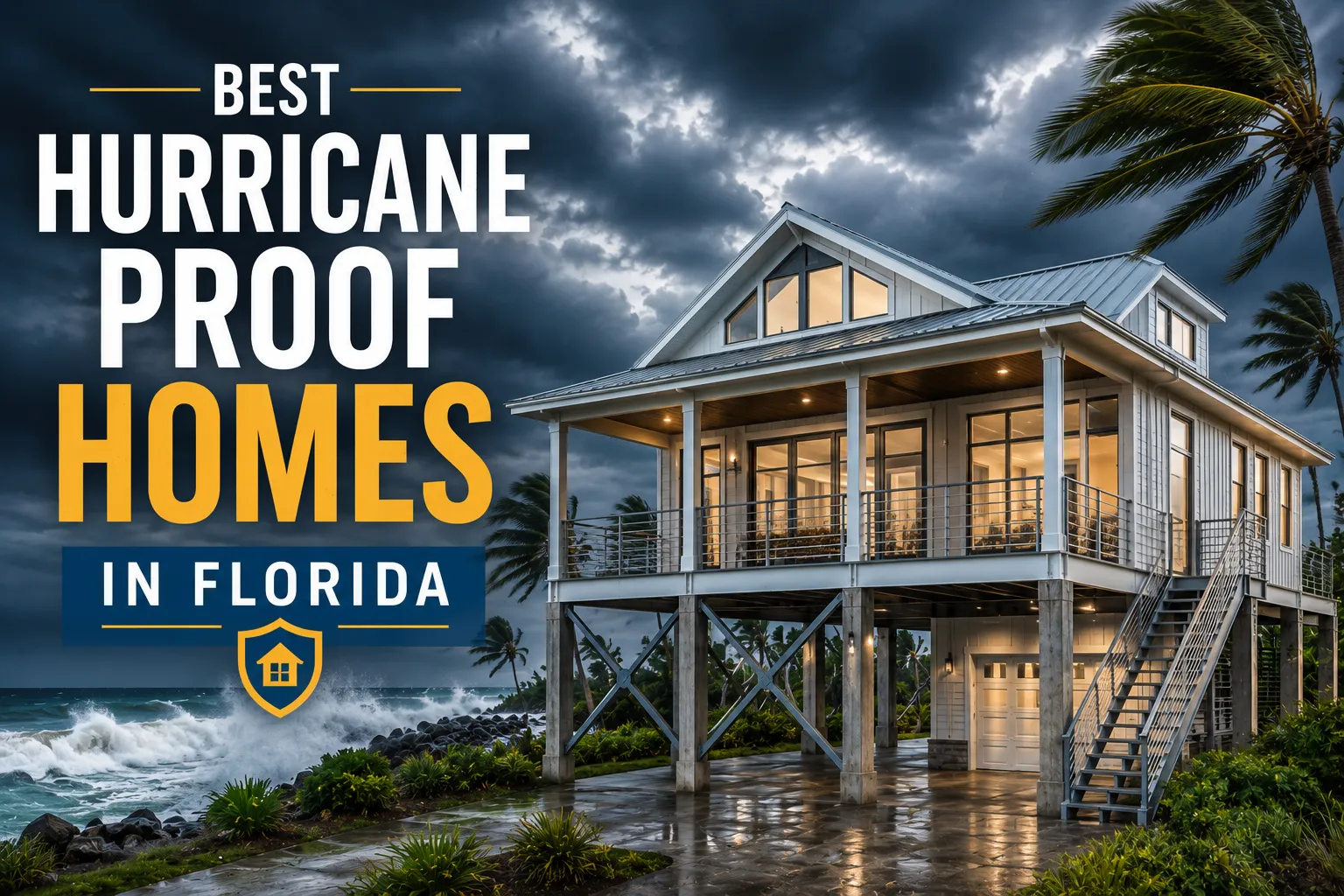
Best Hurricane-Proof Homes in Florida
Why “Hurricane Proof” Isn’t Enough—You Need Specifics
Almost every builder in Florida markets their homes as hurricane-resistant in some way. The problem is that the term isn’t regulated, so it can mean anything from “meets minimum Florida Building Code” to “engineered and independently tested for Category 5 winds.” If you’re serious about finding a genuinely storm-resilient home, you need to look past the marketing language and check the underlying specifications.
Here’s exactly what separates a truly hurricane-resistant home from one that just uses the term loosely.
1. Structural Framing Material
This is the single biggest factor in how a home performs during a hurricane.
| Framing Type | Wind Performance | Common Weaknesses |
|---|---|---|
| Steel frame | Excellent — high strength-to-weight ratio | Higher upfront cost |
| Insulated Concrete Forms (ICF) | Excellent | Slower to build |
| Reinforced concrete block | Very good | Heavier, higher foundation cost |
| Standard wood frame | Fair (code minimum only) | Vulnerable to rot, termites, and uplift |
If a builder can’t clearly tell you what the frame is made of and its engineered wind rating, that’s a red flag—not a marketing gap.
2. Miami-Dade HVHZ Product Approval
Miami-Dade County’s High-Velocity Hurricane Zone code is the strictest building standard in the country, requiring products (windows, doors, roofing, and connectors) to be independently tested against wind and impact loads far beyond standard Florida code. A home built with HVHZ-approved components — even outside Miami-Dade — gives you a reliable, third-party-verified performance benchmark rather than a builder’s own claim.
What to ask: “Do your windows, doors, and roofing carry Miami-Dade NOA (Notice of Acceptance) approval?”
3. Roof System and Hurricane Straps
The roof is where most hurricane damage starts. Look for:
- Metal or high-wind-rated roofing material
- Hurricane straps or clips at every roof-to-wall connection (not just some)
- A continuous load path — meaning the roof, walls, and foundation are all structurally tied together, not just individually strong
What to ask: “Can you show me the roof-to-wall connection detail in the engineering drawings?”
4. Impact-Rated Windows and Doors
Impact windows are tested against large missile impacts (typically a 9-lb 2×4 fired at high speed) followed by thousands of pressure cycles simulating sustained hurricane winds. This is different from simple tempered or laminated glass.
What to ask: “What’s the design pressure (DP) rating on the windows and doors, and do you have the NOA documentation?”
5. Foundation and Flood Elevation
In coastal and flood-prone zones, elevation matters as much as wind resistance. Look for:
- Elevated foundations (pilings or raised slabs) in FEMA flood zones
- Foundation anchoring that resists both uplift and storm surge
- Compliance with local FEMA Base Flood Elevation (BFE) requirements
6. Builder Licensing and Track Record
Florida requires state licensing for general contractors, but licensing alone doesn’t guarantee hurricane-specific expertise. Look for:
- A Florida-licensed general contractor (verify on the Florida DBPR license search)
- Completed projects you can see or verify, ideally in your specific coastal zone
- Engineering documentation provided upfront, not “available on request”
7. Wind Mitigation Inspection and Insurance Discount Potential
A completed home should be able to pass a wind mitigation inspection, which insurance companies use to calculate premium discounts. Ask the builder whether they provide this inspection as part of the build and what wind mitigation credits their homes typically qualify for.
Quick Checklist: What to Look For
- Steel, ICF, or reinforced concrete framing (not standard wood)
- Miami-Dade HVHZ / NOA-approved windows, doors, and roofing
- Hurricane straps at every roof-to-wall connection
- Design pressure (DP) rating documentation for openings
- Elevated foundation if in a flood zone
- Florida-licensed general contractor with a verifiable track record
- Wind mitigation inspection included or offered post-construction
- Written engineering documentation, not just marketing claims
Frequently Asked Questions
What is the best material for a hurricane-proof home in Florida? Steel framing and Insulated Concrete Forms (ICF) currently offer the best combination of wind resistance, longevity, and low maintenance for Florida’s climate, though reinforced concrete block remains a solid, widely used option.
Do hurricane-proof homes in Florida need to meet the Miami-Dade HVHZ code even outside Miami-Dade County? No, but choosing HVHZ-approved products anywhere in Florida gives you a wind and impact performance standard that’s independently tested and verified, rather than relying on standard code minimums.
How do I verify a builder’s hurricane-resistant construction claims? Ask for engineering documentation, Miami-Dade NOA numbers for windows/doors/roofing, and a completed wind mitigation inspection report. A credible builder will have these readily available, not “on request only.”
Does a hurricane-proof home automatically qualify for lower insurance premiums? Not automatically — the discount is based on a wind mitigation inspection completed after construction, which documents specific features like roof-to-wall connections and opening protection.
Finding the best hurricane-proof home in Florida isn’t about trusting a builder’s marketing language—it’s about verifying specific, checkable details: framing material, HVHZ-approved components, roof-to-wall connections, and a builder with real documentation to back up their claims. Homeowners who ask the right technical questions upfront end up with homes that perform better in a storm and cost less to insure and maintain over time.