No house is truly 100% “hurricane-proof”—but a properly engineered steel-framed home built to the current Florida Building Code can be hurricane-resistant enough to withstand sustained winds of 175+ mph, resist wind-borne debris, and keep a family safe through a major hurricane. The difference between “surviving” and “collapsing” almost always comes down to three things: the frame material, the building code the home was permitted under, and the quality of construction.
Are Houses in Florida Hurricane-Proof ?
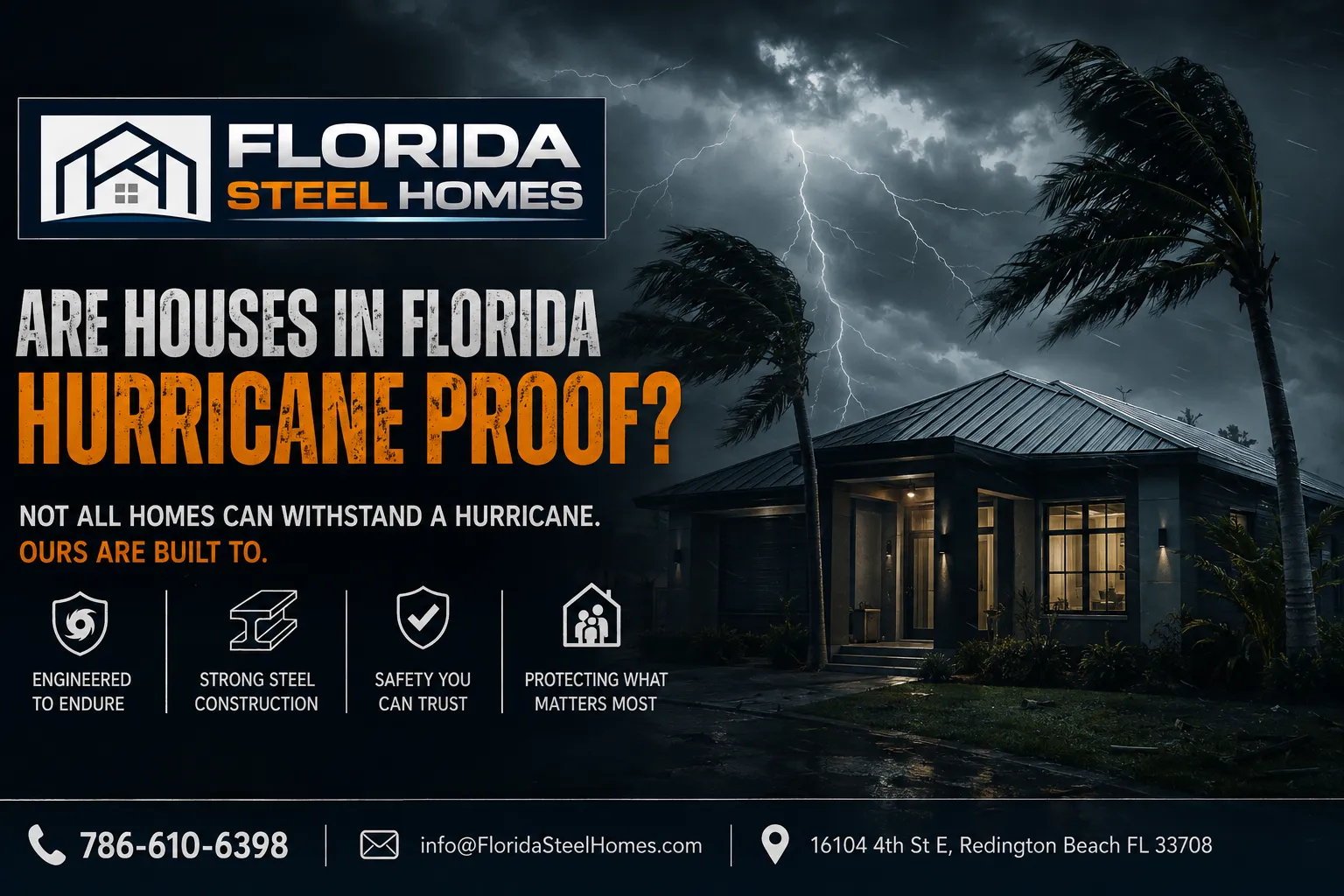
Below, we break down exactly what “hurricane-proof” means, what Florida law actually requires, and how steel-framed construction compares to traditional wood-framed homes.
Is Any House Truly Hurricane-Proof?
Short answer: no. “Hurricane-proof” is a marketing term, not an engineering one. Every structure has a wind-load limit, and a strong enough storm can exceed it. What actually exists — and what regulators, engineers, and reputable builders talk about — is hurricane-resistant or hurricane-rated construction: homes engineered to a specific, testable wind speed and impact standard.
The goal of hurricane-resistant construction isn’t to guarantee zero damage. It’s to:
- Keep the structural frame, roof, and walls intact during design-level wind events
- Prevent wind-borne debris from breaching the building envelope
- Stop the “domino effect” where one failure (a broken window, a lifted roof panel) leads to total structural failure
- Protect the people inside until the storm passes
A steel-framed home engineered to Florida’s High-Velocity Hurricane Zone (HVHZ) standards and a code-minimum wood-framed home built decades ago are not the same product, even if both are technically “up to code” for the year they were built. This is why the age and frame material of a home matter as much as its location.
What Florida’s Building Code Actually Requires
Florida has the strictest hurricane building code in the United States, and it has been tightened after nearly every major storm since Hurricane Andrew in 1992. Here’s where things stand heading into the rest of 2026:
- The current 8th Edition of the Florida Building Code, effective since December 31, 2023, adopted ASCE 7-22, the latest wind load standard from the American Society of Civil Engineers, bringing updated wind speed maps and more precise hurricane wind-resistance calculations.
- In the High-Velocity Hurricane Zone (Miami-Dade and Broward counties), design wind speeds reach 175 mph and 170 mph respectively, for standard residential (Risk Category II) structures, and every exterior building component in the HVHZ must carry a valid Miami-Dade County Notice of Acceptance and pass large-missile impact, cyclic pressure, and post-impact water resistance testing.
- Florida’s code requires engineered roof structures with hurricane straps, impact-rated windows or shutters, wind-rated cladding and doors, and a continuous load path from the roof all the way down to the foundation.
- Meeting these standards typically adds five to ten percent to a home’s construction budget, but it also qualifies homeowners for the strongest wind-mitigation discounts on insurance — and it’s what actually keeps people safe during a real storm.
- A 9th Edition of the code is expected to take effect December 31, 2026, and proposed provisions would push the 160 mph impact-resistant building envelope requirement beyond the traditional HVHZ counties to new construction within five miles of tidal water statewide.
What this means for homeowners: a home permitted in 2015 was built to a lower standard than one permitted today. If your home predates the 2002 post-Andrew code rewrite, it likely has none of these protections.
Wood Frame vs. Steel Frame: How They Perform in a Hurricane
This is the question we get asked most often at Florida Steel Homes, so let’s be direct about it.
| Factor | Traditional Wood Frame | Cold-Formed Steel Frame |
|---|---|---|
| Wind resistance | Can meet code with engineering, but wood connections are the common failure point in high winds | Steel-to-steel fastened connections create a stronger continuous load path from roof to foundation |
| Moisture & termite damage | Vulnerable over time in Florida’s humidity; can silently weaken structural integrity | Non-combustible, doesn’t rot, and isn’t a termite food source |
| Consistency | Wood strength varies by piece, moisture content, and installation | Engineered steel has consistent, certified strength specifications |
| Insurance impact | Standard wind-mitigation credits apply if code-built | Often qualifies for additional wind-mitigation and construction-type discounts |
| Long-term maintenance | Higher — susceptible to warping, rot, pests | Lower — steel framing doesn’t warp, shrink, or attract termites |
Both wood and steel framing can be built to meet Florida’s wind-load code. The difference is in the margin of safety, the consistency of the materials, and how the home performs over 20–30 years of Florida heat, humidity, and repeated storm cycles — not just its first inspection.
The 6 Features That Make a Florida Home Storm-Resistant
- Engineered steel or reinforced structural framing with a continuous, code-compliant load path from roof to foundation.
- Impact-rated windows and doors, tested for large-missile impact, or code-compliant hurricane shutters on every opening.
- Hurricane straps and clips connecting the roof structure to the walls, and the walls to the foundation.
- Wind-rated roofing systems, including secondary water barriers required under current code.
- Reinforced garage doors, historically one of the most common points of failure that leads to internal pressurization and roof loss.
- Elevated or flood-vented foundations in flood zones, addressing water intrusion alongside wind resistance.
A home is only as strong as its weakest connection point — which is why piecemeal upgrades (just adding shutters, for example) help, but don’t replace a structure engineered as a complete system.
How to Tell If Your Current Home Meets Modern Standards
If you’re not building new and want to know how your existing home stacks up:
- Check your permit history with your county building department to see which code edition your home was built under.
- Hire a licensed Florida structural engineer or home inspector to conduct a wind-mitigation inspection and compare your home against current standards.
- Review your hurricane protection systems — confirm your shutters or impact windows carry current Miami-Dade NOA or Florida Product Approval ratings, not just a manufacturer’s general claim.
- Ask about your roof-to-wall connections. Homes built before the mid-1990s frequently lack hurricane straps entirely.
Major renovations, additions, and structural repairs can also trigger a requirement to bring parts of an older home up to current code, so it’s worth understanding your home’s baseline before storm season, not during it.
Frequently Asked Questions
Are new houses in Florida required to be hurricane-proof? No. Florida law requires new homes to be built to specific, engineered wind-load and impact-resistance standards under the Florida Building Code — currently up to 175 mph design wind speeds in the High-Velocity Hurricane Zone. “Hurricane proof” isn’t a legal or engineering standard; “code-compliant hurricane-resistant construction” is.
What wind speed can a steel-framed home withstand? Properly engineered steel-framed homes built to current Florida code specifications in HVHZ counties are designed for sustained wind speeds up to 175–185 mph depending on risk category, plus wind-borne debris impact resistance.
Is a steel-frame home better than a wood-frame home in a hurricane? Both can meet Florida’s building code. Steel framing generally offers a stronger, more consistent structural connection system and doesn’t degrade from moisture, rot, or termites over time — factors that can quietly weaken a wood-framed home’s storm performance over decades.
Do older Florida homes meet current hurricane codes? Usually not. Homes built before 2002 (pre-Hurricane Andrew code rewrite) often lack hurricane straps, impact-rated openings, and modern load-path engineering. Even homes built under the 2017–2023 code editions will be outmatched by the 9th Edition standards taking effect in late 2026.
Will a hurricane-resistant home lower my insurance premium? Often, yes. Homes with verified wind mitigation features (impact windows, hurricane straps, wind-rated roofing) typically qualify for wind-mitigation insurance credits in Florida. Ask your insurer for a wind mitigation inspection after construction or upgrades.
What is the High-Velocity Hurricane Zone (HVHZ)? The HVHZ covers Miami-Dade and Broward counties and carries the strictest version of the Florida Building Code, including mandatory Miami-Dade Notice of Acceptance approval for exterior building products and design wind speeds of 175 mph (Miami-Dade) and 170 mph (Broward) for standard residential structures.
Get a Free Hurricane-Resistance Assessment
Florida Steel Homes builds and retrofits homes engineered for Florida’s real wind and storm conditions — not just the code minimum. If you’re building new, buying, or want to know how your current home would perform in the next major storm, our team can walk you through it.
📍 16104 4th St E, Redington Beach, FL 33708
This article is for general educational purposes and does not replace a structural engineering assessment. Wind-load and impact requirements vary by county — confirm current requirements with your local building department or a licensed Florida engineer before construction or renovation.