No home is “hurricane-proof” — including Boxabl’s. Boxabl’s structural insulated panels (SIPs) are code-tested and carry an ICC-ES evaluation report, but as of 2026, Florida is not one of Boxabl’s approved modular states, and the Casita hasn’t been through Florida’s High-Velocity Hurricane Zone (HVHZ) testing that Miami-Dade and Broward require. If you live on Florida’s coast, that gap matters more than any marketing claim.
Are Boxabl Homes Hurricane Proof? An Honest Comparison for Florida Buyers
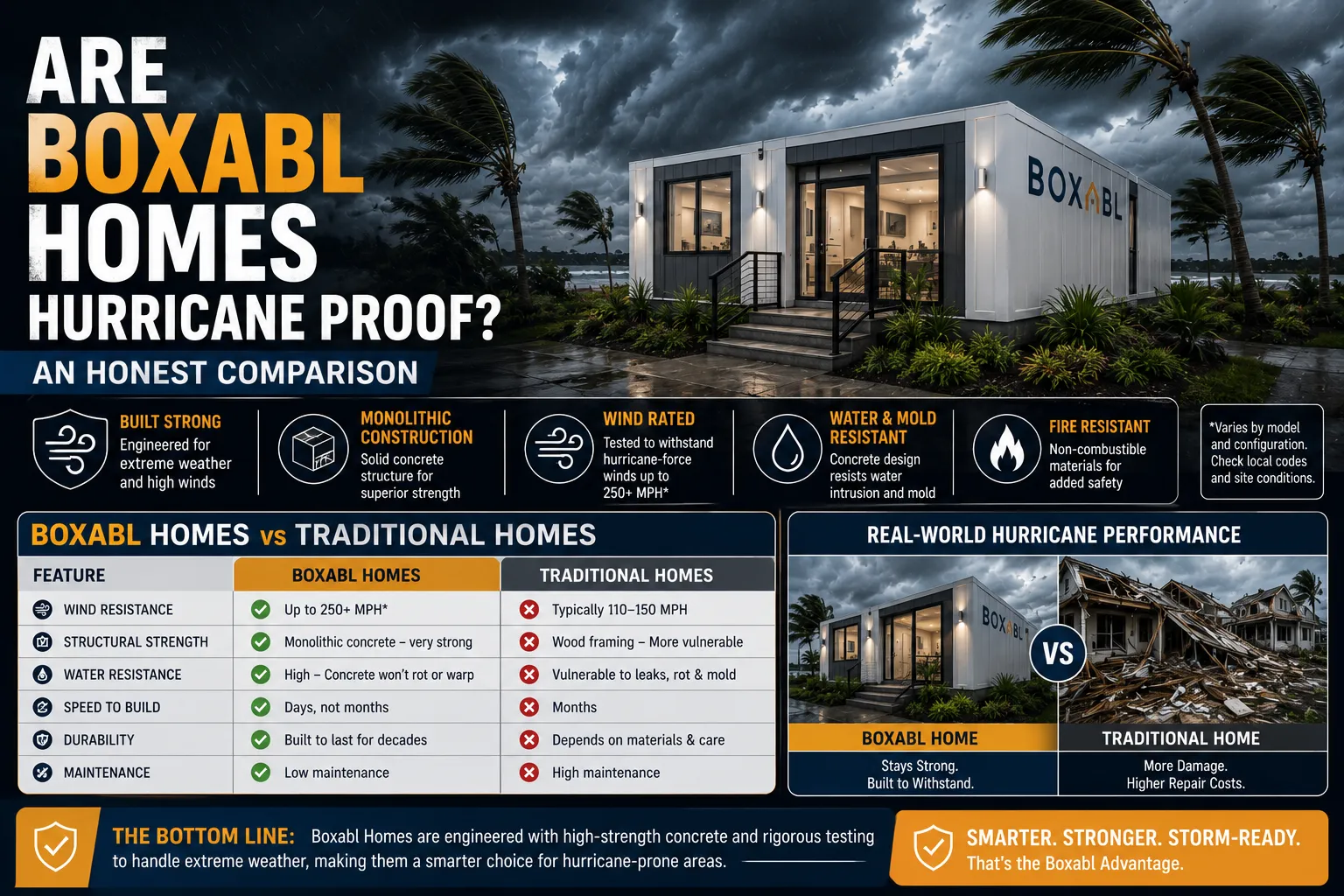
Here’s the honest, detail-level breakdown.
What “Hurricane Proof” Actually Means (And Why No One Should Claim It)
Nothing built by human hands is hurricane-proof. Engineers talk in terms of design wind speed and risk category, not invincibility. A structure is rated to withstand a specific wind load, tested against specific debris-impact standards, for a specific occupancy type. Once winds exceed that design threshold — or once water, storm surge, or airborne debris hits an unprotected opening — even the best-engineered building can fail.
So the real question isn’t “Is Boxabl hurricane-proof?” It’s: what wind speeds is a Boxabl actually engineered for, and how does that stack up against what Florida code requires and what traditional Florida homes are built to?
What Boxabl’s Engineering Actually Covers
Boxabl’s structural insulated panels — the core building material in the Casita — are covered under ICC-ES Evaluation Report ESR-4725, which confirms the panels comply with the 2021 and 2018 International Building Code and International Residential Code provisions for wall, roof, and floor assemblies, including allowable wind and axial loads. That’s a real, independently verified engineering document — not just a marketing claim. Boxabl has also secured a supplemental listing for compliance with the Los Angeles Building Code.
Company materials describe the Casita as rated for “hurricane-speed winds” capable of handling severe wind conditions found in North America. That’s a fair characterization of the panel system’s tested capacity. But a wind-load rating on a panel is not the same thing as a home being certified for Florida’s coastal wind zones, and it’s not the same as passing Florida’s windborne-debris impact testing.
The Florida-Specific Problem: Approval Status
This is the part most Boxabl content skips, and it’s the most important thing for a Florida buyer to know.
As of 2026, Florida is not on Boxabl’s list of modular-approved states. States like Arizona, California, Nevada, and about a dozen others currently allow the Casita to be sold and installed as a certified modular home. Florida, along with Texas, New York, Illinois, and Pennsylvania, does not yet have that approval in place. Boxabl has said it’s pursuing it, but pursuing approval and having it are two different things.
In states without modular approval, Boxabl’s fallback option is a Park RV Casita, certified under the ANSI A119.5 recreational-vehicle standard rather than residential building code. A Park RV classification lets you place a unit in an RV park or a permitted backyard in some jurisdictions — but it generally does not satisfy Florida’s residential building permit requirements for a permanent home, and it is not evaluated against Florida’s hurricane-specific wind and impact standards.
Practically, that means: if a company or reseller tells you they can put a “hurricane-proof Boxabl” on your permanent Florida lot right now, ask directly whether it’s being permitted as a modular residential structure or as a titled RV. That distinction affects your insurance, your financing, your resale value, and — most relevant here — what wind and impact standard the unit was actually tested to.
Florida’s Wind Code Bar Is Genuinely High
To understand the gap, you need to know what Florida actually requires, especially near the coast.
- Florida uses ultimate wind speeds under ASCE 7, adopted into the Florida Building Code. Inland areas typically require design speeds of 115–140 mph; coastal and southern counties can require 170–190 mph or higher.
- Miami-Dade and Broward Counties fall inside the High-Velocity Hurricane Zone (HVHZ), which layers on stricter product approval and structural testing. In Miami-Dade, Risk Category II buildings (standard residential) are designed for 175 mph; in Broward, 170 mph.
- Anything in the windborne debris region — generally within a mile of the coast in high-wind areas — must have openings that are either impact-resistant or protected by tested, rated coverings, per Missile Level C/D impact testing (a 9 lb 2×4 fired at speeds simulating storm debris).
None of Boxabl’s current public documentation shows the Casita has been tested against HVHZ-level product approval or Florida’s specific windborne-debris impact standards. The SIP panels’ IBC compliance is real, but IBC compliance and HVHZ/Miami-Dade product approval are two separate certification tracks, and Florida coastal buyers specifically need the latter for full code compliance in those zones.
Boxabl vs. Traditional Florida Construction: An Honest Comparison
| Factor | Boxabl Casita | Concrete Block (CBS) | Wood Frame (Florida code-built) |
|---|---|---|---|
| Core wall material | SIP panel (steel-faced foam/MgO core) | Reinforced concrete masonry | Engineered lumber, code-rated sheathing |
| Wind engineering basis | ICC-ES ESR-4725, IBC 2018/2021 | Florida Building Code, HVHZ product approval where applicable | Florida Building Code, HVHZ product approval where applicable |
| Florida HVHZ-specific approval | Not currently documented | Standard practice in Miami-Dade/Broward | Standard practice in Miami-Dade/Broward |
| Florida modular/residential approval | Not yet approved (as of 2026) | N/A — site-built | N/A — site-built |
| Impact-rated openings | Depends on windows/doors installed on site | Required and tested in WBDR | Required and tested in WBDR |
| Flood/water resistance | No standard lumber or sheetrock; more mold-resistant than typical framing | Concrete performs well against water intrusion but isn’t waterproof at openings | Vulnerable to water intrusion without elevation and sealing |
| Foundation requirement | Engineered foundation still required; unit itself isn’t the whole system | Slab or elevated foundation per flood zone | Slab or elevated foundation per flood zone |
The honest takeaway: a Boxabl’s wall panels are engineered to a real, tested standard, and the company’s fire-resistance and mold-resistance claims (non-combustible cladding, no standard sheetrock) are reasonable advantages over cheap stick-built construction. But a hurricane-resistant home is a system — walls, roof attachment, foundation anchoring, window and door impact protection, and local code approval all have to work together. Right now, the piece of that system Florida cares about most — HVHZ/coastal product approval — isn’t confirmed in Boxabl’s public documentation for the Casita as installed in Florida.
What This Means If You’re Building in Florida
- If you’re inland, outside the HVHZ, and modular approval eventually comes through, a Boxabl could be a reasonable option once local wind-load and impact-window requirements for your specific county are met on-site.
- If you’re on the coast or in Miami-Dade/Broward, don’t assume “rated for hurricane-speed winds” means HVHZ-compliant. Ask directly for Miami-Dade/Broward product approval documentation, not just the ICC-ES report.
- Confirm which classification you’re buying under — modular residential vs. Park RV — because that single distinction determines what code, if any, the unit was actually evaluated against for your site.
- Get an independent Florida-licensed structural engineer to review the foundation, tie-down, and opening-protection plan before you sign anything. The panel rating is only one input into whether the finished, installed home meets your county’s wind and flood requirements.
FAQ
Are Boxabl homes hurricane proof? No. No home is hurricane proof. Boxabl’s SIP panels are tested and code-compliant under ICC-ES ESR-4725 for wind and structural loads, but “hurricane proof” isn’t a real engineering classification, and Florida-specific HVHZ certification isn’t currently documented for the Casita.
Can I legally install a Boxabl Casita in Florida right now? As a fully approved modular residence, not yet — Florida isn’t on Boxabl’s current list of modular-approved states as of 2026. A Park RV Casita may be placed in some RV parks or permitted zones under ANSI A119.5, but that’s not the same as residential building permit approval.
What wind speed is a Boxabl rated for? Boxabl’s panels are evaluated under ICC-ES ESR-4725 for IBC-compliant wind and structural loads, and the company describes the Casita as rated for hurricane-speed winds. Specific psf and mph values vary by panel orientation and load direction; a licensed engineer should confirm exact figures for your site’s required design wind speed.
Do Boxabl homes meet Miami-Dade or Broward County’s hurricane standards? This isn’t currently documented in Boxabl’s public approvals. Miami-Dade and Broward fall inside Florida’s High-Velocity Hurricane Zone, which requires separate, stricter product approval beyond standard IBC compliance — buyers in these counties should request that documentation directly before purchasing.
How does a Boxabl compare to a concrete block (CBS) home in a hurricane? Concrete block construction has decades of proven performance under Florida’s HVHZ testing regime and is the regional standard for coastal wind resistance. Boxabl’s SIP system is newer, tested to national IBC standards, but hasn’t yet demonstrated the same Florida-specific coastal certification track record.
This article reflects publicly available information as of mid-2026, including Boxabl’s stated state-approval list and published ICC-ES documentation. Approval status changes — always verify current Boxabl state availability and Florida/Miami-Dade product approval status directly with Boxabl and your local building department before purchasing.