The morning after Hurricane Ian, a contractor friend of mine drove through Port Charlotte, taking photos. What struck him most wasn’t the destruction — it was one house, still standing, walls completely intact, while everything around it was rubble. It was a concrete home. He called me and said, “We’ve been building wrong for decades.”
That conversation changed how I look at construction. And now, with 3D printed homes entering the Florida market, that same question is back on the table: can a house printed by a machine actually survive a Category 5 hurricane?
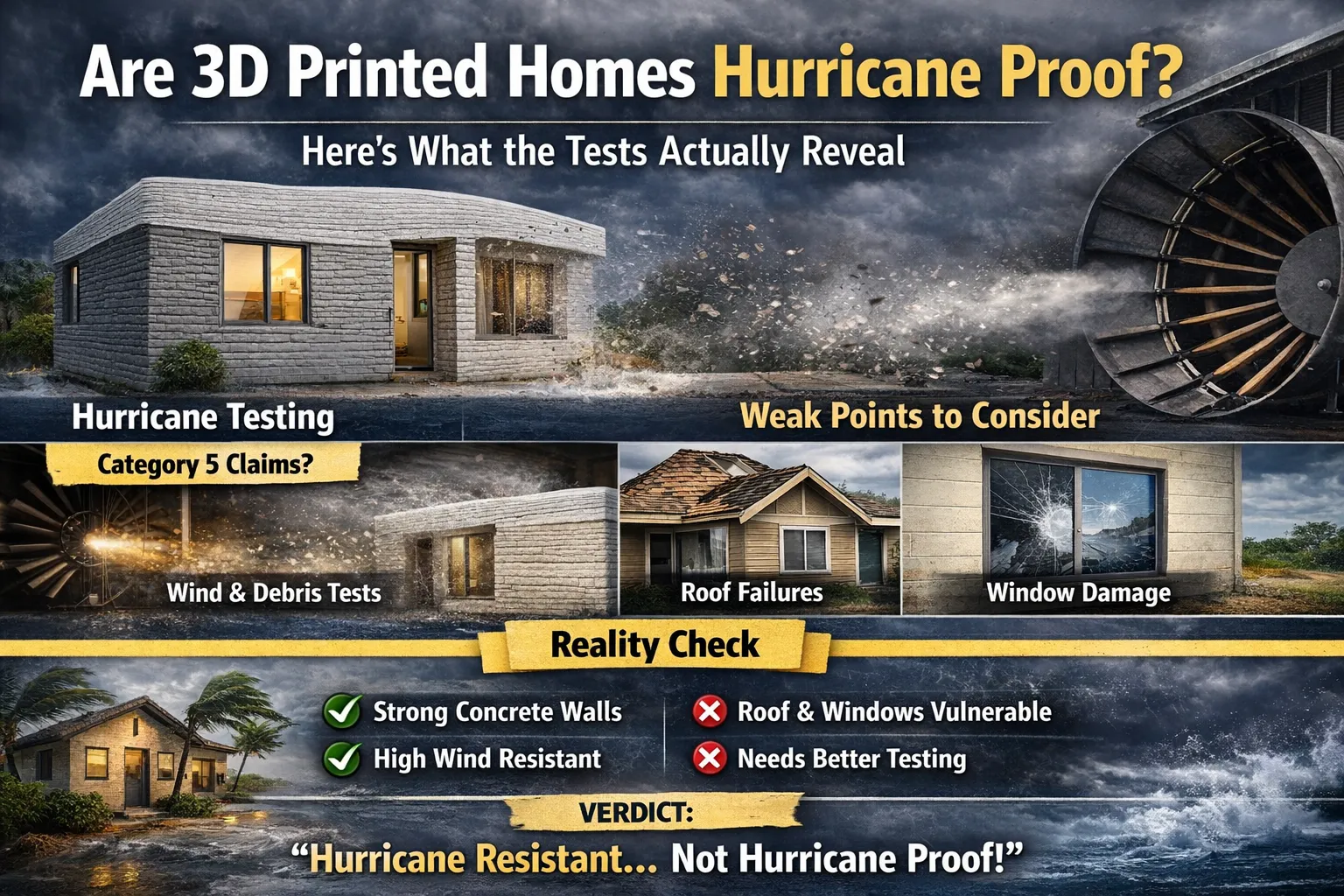
Are 3D Printed Homes Hurricane Proof? Surprising Facts
What Exactly Is a 3D Printed Home — and What’s It Made Of?
Before we talk hurricanes, you need to understand what these homes actually are. Most people picture something flimsy — almost like a plastic model. The reality is the complete opposite.
The Material: Engineered Concrete, Not Ordinary Mix
3D printed homes use a specially formulated concrete mortar, extruded layer by layer through a robotic arm. This isn’t your average sidewalk mix. Companies like ICON and CyBe Construction use purpose-developed mixes that cure denser and stronger than standard poured concrete.
The layering process itself adds structural benefit — the layered printing process creates continuity within the walls, adding strength, and geometric shapes like curves and angles can be incorporated to improve structural integrity.
Think about it like this: a traditional block wall has mortar joints — every one of those joints is a potential weak point. A 3D printed wall is essentially monolithic. No seams, no gaps.
The Design Advantage No One Talks About
Here’s something architects rarely explain to homeowners: the shape of your home determines how wind moves around it. Flat walls are terrible in hurricanes. They catch the wind like a sail.
3D printing allows for circular home designs, in which a weak point is absent, making the structure able to resist wind forces from all sides — exactly the kind of omnidirectional threat a hurricane presents.
You simply cannot build a perfectly curved concrete wall economically using traditional methods. With 3D printing, it’s just a line of code.
What the Hurricane Tests Actually Show
This is where the conversation gets serious. Let’s look at real certified test results — not builder claims.
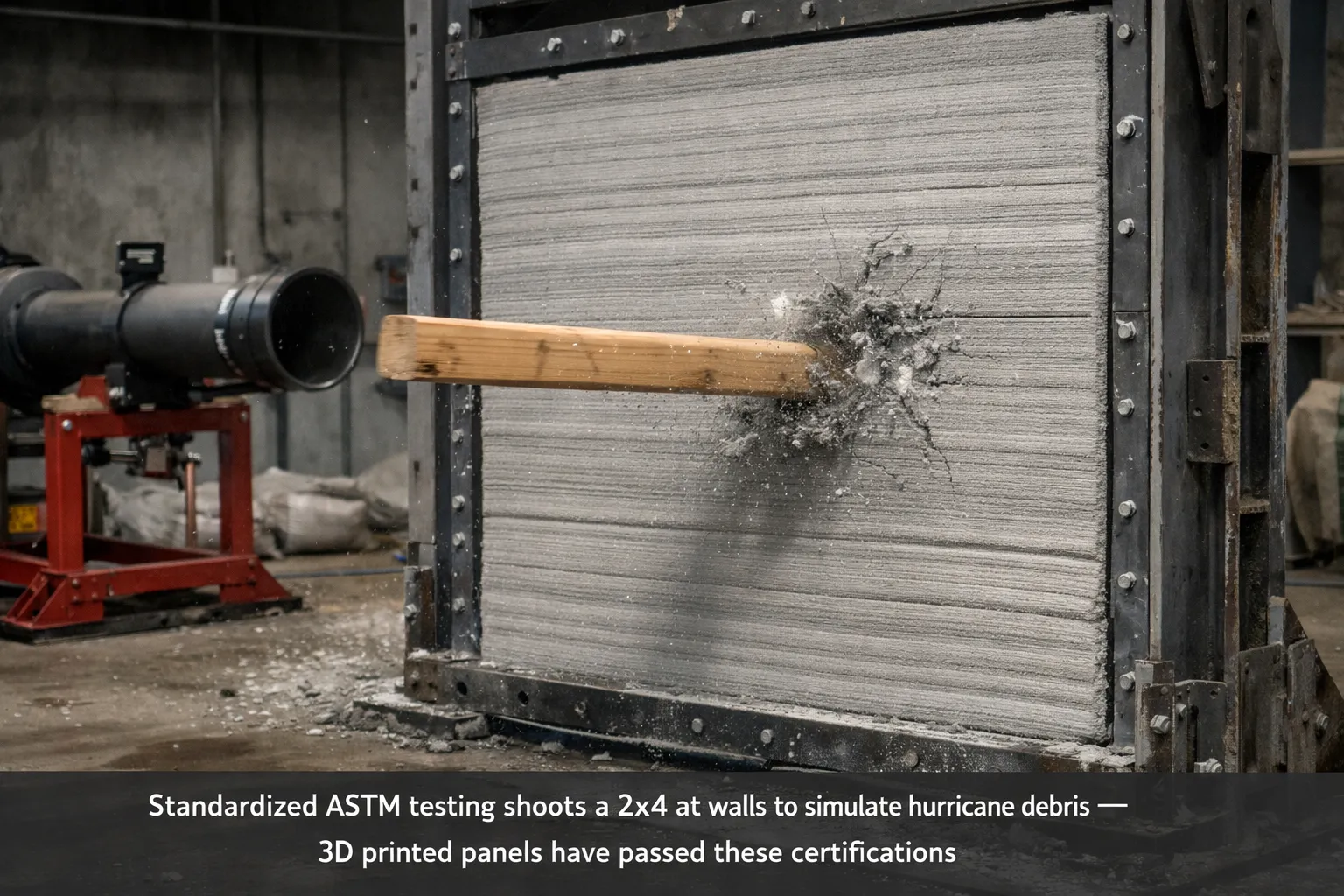
ASTM Windborne Debris Test (ASTM E 330)
ICON completed and passed all required hurricane-zone tests for their printed walls, including ASTM E 330, which evaluates structural performance under simulated windborne debris impact. For this test, a 2×4 “missile” traveling at 30 mph is fired at the wall in several locations. Passing this test ensures walls can safeguard against flying debris, creating a hole in the building’s walls.
That 2×4 at 30 mph? That’s what punches through wood-frame walls in most hurricanes. 3D printed walls absorbed it without structural failure.
Sustained and Fluctuating Wind Pressure Tests
Two standards — ASTM E1886 and E1996 — work together to assess a wall’s resistance to sustained and fluctuating wind pressures. ASTM E1886 focuses on steady wind pressure, while ASTM E1996 tests resistance to varying wind pressure, mimicking the repeated gusts characteristic of hurricanes.
This distinction matters. Most people think hurricane damage comes from one massive gust. Actually, it’s the repeated pressure cycles — the wall flexing in and out — that cause structural failure over time. 3D printed concrete barely flexes at all.
The IBHS Fortified Gold Standard
Combining ICON’s printed walls passing these tests, along with impact-resistant windows and doors, homes can meet the requirements of the Insurance Institute for Business and Home Safety’s (IBHS) Fortified Gold rating — the recognized industry standard for buildings at reduced risk of loss during a hurricane due to high winds.
Fortified Gold isn’t just a badge. In Florida, it can translate to significant insurance premium discounts — sometimes 20–30% annually.
The Flood Problem: Where Concrete Really Wins
Wind gets the headlines. Flooding destroys the homes.
Concrete vs. Water: A No-Contest Match
Wood absorbs water. Drywall dissolves. Insulation turns into a petri dish. The remediation costs after flooding are often higher than the wind damage itself.
Concrete doesn’t work that way. If a 3D printed concrete ground floor floods, you drain it, dry it, and move back in. There’s no mold risk because mold needs organic material to feed on — and there isn’t any in the walls.
3D printed homes meet and exceed virtually all building codes and offer protection against natural disasters like hurricanes and earthquakes, while also offering improved fire resistance.
The University of Florida Is Paying Attention
This isn’t fringe thinking anymore. A 3D construction printer known as BOD3, manufactured by Denmark-based COBOD International, was shipped to the University of Florida’s East Campus to research concrete 3D printing’s ability to reduce hurricane impact. Researchers believe that printing homes with concrete — rather than wood — eliminates the primary vulnerability Florida homeowners face.
When a public university spends research budget on it, that’s a signal. This technology is being taken seriously at an institutional level.
Where 3D Printed Homes Fall Short — Honest Assessment
I won’t sell you a fantasy. No home technology is perfect, and 3D printed construction has real limitations that any honest builder will tell you upfront.
The Walls Are Strong. The Roof Is Still Conventional.
Here’s the uncomfortable truth most 3D printed home marketers skip: the walls are printed. The roof is not.
Roofing systems in 3D printed homes are still installed using conventional methods — trusses, sheathing, shingles, or metal panels. And in a hurricane, the roof is almost always the first failure point. A Category 4 doesn’t blow walls over; it peels roofs off, then the walls follow.
The strength of your 3D printed walls means nothing if your roof-to-wall connections aren’t hurricane-strapped to the same standard.
Windows and Doors Remain the Weakest Link
Meeting full hurricane protection requires impact-resistant windows and doors in addition to the printed walls — the wall alone is not sufficient. Impact glass, proper installation, and storm-grade door hardware are non-negotiable in any hurricane-resistant build, printed or not.
Elevation Still Determines Flood Survival
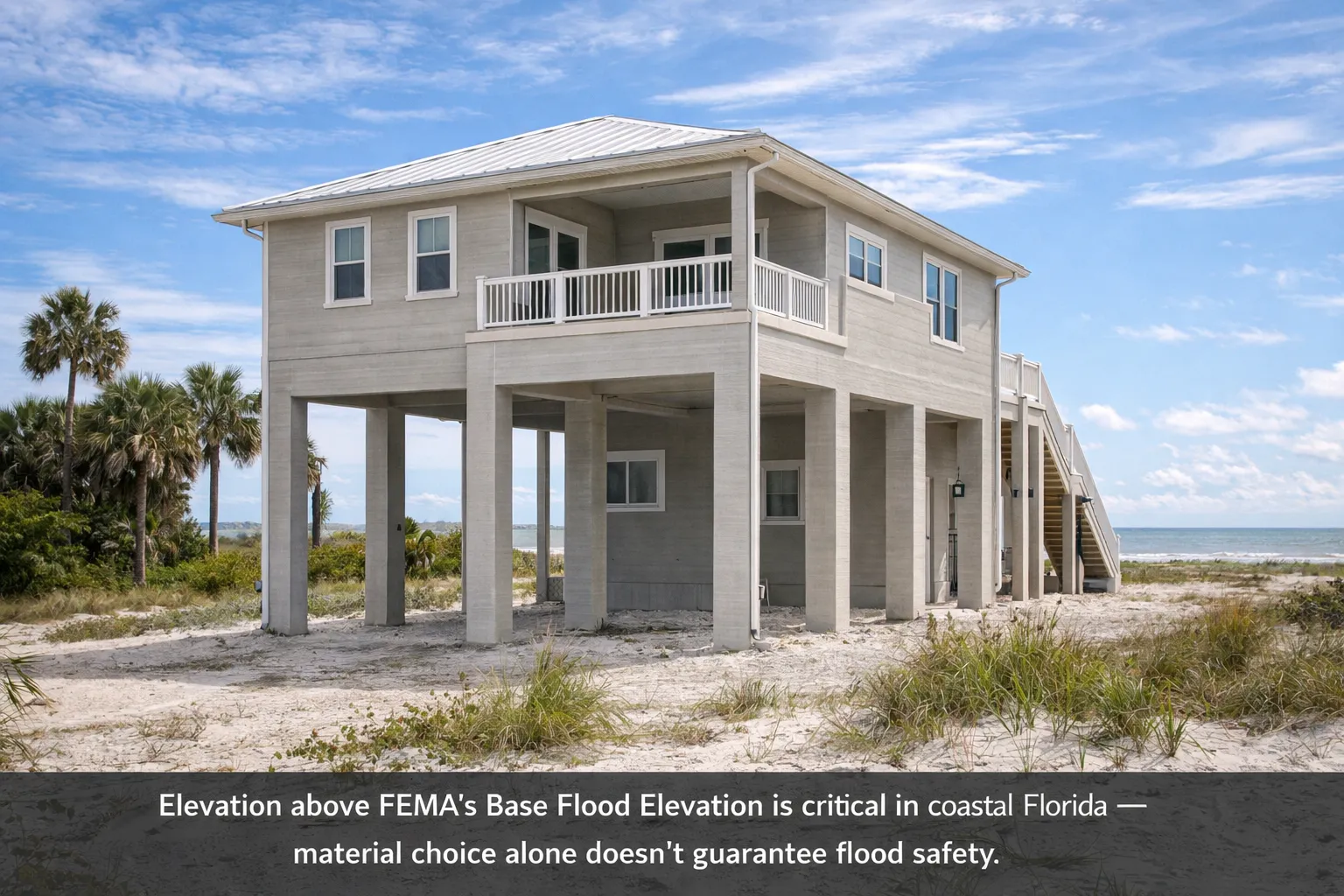
A 3D printed home sitting at grade level in a flood zone is still going to take on water. Elevation above the Base Flood Elevation (BFE), as defined by FEMA’s flood maps, is required regardless of what your walls are made of.
3D Printed Homes vs. Steel Frame: How Do They Compare?
Both are legitimate alternatives to a wood frame. Here’s how they stack up, honestly:
| Feature | 3D Printed Concrete | Steel Frame Construction |
|---|---|---|
| Wind Resistance | 200+ mph certified | 185+ mph Category 5 certified |
| Flood Resistance | Excellent (non-porous) | Excellent (elevated options) |
| Mold Resistance | Excellent | Excellent |
| Termite Resistance | Complete | Complete |
| Design Flexibility | High (curved shapes possible) | High (open floor plans) |
| Build Timeline | 60–120 days | 4–6 months |
| Elevated Foundation | Possible but complex | Highly compatible |
| Real-World Florida Track Record | Emerging | Established |
| Energy Efficiency | High | High (especially with solar) |
| Insurance Discounts | Qualifying | Qualifying |
Both construction methods beat traditional wood frame on every metric that matters for Florida living. The right choice depends on your site, budget, and design preferences.
Conclusion: So, are they hurricane-proof?
The direct answer: 3D printed concrete homes are among the most hurricane-resistant residential structures available today — substantially better than wood frame, and competitive with the best concrete block and steel frame builds.
But “hurricane proof” as a guarantee doesn’t exist for any home. What 3D printing gives you is a monolithic concrete shell that has passed the toughest standardized wind tests, resists flood damage, eliminates mold risk, and offers design shapes that work with wind physics rather than against them.
The remaining variables — roof system, impact windows, elevation, and site selection — still determine whether any home survives a major storm, regardless of how the walls were built.
If you’re building in Florida and you’re serious about storm protection, the question isn’t whether to use hurricane-resistant construction — it’s which method best fits your site, budget, and long-term goals.
At Florida Steel Homes, we’ve built our entire mission around that question. After losing our own home to Hurricane Helene, we don’t take these decisions lightly. Whether you’re comparing 3D printed concrete, steel frame, or traditional methods, the smartest first step is a conversation with someone who has actually lived through what you’re trying to protect against.
→ Schedule a free consultation with Florida Steel Homes — no sales pressure, just real answers from people who’ve been through the storm.