Tampa Bay is long overdue for a serious hurricane, and smart buyers know it. Steel-frame and concrete homes hold up far better than standard wood-frame construction, but the walls are only part of the story. Roof connections, window ratings, and flood zones all matter just as much. This article breaks down what to actually look for before you buy.
Hurricane Resistant Homes in Tampa
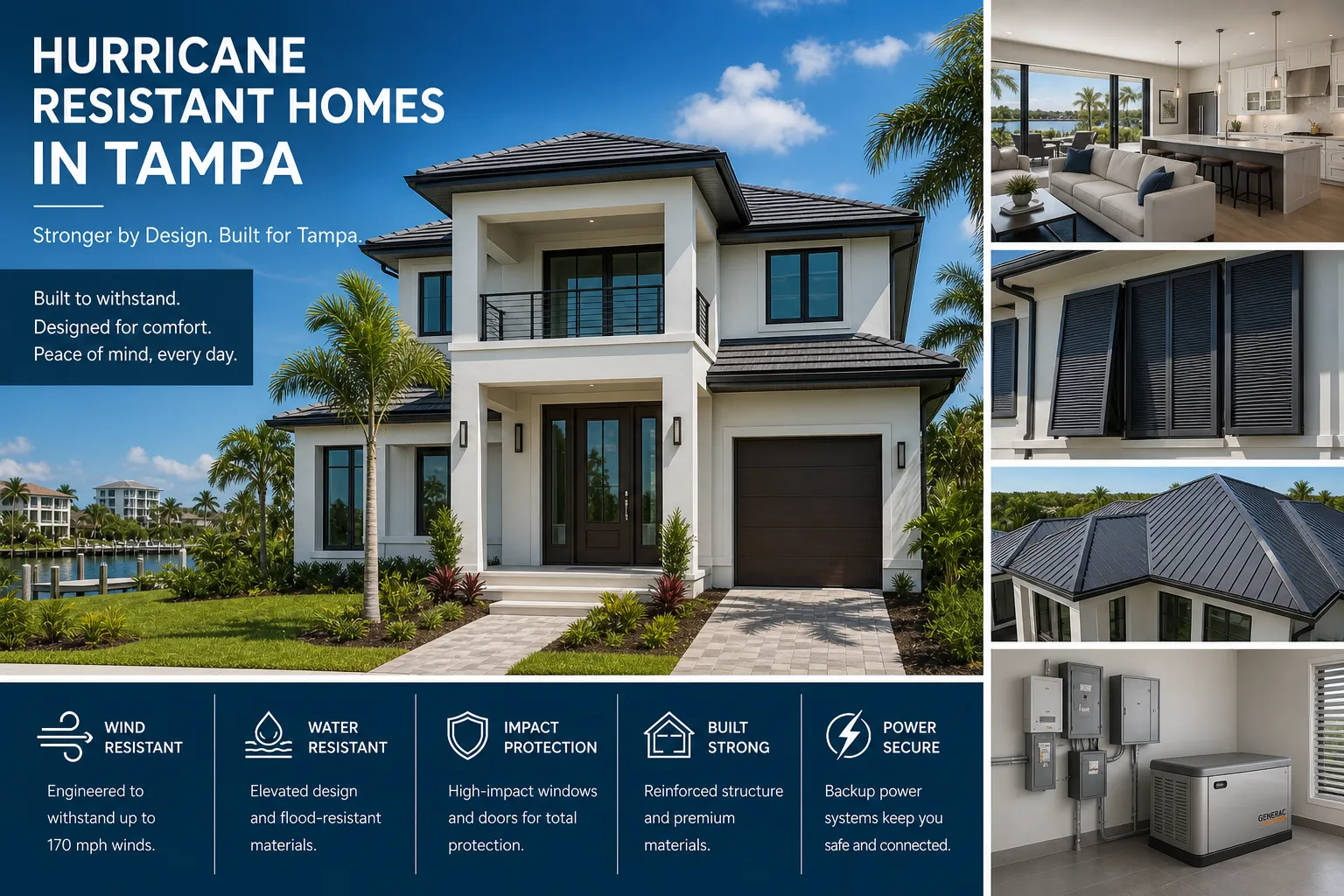
There’s a moment every Tampa Bay homeowner knows. You’re checking your phone at 11 p.m., watching a hurricane track update, and the cone has shifted west. The Gulf is warm. The storm is organizing. And somewhere in the back of your mind, you’re doing the math on whether your house—your actual physical structure—is going to be okay. Not whether you evacuated in time. Whether the house is okay.
That feeling is driving a real change in how people shop for homes here. After back-to-back storm seasons that put Tampa squarely in the conversation, buyers are asking different questions. Not just about square footage and school districts, but about what the walls are made of, whether the roof connections are strapped, and what the home’s wind mitigation report says. It’s not paranoia — it’s just Tampa, and people are finally treating it that way.
Looking for a steel-frame home built for Florida’s real conditions?
Florida Steel Homes builds in the Tampa Bay area and can walk you through your options honestly — no pressure, just straight talk.
Call: 786-610-6398 · Email: info@FloridaSteelHomes.com
Visit: 16104 4th St E, Redington Beach FL 33708
Why buyers are genuinely excited about this right now
There’s a kind of quiet confidence that comes with buying a home you know was built to take a punch. Buyers who’ve gone through the process of choosing steel-frame or reinforced concrete construction often describe the same thing: storm season just feels different. Not stressful, different. Calmer. You still watch the tracks, you still have a plan, but you’re not spending three days running worst-case scenarios about whether your roof is going to stay attached to your house.
And then there’s the financial side, which nobody talks about honestly enough. A genuinely storm-resistant home in Tampa Bay isn’t just safer—it’s often cheaper to own over time. Insurance premiums on a well-built steel or concrete home can run $2,000–$4,000 a year less than a comparable wood-frame house in the same flood zone. Spread that over a 30-year mortgage, and it starts to look a lot like the construction premium paying for itself. Buyers who’ve done that math don’t need much convincing.
What “hurricane resistant” actually means when you’re standing in a listing
Real estate agents use the phrase loosely, and honestly, who can blame them — it sounds good; it sells. But the construction types behind that phrase vary enormously. A 1987 wood-frame home with new impact windows is technically more hurricane-resistant than it was before the windows went in. A purpose-built steel-frame house on a properly elevated foundation is something else entirely. These are not the same category, even if both listings say the same words.
The things that actually determine how a home performs in a major storm are the structural framing material, how the roof connects to the walls, what the windows and doors are rated for, and where the house sits relative to flood risk. Change any one of those, and you’ve got a materially different situation. Most buyers focus on the walls and ignore the roof connection, which is almost always the first thing to fail in a direct strike.
The honest comparison between your main options
| Construction type | Wind performance | Moisture & rot | Insurance | Cost vs. wood frame |
|---|---|---|---|---|
| The steel frame is best. | Holds its shape under extreme lateral loads, with no warping or joint failure | No organic material — nothing to rot; mould doesn’t get a foothold in framing | Real savings possible, often 20–40% lower premiums | 10–20% higher upfront |
| ICF concrete is the best. | Exceptional—mass and rigidity together, walls don’t flex | Very low if sealed properly at construction | Similar savings to steel | 15–25% higher upfront |
| Concrete block (CBS) Solid | Good—walls hold up, but the roof connection is still the variable | Low for walls, standard roof issues still apply | Moderate savings | Roughly comparable in FL |
| Wood frame, updated, adequate | Moderate with straps, impact glass, reinforced garage door | Higher—Florida humidity finds every gap over time | Marginal savings vs. base rate | Lower upfront, costlier to maintain |
| Wood frame, pre-code. Be careful | Genuinely concerning without a full retrofit | High — especially anywhere near the coast | No savings, possible surcharges | Cheapest to buy, highest risk |
The roof is where storms actually win
This isn’t something most home listings volunteer, but it’s the thing every structural engineer and building inspector in Florida will tell you: hurricanes don’t knock houses down by pushing on the walls. They lift roofs off by exploiting weak connections between the roof structure and the top of the walls. Once the roof goes, the walls lose their bracing and the whole thing comes apart fast. This is why the post-Andrew building code changes focused so heavily on hurricane straps and clips — and why a home that exceeds those minimums is a genuinely different animal from one that just meets them.
When you’re evaluating a home, ask specifically about the roof-to-wall connection type. “Hurricane straps” is a range — there are strap configurations rated for very different wind loads, and a single-wrap strap is not the same as a double-wrap or a structural clip. A wind mitigation inspector can tell you exactly what’s there and what it means for your insurance rate. That report, if the seller has one, is one of the most genuinely useful documents you can read before making an offer on any Tampa Bay property.
Five things worth actually checking before you make an offer
Ask for the wind mitigation inspection report. Florida insurers are required by law to give you premium credits for specific features—roof shape, deck attachment, opening protection, and wall connections. A full set of credits can cut your insurance by 30–50%. If the seller doesn’t have a recent report, get one done yourself before you close. It costs around $150 and tells you more about the home’s real storm readiness than any listing description will.
Look up the flood zone before you fall in love with the house. Go to FEMA’s Flood Map Service Centre and type in the address. Tampa Bay’s surge risk is serious—shallow water and the shape of the bay mean surge can push far inland even in storms that track north of the city. An AE or VE zone designation means mandatory flood insurance, and that can easily add $3,000–$6,000 a year to your carrying costs.
Check the roof shape, not just the age. A hip roof—sloped on all four sides—performs significantly better in high winds than a gable roof, which has flat triangular ends that catch wind like a sail. If you’re looking at an otherwise well-built CBS home with a gable roof, that’s a real vulnerability, and it’s worth factoring into your offer and insurance estimate before you get attached to the house.
Verify what “impact windows” actually mean. Impact-rated glass is tested to a specific design pressure and debris impact standard. In Tampa Bay’s wind zone, you want windows rated to at least DP-50 (design pressure 50 lbs/sq ft) and doors and garage doors to match these standards. Some listings use “impact windows” loosely to mean storm film or basic laminated glass that doesn’t meet the full standard. Ask for the product specs and verify the rating.
- Get insurance quotes before you close, not after. The insurance market in Florida is volatile right now — carriers have left the state, rates have spiked, and availability varies by zip code and construction type. Some carriers offer dramatically better rates on steel and concrete construction and will tell you so directly if you ask. Getting three quotes on the actual property before you’re under contract could save you thousands a year and occasionally reveal a problem the listing didn’t mention.
The 30-year math that changes the conversation
Here’s the thing about the upfront premium on a steel-frame or ICF home that nobody lays out clearly: if you save $2,500 a year on insurance—a conservative estimate in Tampa Bay for a well-built home versus a code-minimum wood-frame home in the same neighborhood—that’s $75,000 over a 30-year mortgage. A $25,000 construction premium paid back in about 10 years, with two decades of savings after that. Add lower maintenance costs (no termite tenting, no rotting sills, and no swollen door frames from moisture cycles), and the math often inverts completely.
This doesn’t mean you should overpay for features you don’t need, or that every steel-frame home is a good deal at any price. But it does mean the sticker shock on a more resilient construction type deserves a full-cycle look, not just a year-one comparison. The buyers who feel best about their Tampa Bay home purchase five years in are usually the ones who did the math up front.
Talk to someone who builds for this coast specifically
Florida Steel Homes works in the Tampa Bay area and builds steel-frame homes designed for Gulf Coast conditions—not just what the code requires, but what the weather actually demands. If you’re comparing options or thinking about building, reach out. It’s a real conversation, not a sales pitch.
Call or text: 786-610-6398
Email: info@FloridaSteelHomes.com
Visit: 16104 4th St E, Redington Beach, FL 33708