Retrofitting your home for hurricane season is more affordable than most Florida homeowners think — and it pays back in lower insurance premiums, higher resale value, and the kind of deep-sleep peace of mind that no amount of plywood can buy. From impact windows to garage door bracing, here’s everything you need to know, with real numbers attached.
How to Hurricane Proof an Existing Home
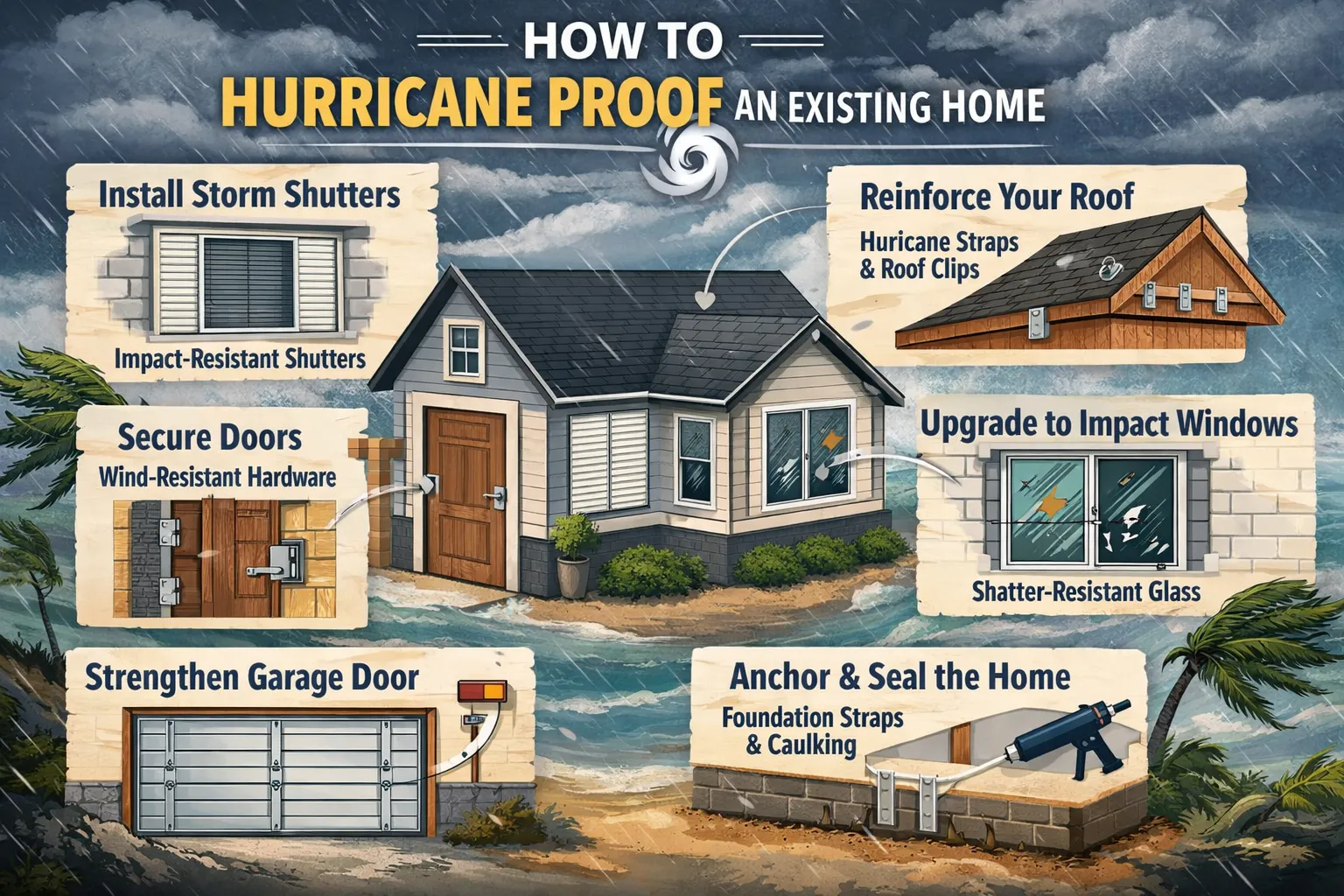
The wind is coming—the question is whether your house is ready.
Picture it: August in South Florida. The sky turns that particular shade of green that locals have learned to take seriously, the NOAA alert on your phone buzzes for the third time that morning, and you’re standing in your garage staring at a single sheet of plywood and two boxes of screws you bought three years ago and never used. That feeling — part dread, part helplessness — is something hundreds of thousands of Florida homeowners know too well. But it doesn’t have to be your story this season.
The good news is that learning how to hurricane-proof an existing home is no longer the overwhelming, bank-breaking project it was a decade ago. Florida’s building code reforms, a competitive market of licensed contractors, and a growing suite of financing options have brought serious storm protection within reach of families who aren’t buying a new-construction fortress. The even better news? Many of these upgrades will slash your homeowner’s insurance premiums — sometimes by 20 to 45 percent — turning a safety investment into a genuine financial win.
This guide is written for the homeowner standing in that garage. The one with a 1990s-era block home in Sarasota, or a 2005 wood-frame in Orlando, or a bungalow near the Gulf in Naples. You don’t need to rebuild your house. You need a clear, specific plan — and that’s exactly what follows.
Why Florida Homeowners Are Feeling Motivated, Not Paralyzed
There’s a psychological shift happening across Florida’s residential neighborhoods, and it’s a healthy one. After years of treating hurricane prep as an annual panic ritual, more homeowners are moving toward permanent upgrades—and the reason is simple: they’ve done the math. A $10,000 to $15,000 investment in impact-resistant windows can cut homeowners’ insurance by $2,000 a year or more in high-risk coastal zones. That’s a payback window of five to seven years, with every year after that putting money back in your pocket. That’s not a home improvement project — that’s a financial strategy.
The psychology here matters because it determines whether you act or delay. Homeowners who frame hurricane proofing as a fear response tend to buy a roll of hurricane film in September and call it done. Homeowners who frame it as an upgrade — one that protects their family, increases their home’s value, and rewards them through lower premiums — actually follow through. The research on this is consistent: homes in Florida with documented wind mitigation features sell faster and closer to the asking price than comparable unprotected homes. Buyers know what they’re getting into, and a fortified home tells a story of ownership pride, not just survival instinct.
The Upgrades That Actually Matter: Ranked by Impact and Value
1. Impact-resistant windows and doors
If you’re only going to do one thing, let it be this. Impact windows — made with laminated glass bonded to a polymer interlayer — don’t just resist shattering; they maintain the structural integrity of your wall system by preventing the pressure breach that causes roofs to fail in high winds. The Florida Building Code mandates these in new construction in high-velocity hurricane zones (Miami-Dade and Broward), but millions of existing homes were built before those standards applied. Retrofitting a 2,000 sq. ft. home typically runs $12,000 to $22,000 installed, depending on window count, frame material, and product rating. The payoff in insurance discounts and peace of mind starts on day one.
2. Garage door reinforcement or replacement
Your garage door is the largest and weakest opening in your home’s envelope. When it fails in a hurricane, the resulting pressure change is severe enough to blow out walls and compromise the roof. A wind-rated garage door replacement costs $1,500 to $4,000. If replacement isn’t in the budget, a bracing kit — a vertical track and horizontal brace system rated to 130+ mph — runs $300 to $800 and can be installed in an afternoon. This is the highest-value, lowest-cost upgrade on this list, and Florida’s My Safe Florida Home program may reimburse part of the cost.
3. Roof-to-wall connections and secondary water barrier
Most pre-2002 Florida homes were built with single-wrap hurricane clips that meet the minimum code of the time but fall short of modern standards. Upgrading to double-wrap clips or structural clips along every rafter-to-top-plate connection significantly improves your roof’s wind resistance. A roofer or structural contractor can do a full re-strap on a typical home for $2,000 to $6,000. Adding a peel-and-stick secondary water barrier under existing shingles (done during a re-roof) costs an additional $800 to $2,000 and protects against the water intrusion that follows even a partial roof loss. Insurance companies reward both upgrades through wind mitigation inspection credits.
4. Storm shutters and panel systems
For homeowners who aren’t ready for full-impact window replacement, panel-based shutters—accordion, roll-down, or corrugated aluminum—are a credible alternative. Accordion shutters run $90 to $160 per linear foot installed and fold away invisibly when not in use. Corrugated panels are the budget entry point at $7 to $15 per square foot but require storage space and annual installation labor. Either option, properly rated and professionally installed, earns insurance discounts through Florida’s wind mitigation credit system.
5. Entry door reinforcement
French doors and sliding glass doors are vulnerabilities that often get overlooked. Impact-rated replacements for a standard pair of French doors run $3,000 to $8,000 installed. If you’re keeping your current doors, add a surface-mounted bolt kit at the top and bottom of each door panel — about $150 to $300 per door in hardware — and make sure the deadbolt is heavy-duty. It’s not a complete solution, but it materially reduces the risk of a door failure during a storm event.
Cost Breakdown and Comparison Table
| Upgrade | Estimated Cost | Insurance Discount Potential | DIY-Friendly? | Priority |
|---|---|---|---|---|
| Impact windows & doors | $12,000 – $22,000 | 20–45% | No licensed install required | Highest |
| Garage door replacement | $1,500 – $4,000 | 5–15% | No | Highest |
| Garage door brace kit | $300 – $800 | 3–7% | Yes | High |
| Roof-to-wall re-strapping | $2,000 – $6,000 | 10–25% | No | Highest |
| Secondary water barrier | $800 – $2,000 | 5–12% | No | High |
| Accordion storm shutters | $4,000 – $12,000 | 10–20% | No | High |
| Corrugated panel shutters | $1,200 – $3,500 | 5–10% | Partial | Moderate |
| Entry door reinforcement | $150 – $8,000 | 2–8% | Partial | High |
Costs are estimates for a 2,000 sq. ft. single-family home in Florida. Insurance discounts vary by carrier, location, and inspection results. Always get a licensed wind mitigation inspection after completing upgrades.
The Wind Mitigation Inspection: Your Financial Unlock
Here’s the step most Florida homeowners skip, and it’s the most important one: get a licensed wind mitigation inspection after completing any structural upgrades. This inspection — which runs $75 to $150 and takes about 90 minutes — documents every qualifying feature of your home and produces an OIR-B1-1802 form that you submit directly to your insurance carrier. Insurance companies are required to apply specific credits for each qualifying feature and the savings stack. A home with impact windows, hurricane clips, and a hip roof (which sheds wind more efficiently than a gable roof) can realistically see annual premium reductions of $1,500 to $3,500 in coastal Florida counties.
What makes this even better is that the inspection results are often valid for five years, and you can submit them to multiple carriers when shopping for better rates. Many Florida homeowners have discovered that their premium savings alone cover the cost of the inspection within the first month. If you’ve made upgrades to your home in the last few years and haven’t had a re-inspection, you may be leaving real money on the table every single year.
Financing Your Hurricane Upgrades: Programs Built for This Exact Moment
The cost of hurricane-proofing an existing home is the biggest barrier most Florida families face—but there are more financing options than most people realize. Florida’s My Safe Florida Home program offers grants of up to $10,000 for qualified homeowners to fund opening protection (windows and shutters) and roof-to-wall connections. The program has reopened and closed several times due to high demand and funding cycles, so checking its current status at floridasteelhomes.com is worth doing today rather than later in the season.
Beyond state grants, PACE (Property Assessed Clean Energy) financing allows Florida homeowners to fund qualifying improvements through a special assessment added to their property tax bill, often with terms of 5 to 25 years and no upfront cost. HERO and Renew Financial are two common PACE administrators operating in Florida. Traditional home equity loans and HELOCs remain solid options for homeowners with sufficient equity, particularly given that the value-add from these improvements often exceeds the cost. Several Florida credit unions and community banks also offer dedicated storm-hardening loan products at competitive rates specifically for this category of home improvement.
Your Home Can Be Ready Before the next storm names itself.
The window between now and peak hurricane season is your most valuable planning asset. Get a free wind mitigation inspection quote, check your eligibility for the Florida Home Grant, and talk to a licensed storm-hardening contractor this week—before the season schedule fills up and the wait lists grow. Your home has protected your family for years. Now it’s time to protect your home.