The morning after Hurricane Helene tore through our neighbourhood, I walked outside to find half my roof in the backyard — and a neighbour’s modular home standing almost untouched across the street. That image stuck with me for years. What made that house different?
The short answer: it wasn’t just the fact that it was modular. It was how it was built.
If you’re in Florida, the Gulf Coast, or any hurricane-prone region, you’re probably asking the same question I asked that morning: Are modular homes hurricane-proof? And the honest answer — from someone who has spent years digging into construction standards and talking to builders — is: it depends entirely on the engineering, materials, and local code compliance.
Let’s break this down properly.
Are Modular Homes Hurricane Proof ?
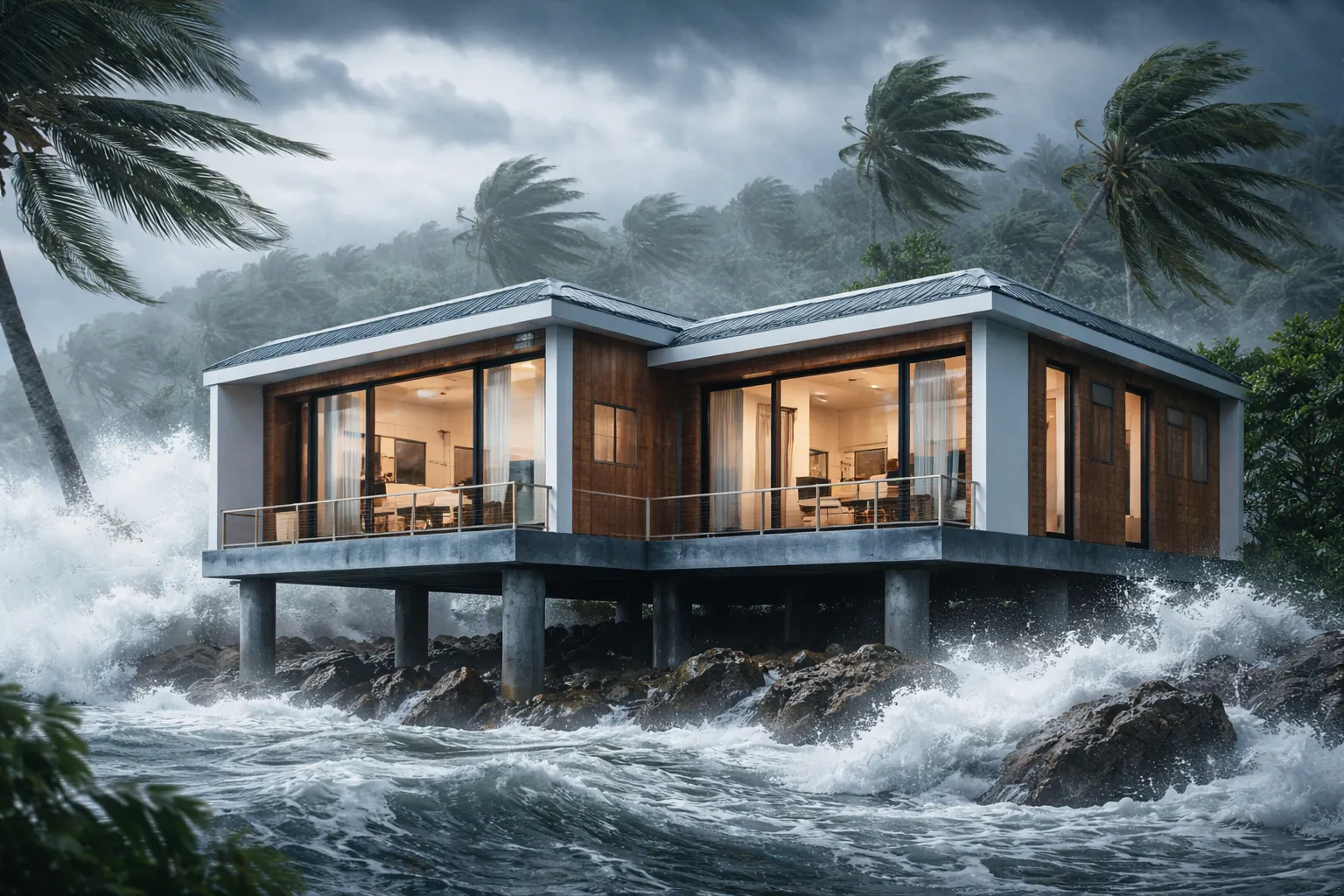
What “Modular” Actually Means — And Why It Matters for Storm Resistance
Most people use “modular” and “manufactured” interchangeably. They shouldn’t. This distinction could literally save your life.
Modular Homes vs. Manufactured Homes: Not the Same Thing
A manufactured home (what older generations called a “mobile home”) is built to HUD federal standards and sits on a chassis. These homes have historically performed poorly in hurricanes — FEMA data after Hurricane Andrew showed manufactured housing accounted for a disproportionately high share of total losses.
A modular home, by contrast, is built in sections at a factory and then transported to your site — but it must meet the same local building codes as a site-built home. That’s a crucial difference. In Florida, that means complying with the Florida Building Code, one of the toughest in the country.
How Factory-Built Construction Affects Structural Integrity
Here’s something most people don’t realise: modular construction can actually exceed site-built quality in certain ways.
Factory conditions mean no rain-soaked lumber, no rushed crew working in humidity, and machine-precision framing. Sections are built under controlled conditions and inspected multiple times before they ever reach your lot.
The problem? If the design isn’t engineered for high-wind loads — regardless of how perfectly it’s assembled — the home will still fail.
The Role of Local Building Codes in Hurricane Zones
Florida’s building code requires homes in certain wind zones to withstand sustained winds of 130–185 mph or more, depending on location. A modular home built to these specs — and properly anchored — can absolutely survive a major hurricane.
One built to a weaker standard? That’s a different story.
The Science Behind Hurricane-Proof Home Design
Let me be direct: no home is 100% “hurricane proof.” Engineers prefer the term hurricane-resistant — and for good reason. But the gap between a home that survives and one that doesn’t comes down to a few key engineering principles.
Wind Load Engineering: What the Numbers Mean
Wind doesn’t just blow against your walls. It creates positive pressure on windward surfaces and — more dangerously — negative suction on the leeward side and roof. This uplift force is what rips roofs off homes.
A home certified for Category 5 protection must be engineered to handle wind speeds exceeding 157 mph (Category 5 starts at 157 mph per the Saffir-Simpson scale). Florida Steel Homes, for example, engineers their steel-frame homes to withstand 185+ mph winds — providing a real safety margin above Category 5 minimums.
The American Society of Civil Engineers’ ASCE 7 standard governs wind load calculations for structures. Homes built to ASCE 7-22 provisions in high-wind zones are significantly more resistant than older builds.
The Critical Importance of Roof-to-Wall Connections
Ask any structural engineer, and they’ll tell you: most hurricane deaths and injuries happen because the roof fails first, then the walls follow. The connection between your roof structure and your walls is the single most important junction in a hurricane.
Hurricane straps (also called tie-downs or clips) made of galvanised steel must secure each rafter or truss to the wall framing below. Modern codes require these, but older homes and some modular builds use inadequate toe-nailing that isn’t up to the task.
Foundation Anchoring and Flood Elevation
Modular homes must be anchored to their foundations exactly like site-built homes. In flood zones — which cover massive portions of Florida’s coast — that foundation also needs to be elevated above the Base Flood Elevation (BFE) set by FEMA’s National Flood Insurance Program maps.
A home that survives 180 mph winds but sits two feet below flood elevation can still be destroyed by storm surge. Elevation isn’t optional in coastal Florida. It’s survival.
Where Standard Modular Homes Fall Short in a Hurricane
Here’s where I have to be honest, even if it’s uncomfortable reading for someone who already bought a standard modular home.
Wood Frame Modular Homes: The Weak Links
The majority of modular homes sold across the US are still built with wood framing. Wood is lightweight, workable, and cost-effective — but it has real limitations in extreme conditions:
- Moisture and rot: Wood that gets wet repeatedly loses structural integrity over time. Florida’s humidity accelerates this process significantly.
- Termite vulnerability: Subterranean termites are endemic in Florida. They can compromise structural members without visible external damage for years.
- Wind uplift: Wood-to-wood connections, even with proper hurricane straps, generate less resistance than steel-to-steel connections under extreme uplift loads.
- Post-storm mould: Flooded or storm-damaged wood framing becomes a mould incubator within 24–48 hours.
This doesn’t mean wood-frame modular homes always fail. Many survive storms when properly built and anchored. But the margin for error is smaller.
The Anchoring Problem in Older Modular Builds
Pre-2002 modular homes — built before Florida updated its building code after Hurricane Andrew — often used anchoring systems that simply don’t meet current standards. If you’re buying an older modular home in a hurricane zone, get a structural inspection before you close. Period.
What Happens to Modular Homes in Storm Surge
Storm surge — the wall of ocean water pushed inland by a hurricane — is responsible for the majority of hurricane fatalities in the US, according to NOAA. A home at grade level in a coastal flood zone faces an existential threat from surge, regardless of whether it’s modular, site-built, or steel-framed.
Elevation is non-negotiable. And this is where the construction type matters less than the foundation design.
Steel-Frame Modular Homes: A Different Category of Protection
This is where the conversation gets interesting — and where I think most online articles miss the real story.
Why Steel Changes the Equation Entirely
Steel framing for residential construction isn’t new, but it’s gaining serious momentum in hurricane zones for good reason. Here’s what steel does differently:
Structural continuity: Steel members can be welded or bolted into a continuous load path from roof to foundation. Wind forces transfer through the structure more efficiently without the weak-point connections that plague wood framing.
Dimensional stability: Steel doesn’t shrink, swell, warp, or creep over time. A steel-framed home built precisely to spec stays precisely to spec 30 years later.
Termite and rot immunity: Steel simply doesn’t provide food or habitat for termites or mould. This isn’t a minor benefit in Florida — it’s a massive long-term structural advantage.
Fire resistance: Steel doesn’t burn. In post-hurricane fires — which are more common than people realise, due to gas line damage — steel-framed homes have a fundamentally different risk profile.
Real-World Performance: What the Storm Data Shows
After multiple major hurricanes in the past decade, engineers conducting post-storm damage assessments have documented patterns that align with what material science would predict. Steel-frame structures consistently show lower rates of catastrophic failure under equivalent wind conditions compared to wood-frame structures of similar age.
I spoke with a contractor in Pinellas County who told me something that stayed with me: “After Ian, we had clients whose wood-frame homes were total losses. The steel buildings we’d done nearby? Mostly cosmetic damage. Landscaping, not structure.”
That’s not a scientific study. But it matches the emerging data pattern.
Comparing Your Options: Modular Home Types in Hurricane Zones
| Feature | Standard Wood Modular | Steel-Frame Modular | Site-Built Steel |
|---|---|---|---|
| Wind resistance (typical) | 130–150 mph | 180–185+ mph | 180–185+ mph |
| Termite resistance | Low | Excellent | Excellent |
| Flood/mould vulnerability | High | Low | Low |
| Construction time | 4–6 months | 4–6 months | 8–14 months |
| Lifespan | 50–80 years | 150+ years | 150+ years |
| Insurance premium impact | Standard | Significant reduction | Significant reduction |
| Post-storm repair costs | High | Low | Low |
What Makes a Modular Home Truly Hurricane Resistant: A Checklist
If you’re evaluating a modular home in a storm-prone area, here’s exactly what to look for:
- Wind speed certification: Ask for documentation. Look for 180 mph or higher in Category 5 zones. Anything less than 130 mph is inadequate for most of Florida.
- Roof-to-wall connection method: Hurricane straps are a minimum. Engineered continuous load path connections are better.
- Foundation type and elevation: Must meet or exceed FEMA BFE for your flood zone. Request the elevation certificate.
- Anchoring system: Ground anchors, concrete piers, or engineered slab — must be certified for your local wind zone.
- Frame material: Steel vs. wood matters enormously for long-term performance in Florida’s climate.
- Building code compliance: Must meet Florida Building Code (or your state equivalent) — not just HUD/federal standards.
- Third-party inspection: Factory inspections are good. An independent structural engineer review before purchase is better.
- Insurance rating: A properly built, hurricane-resistant modular home should qualify for substantial wind mitigation credits. If an insurer won’t credit it, find out why.
The Bottom Line: Modular Homes and Hurricanes
Here’s my honest assessment after years of watching Florida storms come and go:
The question isn’t really “are modular homes hurricane proof?” The better question is, “Is this specific modular home engineered to survive the storms I’ll face in this specific location?”
A cheaply built wood-frame modular home in a Category 5 coastal zone is not going to give you the peace of mind you deserve. But a steel-frame modular home, built to 185+ mph wind certification, properly elevated, anchored, and compliant with the Florida Building Code? That’s a different conversation entirely.
The technology exists. The engineering is proven. The question is whether you choose to use it.
Florida has already taught us — repeatedly and brutally — that the weather isn’t getting gentler. Building to minimum code is building to minimum survival odds. If you’re going to plant roots in storm country, build like you mean it.