A friend of mine — a general contractor who has rebuilt homes across Pinellas County after multiple hurricane seasons — called me one afternoon, genuinely excited. “Have you seen these Boxabl things? Steel, concrete, folds up on a truck. They’re saying it’s hurricane-rated.” He had three clients asking about them in the same week.
That call sent me down a deep rabbit hole. And what I found was both impressive and, in some ways, frustrating for anyone trying to make a serious safety decision for their family. So, are Boxabl homes hurricane-proof? Let’s get into the real answer, not the brochure version.
Boxabl Homes Hurricane Proof? Shocking Truth Inside
What Is a Boxabl Home and What Is It Actually Made Of?
Before we can answer the hurricane question, you need to understand what Boxabl is building — because it’s genuinely different from anything most Florida homeowners have seen.
Steel, Concrete, and EPS Foam — Not a Single Piece of Wood
Boxabl homes are built from steel, concrete, and EPS foam — building materials chosen specifically because they don’t degrade and are engineered to last a lifetime. The walls, floor, and roof are structurally laminated panels that are significantly stronger than those in a traditional site-built home.
Think about what that means in a Florida context. Traditional wood-frame construction — the kind that dominates most Florida neighborhoods — uses dimensional lumber that absorbs moisture, hosts termites, warps under heat, and fails structurally when wet. Boxabl eliminates every one of those vulnerabilities from the ground up.
The Panel System: What ICC-ES ESR-4725 Actually Says
This is the detail most review sites skip entirely. Boxabl’s Structural Insulated Panels (SIPs) have received an official ICC-ES Evaluation Report — document ESR-4725 — from the International Code Council Evaluation Service, a recognized authority in U.S. building certification.
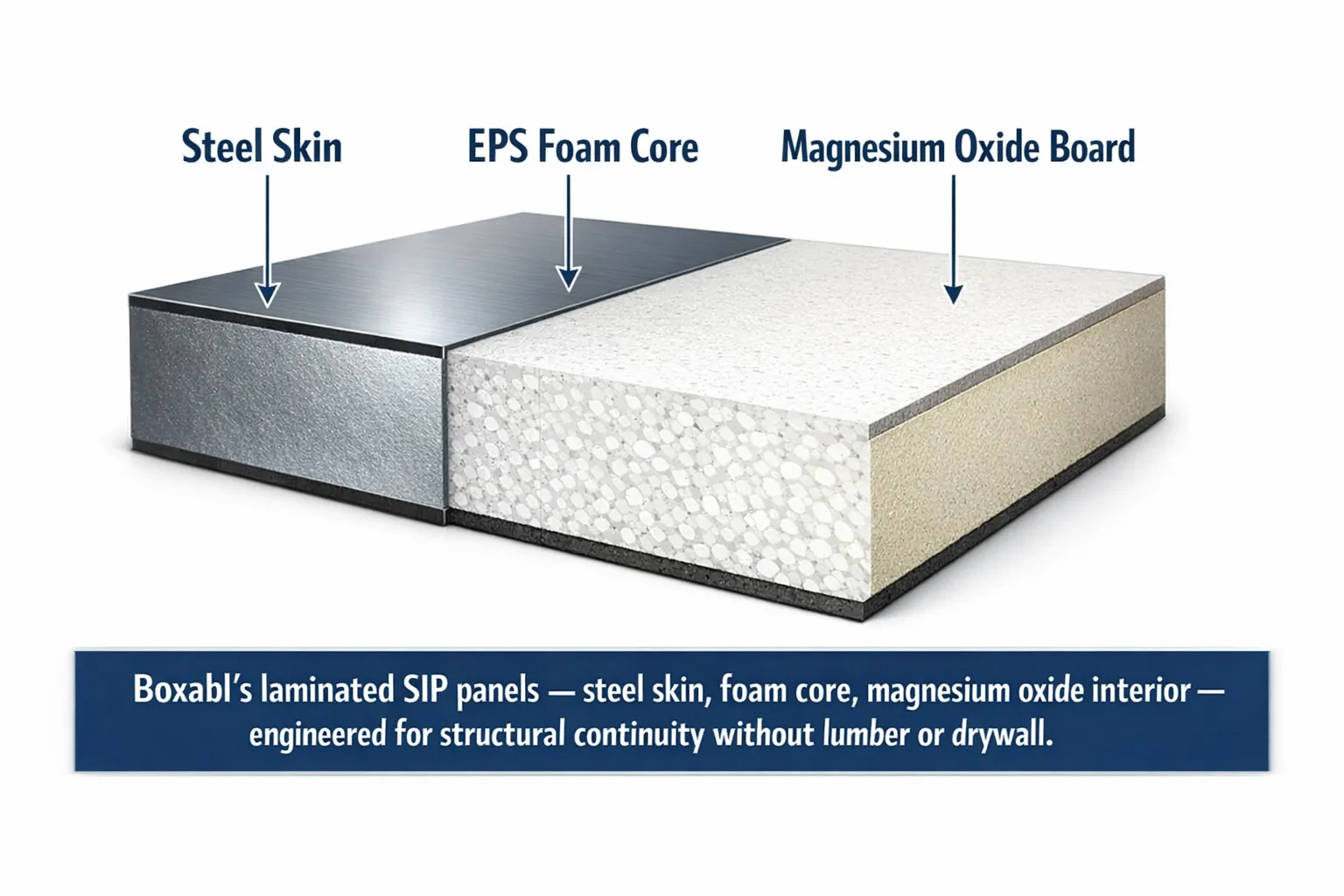
According to ICC-ES ESR-4725, Boxabl’s Structural Insulated Panels are factory-laminated sandwich panels consisting of one steel facing and one magnesium oxide panel facing with an expanded polystyrene foam core. Wall panels are 6 inches thick, while roof and floor panels are 7.3 inches thick.
Magnesium oxide board — the interior facing — is worth understanding separately. It’s an environmentally friendly material with strong fire resistance and natural mold suppression properties. It’s not drywall. It doesn’t dissolve in water. That distinction matters enormously in Florida’s humid, flood-prone environment.
Factory Precision vs. Site-Built Variability
Here’s something contractors rarely tell homeowners: most structural failures in hurricanes aren’t caused by weak materials — they’re caused by inconsistent installation. A nail gun misfired at the wrong angle, a hurricane strap was installed backwards, and a roof sheathing panel had insufficient fasteners.
Boxabl Casita homes are built using advanced composite panels that combine steel, concrete, and expanded polystyrene insulation in a factory environment, giving the home superior strength and thermal performance compared to traditional stick-built houses, with a building envelope engineered to resist mold, rot, pests, and water damage. Factory-controlled precision eliminates the human error variable almost entirely.
What Boxabl Actually Claims About Hurricane Resistance
Let’s be precise here, because the marketing language and the engineering reality are two different conversations.
The Official Company Position
According to Boxabl’s FAQ, their homes are rated for hurricane-force winds and can withstand the worst wind conditions in North America. That’s a strong claim — and it’s repeated consistently across their official communications.
Boxabl homes are also built to specified snow load ratings. The units are fire-resistant with interior and exterior claddings constructed from non-combustible materials, and they sustain much less water damage in flooding events because they do not use standard lumber or sheetrock, which also makes the structures mold-resistant.
For a Florida buyer, that trifecta — wind rating, mold resistance, flood resilience — checks the three most important boxes.
The Part Boxable hasn’t been publicly released.
Here’s where I have to be honest with you, because this is exactly the kind of thing a trusted advisor should flag.
Boxabl does not include specific test results or detailed documentation on exactly how and at what wind speed their homes are rated for hurricanes, so independent verification of their hurricane claims remains limited based on publicly available information.
This doesn’t mean the claim is false. It means it hasn’t been independently verified in the same way that, say, ICON’s 3D printed walls have been through ASTM E330 and E1886 testing with published results. For a Florida homeowner buying in a High Velocity Hurricane Zone, that distinction matters when your insurance adjuster comes knocking.
Where Boxabl Homes Perform Well in Hurricane Conditions
Despite the transparency gap above, the material science behind Boxabl is genuinely impressive in several real-world storm scenarios.
Flood Resistance: A Clear Advantage Over Wood Frame
Because Boxabl does not use wood or drywall, the structures are not susceptible to water damage or mold growth — meaning if a Boxabl becomes flooded, the water will drain out, leaving the construction intact.
This is enormous. The most expensive part of hurricane recovery in Florida is rarely the wind damage. It’s the remediation — tearing out saturated drywall, disposing of mold-compromised insulation, and replacing warped framing. A Boxabl home eliminates that entire category of damage.
Fire Resistance After the Storm
Post-hurricane fires are a serious and underreported risk. Gas lines rupture. Debris catches embers. Emergency services are stretched thin.
The interior and exterior of a Boxabl home are clad in non-combustible materials, meaning that flying embers from surrounding fire sources will not ignite the structure. In a disaster scenario where neighboring homes are burning, and fire trucks can’t get through, that’s not a minor detail.
Structural Lamination: The Hidden Strength Factor
As long as the wall remains laminated, metal SIPs are impervious to condensation and mold growth. No cracks in the walls mean no cold spots for moisture to condense — and the homes are well-sealed and joined, making them essentially leak-proof at the structural level.
In a Category 3 or 4 event, it’s often the small breaches — a cracked window seal, a loose roof flashing, a gap around a utility penetration — that allow catastrophic water intrusion. Boxabl’s monolithic laminated panel system addresses this at the manufacturing stage.
Where Boxabl Homes Fall Short for Florida Hurricane Zones
This section is where most Boxabl reviews fail you. Let’s be direct.
The Flat Roof Is a Real Concern
The Boxabl home design has a flat roof system, though Boxabl can provide roof plans if your area requires a pitched roof, which your installer would then install on-site.
Here’s why this matters specifically in Florida: flat roofs in high-velocity hurricane zones require special engineering attention. Water ponding, uplift forces on flat surfaces, and the connection between the flat roof system and the wall panels all become critical engineering questions that depend heavily on your installer’s local expertise — not just the factory specifications.
If you’re in a Miami-Dade or Broward County High Velocity Hurricane Zone, your contractor must verify that the roof installation method meets those specific local code requirements. The factory-built panels may be excellent, but the roof-to-wall connection on-site is where variability enters.
Elevation and Foundation Are Your Responsibility
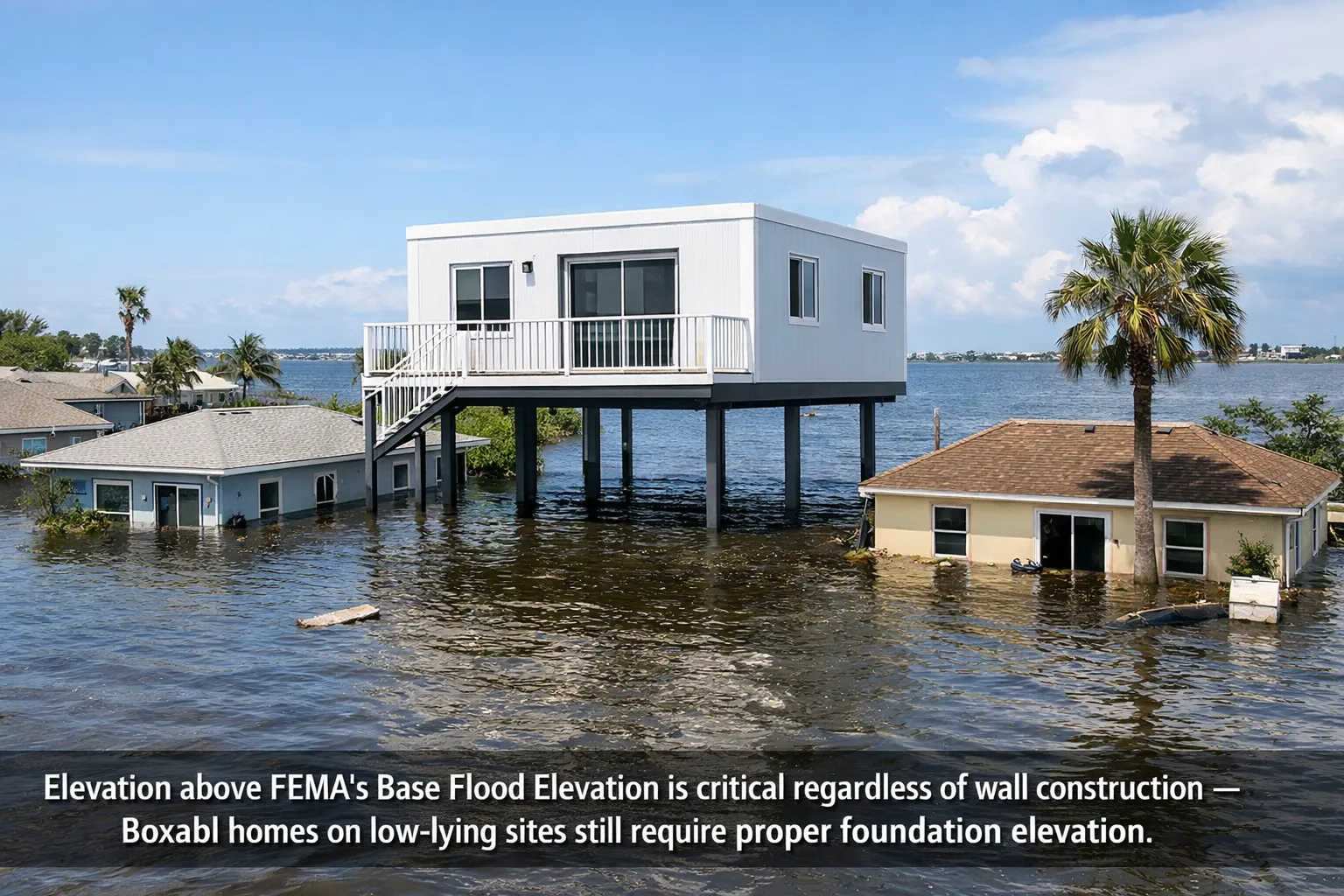
It is a good idea to install your Boxabl on a concrete foundation even if your state does not mandate it. In Florida flood zones — which cover enormous portions of the Gulf Coast, Atlantic Coast, and South Florida — “good idea” is an understatement. FEMA’s National Flood Insurance Program requires homes to be elevated above the Base Flood Elevation (BFE) to qualify for standard flood insurance rates. A Boxabl home sitting at grade in Flood Zone AE is still going to flood, regardless of how strong its walls are.
Elevation is a site decision, not a product decision. Your Boxabl installer and a local Florida-licensed engineer need to determine this based on your specific parcel’s flood map data.
Window and Door Specifications Need Verification
Boxabl has not specifically mentioned hurricane-proof windows, roofing add-ons, or impact-resistant door upgrades on its website, meaning buyers may need to explore those separately.
In Florida’s High Velocity Hurricane Zones, impact-resistant openings aren’t optional — they’re required by the Florida Building Code. Before purchasing a Boxabl for a Florida hurricane zone, confirm in writing what glazing standard the windows meet and whether the doors are impact-rated to Miami-Dade NOA (Notice of Acceptance) standards.
Boxabl Homes vs. Steel Frame Construction: Side-by-Side
Both are steel-based, and both eliminate wood-frame vulnerabilities. Here’s how they compare honestly:
| Feature | Boxabl Casita | Steel Frame Home (e.g., Florida Steel Homes) |
|---|---|---|
| Wall Material | Steel + Concrete + EPS SIP panels | Structural steel frame |
| Published Wind Rating | “Hurricane-speed winds in North America” (no specific mph published) | 185+ mph, Category 5 certified |
| Third-Party Test Documentation | ICC-ES ESR-4725 (structural panels) | ASTM certified, Florida Building Code compliant |
| Flood Resistance | Excellent — no wood or drywall | Excellent — elevated foundation options |
| Mold Resistance | Excellent | Excellent |
| Termite Resistance | Complete | Complete |
| Size Options | 361 sq ft (Casita only, currently) | Fully custom — 1,000–3,000+ sq ft |
| Elevation Compatibility | Possible but requires installer expertise | Highly compatible — designed for coastal elevation |
| Setup Time | 1 day (unit) + site prep | 4–6 months full build |
| Florida Building Code Compliance | Varies by county — verify locally | Designed to meet or exceed the Florida Building Code |
| Real-World Florida Track Record | Emerging | Established |
| Price Range | From ~$60,000 (unit only) | Custom — varies by design |
Both beat traditional wood frames on every metric that matters for Florida storm survival. The right choice depends on your size requirements, timeline, site conditions, and how much independent certification documentation your insurance provider requires.
Conclusion: Should Florida Homeowners Trust Boxabl’s Hurricane Claims?
The material science behind Boxabl is real, and it’s impressive. Steel and concrete laminated panels that don’t rot, don’t mold, don’t absorb water, and don’t feed termites — that’s a genuine upgrade over the wood-frame homes that get destroyed every hurricane season in Florida.
The honest limitation is documentation transparency. Until Boxabl publishes specific third-party wind speed test results — the kind of ASTM-certified data that insurance companies and Florida building officials require — buyers in serious hurricane zones should treat their claims as manufacturer-stated rather than independently verified.
That doesn’t make Boxabl a bad choice. It makes it a choice that requires additional due diligence: verify your county’s specific code requirements, confirm window and door impact ratings, ensure your installer handles foundation elevation correctly, and get written wind speed certification before you sign.
At Florida Steel Homes, we’ve been answering these exact questions since Hurricane Helene destroyed our own family’s home. We know what it means to lose everything — and we know what it takes to build something that won’t let that happen again.
Whether you’re comparing Boxabl, 3D printed concrete, or steel frame construction, the conversation starts the same way: understanding your specific site, your flood zone, your budget, and your family’s long-term safety needs.
→ Schedule a free consultation with Florida Steel Homes — no pressure, no pitch. Just honest answers from people who have lived through what you’re trying to protect against.