Florida Steel Homes

Hurricane resistant homes are no longer a luxury in Florida — they’re a necessity. Every hurricane season, homeowners watch news footage of entire neighborhoods damaged while a few houses remain standing. Naturally, the question comes up: Why do some homes survive hurricanes better than others?

In most cases, the answer comes down to the materials used to build them.

Many traditional building materials simply aren’t designed to handle extreme wind, flying debris, and constant moisture exposure. When these materials fail, damage spreads quickly — roofs peel away, walls crack, and rain enters the home. What starts as minor damage can turn into total loss.

That’s why choosing the best materials for hurricane-resistant homes is one of the most important decisions for anyone building or rebuilding in Florida and coastal U.S. regions.

2026’s Best Materials for Hurricane Resistant Homes
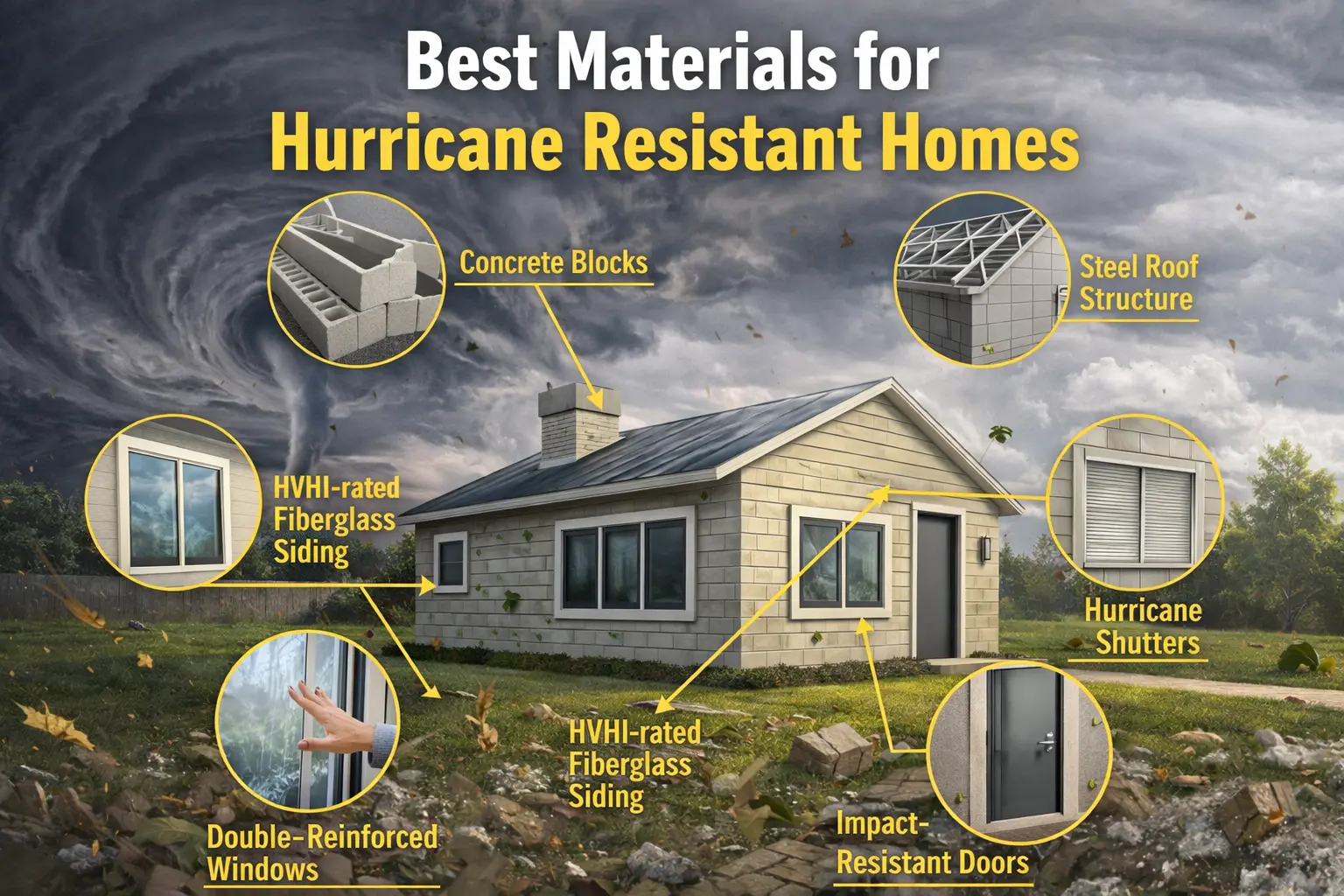
Best Materials for Hurricane Resistant Homes What Florida Builders Recommend

This guide explains the top hurricane-resistant materials used in modern storm-safe homes and why they perform better in extreme conditions.

Why Material Choice Matters in Hurricanes

Hurricanes force attacks on a home in three primary ways:

If materials fail in any of these areas, the structure becomes vulnerable. For example:

Hurricane-resistant materials are chosen specifically to resist these forces.

1. Reinforced Concrete

Reinforced concrete is widely considered the most durable structural material for hurricane zones. Steel rebar embedded in concrete creates a composite material that resists both compression and tension.

Hurricane resistance advantages

Concrete walls can withstand forces that destroy wood framing.

Where it’s used

Concrete forms the backbone of many hurricane-resistant homes.

2. Structural Steel Framing

Steel is one of the strongest building materials available for residential construction. Unlike wood, steel does not weaken when exposed to moisture, termites, or mold.

This is the primary structural system used by Florida Steel Homes.

Hurricane resistance advantages

  • High strength-to-weight ratio

  • Flexible under wind load

  • Precise engineered connections

  • No rot or warping

  • Long-term structural stability

Steel framing can be engineered for 180–200+ mph wind ratings, common in Florida coastal design.

3. Insulated Concrete Forms (ICF)

ICF combines reinforced concrete with permanent foam insulation layers. The result is a thick, solid wall with exceptional strength and energy efficiency.

Hurricane resistance advantages

  • Reinforced concrete core

  • Continuous load path

  • High debris impact resistance

  • Strong roof anchoring

  • Energy efficiency

ICF walls are significantly stronger than standard block or wood walls.

4. Concrete Masonry Block (CMU)

Concrete block is widely used in Florida due to its durability and cost balance. When reinforced with steel and grout, CMU walls can provide solid hurricane resistance.

Advantages

  • Better than wood framing

  • Fire and moisture resistant

  • Widely code-approved

  • Durable in coastal climates

Limitations

Performance depends on:

  • Reinforcement spacing

  • Grout quality

  • Roof connection strength

Properly reinforced CMU performs far better than unreinforced block.

5. Impact-Resistant Glass

Openings are the most vulnerable parts of a hurricane-exposed home. Impact-resistant glass prevents wind and debris from breaching the building envelope.

Why it matters

When windows fail:

  • Internal pressure rises

  • Roof uplift increases

  • Water enters

  • Structural damage escalates

Impact glass maintains seal integrity even after cracking.

6. Metal Roofing Systems

Roof failure is one of the most common hurricane damage mechanisms. Metal roofing systems provide superior uplift resistance compared to asphalt shingles.

Hurricane resistance advantages

  • Strong mechanical fastening

  • Continuous panels

  • Lightweight yet strong

  • Wind uplift resistance

  • Long lifespan

Standing-seam metal roofs are especially hurricane-resistant.

7. Stainless or Galvanized Fasteners and Connectors

Small components often determine structural survival.

Hurricane-resistant homes use:

  • Galvanized steel connectors

  • Stainless steel fasteners

  • Structural anchors

  • Hurricane straps

These create the continuous load path tying the roof, walls, and foundation together.

Corrosion-resistant metals are critical in coastal Florida environments.

8. Elevated and Reinforced Foundations

In coastal zones, materials must also resist:

  • Flooding

  • Soil erosion

  • Saltwater exposure

Best foundation materials:

  • Reinforced concrete piles

  • Elevated slabs

  • Marine-grade concrete

  • Steel reinforcement

These prevent surge damage and structural shifting.

Material Performance Ranking for Hurricane Resistance

Typical structural strength hierarchy:

  1. Reinforced concrete

  2. Steel framing

  3. ICF concrete systems

  4. Reinforced CMU block

  5. Wood framing

Wood can be upgraded with connectors and sheathing, but remains less durable under extreme hurricane forces.

How Materials Work Together in Hurricane-Resistant Homes

True hurricane resistance comes from system design, not just one material.

Modern storm-resistant homes combine:

  • Steel or concrete structure

  • Impact windows

  • Metal roof

  • Reinforced connections

  • Elevated foundation

This creates a sealed, continuous structural shell capable of resisting wind and debris.

Choosing the Best Material for Your Florida Home

Material selection depends on:

  • Coastal proximity

  • Wind zone rating

  • Flood zone

  • Budget

  • Insurance requirements

  • Long-term durability goals

For high-risk coastal regions, steel and reinforced concrete systems typically provide the highest structural safety.

Final Thoughts

Hurricanes are powerful enough to destroy conventional homes, but modern materials now allow houses to be built far stronger than traditional construction.

Reinforced concrete, steel framing, impact-rated openings, and metal roofing form the core of today’s hurricane-resistant homes. Choosing these materials can dramatically reduce storm damage risk, improve structural safety, and protect long-term property value.

For Florida homeowners building or rebuilding in hurricane zones, material choice is not just a construction decision — it’s a safety investment.

Florida Steel Homes
Hurricane-Resistant Steel Home Specialists

📞 786-610-6398
📧 info@FloridaSteelHomes.com
📍 16104 4th St E, Redington Beach, FL 33708

Leave a Reply

Your email address will not be published. Required fields are marked *