For many American homeowners, severe storms are a seasonal concern. But in tornado-prone regions, they’re a life-safety threat. Tornadoes produce the most violent winds on Earth — often exceeding 200 mph, with rapidly changing pressure and airborne debris capable of penetrating standard homes.
After major tornado events across the U.S., investigators consistently observe the same pattern: conventional wood-frame houses are destroyed, while reinforced or engineered structures remain standing or partially intact.
This has led to growing interest in tornado-proof house designs — homes engineered specifically to resist extreme wind loads, debris impact, and structural collapse.
If you’re building in a high-wind region or want maximum structural safety, understanding tornado-resistant design strategies can help you create a far more resilient home.
Tornado-Proof House Designs That Survive
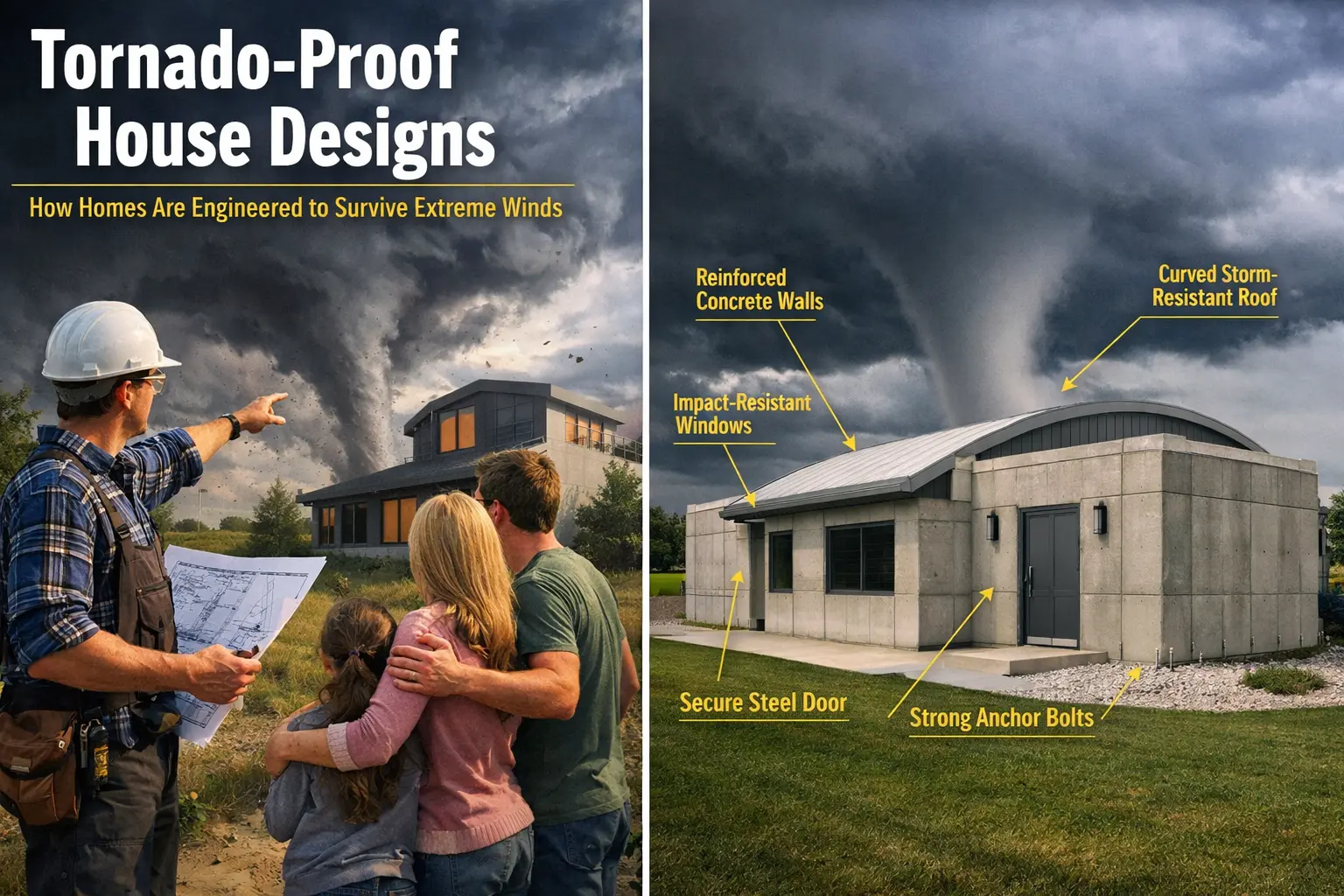
Why Standard Homes Fail in Tornadoes
Typical U.S. houses use wood framing, which performs adequately in normal storms but fails under tornado forces.
Common tornado failure mechanisms:
Roof uplift and separation
Wall collapse from lateral pressure
Debris penetration
Progressive structural failure
Foundation anchoring failure
Once the roof lifts, walls lose lateral support and collapse quickly.
Tornado-resistant homes instead focus on:
Continuous structural shell
Reinforced materials
Aerodynamic geometry
Strong anchoring
Debris-resistant openings
1. Reinforced Concrete Dome Homes
Concrete dome homes are among the most tornado-resistant structures ever built. Their curved shape allows wind to flow around rather than push against flat walls.
Why domes survive tornadoes
Aerodynamic shape reduces wind pressure
Reinforced concrete shell
No roof edges to lift
Even load distribution
Extreme debris resistance
Many dome homes have survived direct tornado strikes with minimal damage.
Key advantage
Wind cannot “grab” the structure — a major reason flat-walled homes fail.
2. Steel-Frame Tornado-Resistant Homes
Steel framing offers exceptional strength and flexibility under extreme wind loads. When engineered correctly, steel homes can resist forces far beyond wood framing limits.
Tornado resistance benefits
High strength-to-weight ratio
Flexible energy absorption
Strong mechanical connections
Anchored to the foundation
Resistant to debris penetration
Steel homes are commonly used in hurricane and tornado-resistant construction for this reason.
Real-world performance
Post-tornado damage surveys often show steel-framed structures still standing while nearby wood homes are destroyed.