If you live anywhere along Florida’s Gulf Coast—from Redington Beach to Tampa Bay and beyond—”hurricane-proof” isn’t a buzzword. It’s a survival question. Every storm season, homeowners ask the same thing: when a Category 5 hurricane makes landfall, what actually keeps a house standing—concrete or steel?
Hurricane-Proof Concrete Homes vs. Steel Homes
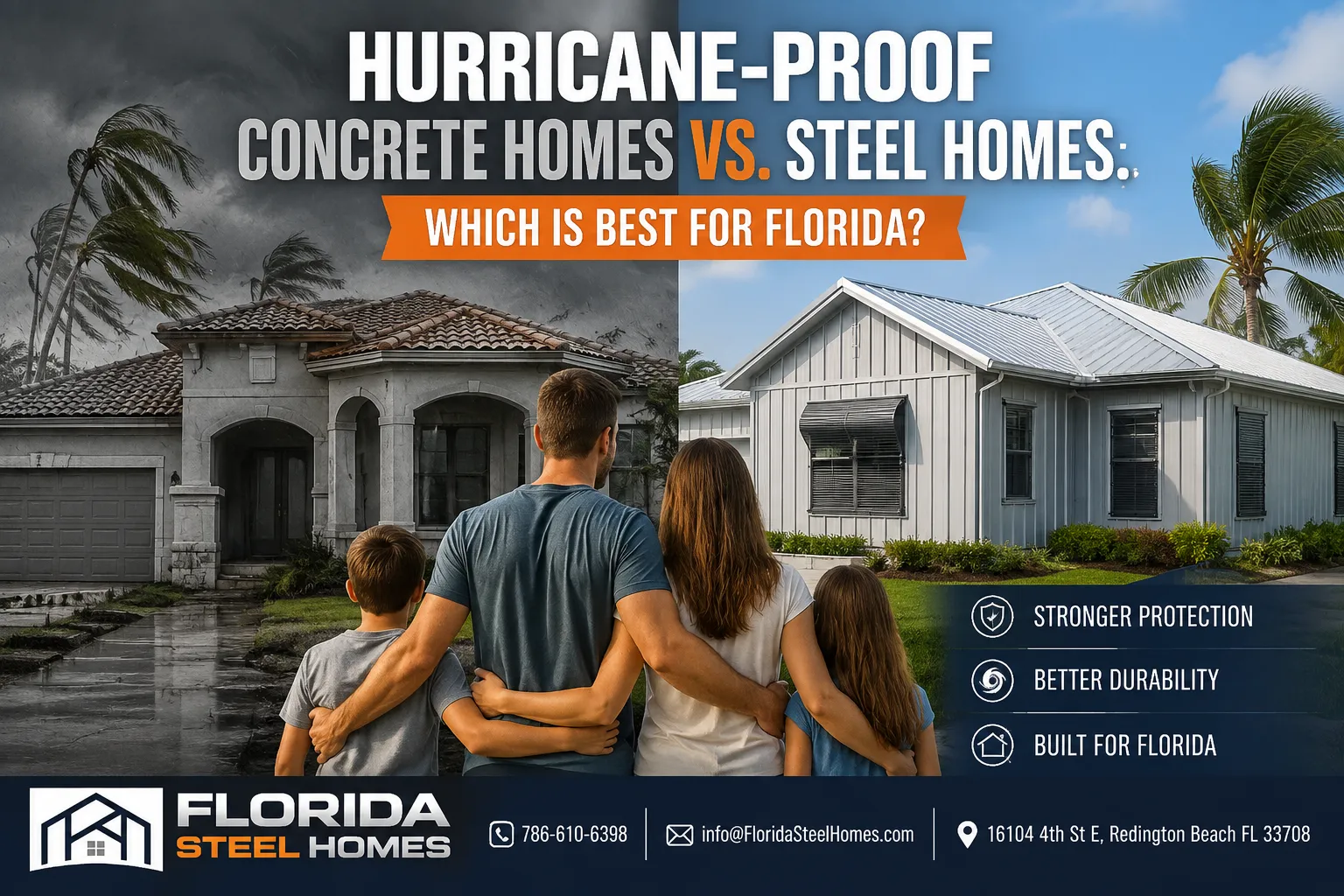
The honest answer: both can survive a Cat 5 if engineered correctly, but they don’t survive the same way, and one comes with fewer long-term headaches in Florida’s climate. Let’s break it down.
Not sure which build is right for your lot? Call Florida Steel Homes at 786-610-6398 for a free structural consultation — no obligation, just straight answers.
What Actually Makes a Home “Hurricane-Proof”?
No home is 100% indestructible, but a true hurricane-resistant home is engineered around three things:
- Wind resistance — the structure must handle sustained winds of 157+ mph (Cat 5 threshold) and gusts well beyond that
- Impact resistance — walls and openings must survive wind-borne debris, the #1 cause of building envelope failure
- Structural continuity — the roof, walls, and foundation must be tied together as one continuous system, not separate parts that can peel apart
Both concrete and steel construction can meet these standards. The difference shows up in how they perform, what they cost, and how they hold up over decades in Florida’s heat, humidity, and salt air.
Concrete Homes: Strength Through Mass
Poured concrete or insulated concrete form (ICF) homes have long been Florida’s go-to for storm resistance, and for good reason.
Strengths:
- Excellent compressive strength and wind resistance when properly reinforced with rebar
- Naturally fire-resistant and pest-proof
- Thermal mass helps with energy efficiency
Weaknesses in a Cat 5 scenario:
- Concrete is brittle under lateral and uplift stress unless heavily reinforced — cracking can develop at connection points
- Heavy, which means higher foundation costs and longer build timelines
- Rebar inside concrete is vulnerable to corrosion from saltwater intrusion and humidity over time, a real issue for coastal Florida
- Repairs after storm damage are labour-intensive and expensive
Steel Homes: Strength Through Flexibility and Continuous Load Paths
Steel-framed homes work differently. Instead of relying purely on mass, steel structures use a continuous load path — every connection, from roof to wall to foundation, is bolted and engineered to transfer wind force down into the ground rather than letting it rip the structure apart.
Strengths:
- Steel has a higher strength-to-weight ratio than concrete, meaning less material carries more load
- Engineered steel connections are tested to resist uplift and lateral wind shear — the exact forces that tear roofs off in a Cat 5
- Doesn’t crack, rot, warp, or attract termites (a major issue for Florida wood-frame homes)
- Non-combustible and doesn’t corrode the way rebar-in-concrete does, especially with galvanised or coated steel
- Faster build times, which matter when you’re racing a construction season against hurricane season
Trade-offs:
- Requires quality insulation planning since steel conducts heat/cold
- Upfront framing costs can run higher than wood, though often comparable to reinforced concrete
Curious how a steel-framed build compares for your specific property? Email info@FloridaSteelHomes.com and our team will walk you through real wind-load numbers for your area.
Side-by-Side: Concrete vs. Steel for Cat 5 Survivability
| Factor | Concrete Homes | Steel Homes |
|---|---|---|
| Wind uplift resistance | Strong, but connection points can be a weak spot | Very strong — engineered continuous load path |
| Debris impact resistance | Excellent (mass-based) | Excellent (with reinforced panels) |
| Long-term corrosion risk (coastal FL) | Rebar corrosion over time | Low, with galvanised/coated steel |
| Termite/pest resistance | Yes | Yes |
| Build speed | Slower | Faster |
| Repair cost after storm damage | Higher | Lower |
| Energy efficiency | Good (thermal mass) | Good (with proper insulation) |
| Ideal for tiny homes/ADUs | Less practical | Excellent — lightweight, modular, fast to deploy |
Why Steel Is Gaining Ground for Hurricane-Proof Tiny Homes in Florida
Here’s where steel really separates itself: tiny homes and accessory dwelling units (ADUs).
Florida homeowners increasingly want a compact, storm-rated structure — a guest house, rental unit, or standalone retreat — without pouring a massive concrete footprint. Steel is the natural fit:
- Lightweight framing means a hurricane-proof tiny home can be engineered and built far faster than an equivalent concrete structure
- Modular steel panels allow tiny homes to be pre-engineered for wind ratings up to and including Cat 5, without the bulk of reinforced concrete
- Lower foundation demands since steel structures weigh significantly less, which cuts site prep and cost
- Corrosion-resistant coatings hold up better than concrete’s embedded rebar in salt-air environments common across coastal Florida
If you’re exploring a hurricane-proof tiny home in Florida — whether as an investment property, in-law suite, or storm-hardened retreat — steel framing is currently the more practical, faster, and often more affordable path to true Cat 5-rated construction.
Thinking about a tiny home build? Call 786-610-6398 — Florida Steel Homes designs tiny homes engineered specifically for Cat 5 wind ratings.
Frequently Asked Questions
Can a steel home really withstand a Category 5 hurricane? Yes, when engineered with a continuous load path, properly rated connectors, and impact-resistant panels, steel-framed homes are certified to withstand Cat 5 wind speeds (157+ mph).
Is concrete or steel better for coastal Florida specifically? Steel generally performs better long-term in coastal environments because it avoids the rebar corrosion issue that affects concrete structures exposed to salt air and humidity over decades.
Are hurricane-proof tiny homes actually Cat 5 rated? They can be, if built with engineered steel framing, impact-rated windows/doors, and a properly anchored foundation. Not all “tiny homes” marketed in Florida meet this standard — always ask for the wind rating and engineering documentation.
Does a steel home cost more than a concrete home? Not necessarily. While steel framing materials can be comparable or slightly higher upfront, faster build times and lower long-term repair/corrosion costs often make steel more cost-effective over the life of the home.
How do I know if a home is truly rated for Cat 5 winds? Ask your builder for the engineered wind design speed (in mph) and Miami-Dade/Florida Building Code approval documentation — not just the term “hurricane-proof”.
The Verdict
Both concrete and steel can be built to survive a Category 5 hurricane. But steel’s strength-to-weight ratio, resistance to long-term coastal corrosion, faster build timelines, and suitability for tiny homes and ADUs give it a practical edge for most Florida homeowners building today — especially anywhere near the water.
Florida Steel Homes
📍 16104 4th St E, Redington Beach, FL 33708
📞 786-610-6398
✉️ info@FloridaSteelHomes.com
Ready to build a home engineered for the next Cat 5? Call us today or send us an email—we’ll walk you through wind ratings, timelines, and pricing for concrete vs. steel builds, including hurricane-proof tiny homes.