If you’re building on an island or coastal property anywhere from Puerto Rico to the Bahamas, Jamaica, or the Virgin Islands, one question matters more than square footage or floor plan: will this house still be standing after the next Category 4?
Traditional wood-frame construction struggles in the Caribbean’s climate — humidity, termites, salt air, and, of course, hurricanes. That’s why more homeowners, developers, and vacation-rental owners are turning to hurricane-proof prefab homes: factory-engineered structures built to a wind rating, then shipped and assembled on-site in weeks instead of months.
Hurricane-Proof Prefab Homes
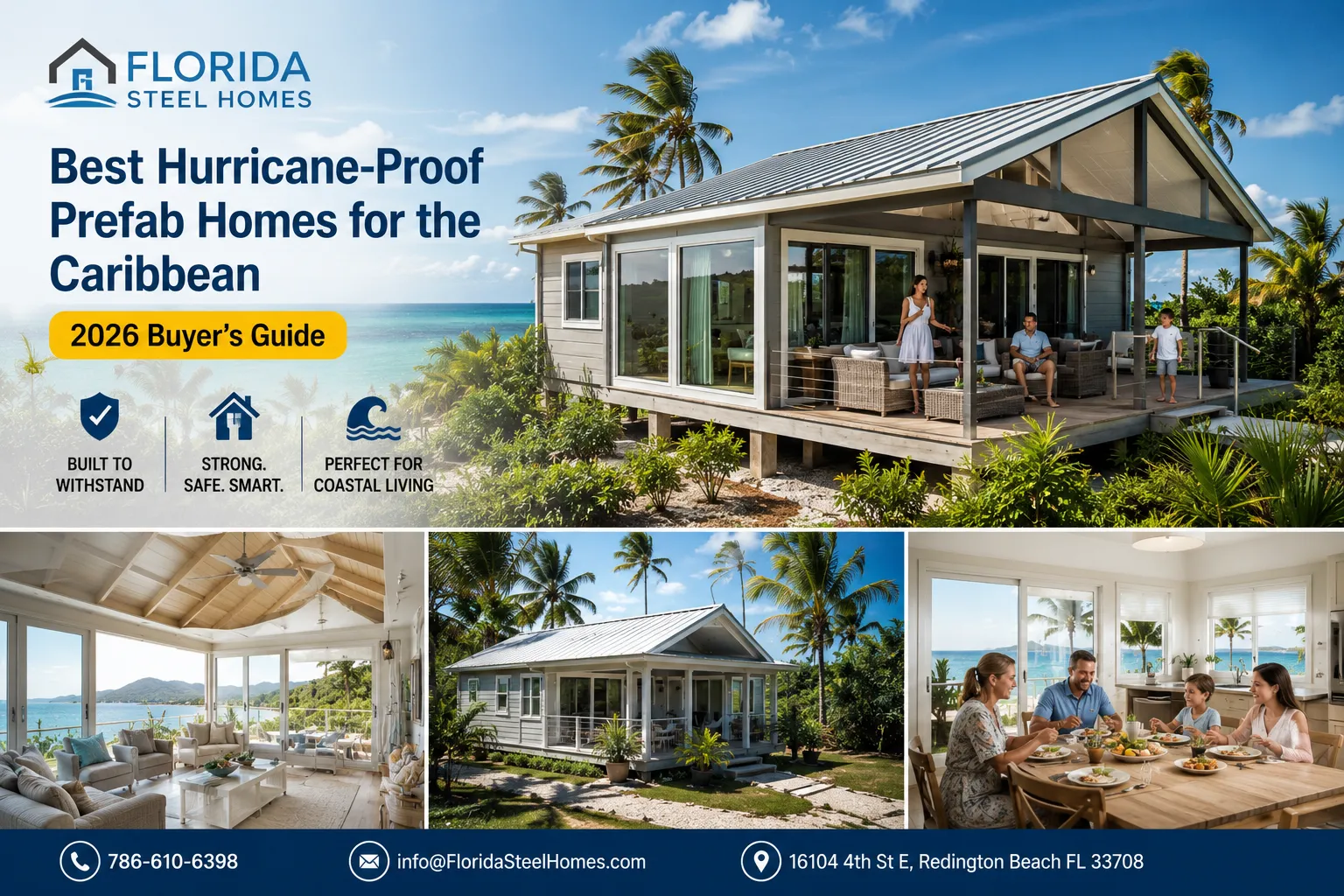
This guide breaks down what actually makes a prefab home hurricane-proof, the best construction types for the Caribbean, and how to choose a builder that won’t cut corners where it counts.
Want a free wind-rating consultation for your property? Call Florida Steel Homes at 786-610-6398 or email info@FloridaSteelHomes.com—they engineer and ship steel prefab homes throughout Florida and the Caribbean.
What Makes a Prefab Home Actually “Hurricane-Proof”?
No home is 100% storm-proof, but a properly engineered prefab can be built to withstand sustained winds of 160+ mph — well into Category 5 territory. Look for these non-negotiables:
- Steel frame construction — steel doesn’t rot, warp, or feed termites, and it resists uplift far better than wood framing
- Wind rating of 160+ mph, tested to Miami-Dade County’s High Velocity Hurricane Zone (HVHZ) standard — the toughest building code in the U.S. and a strong benchmark for Caribbean conditions
- Impact-rated windows and doors rated for large missile impact, not just “hurricane shutters bolted on after the fact”
- Engineered foundation anchoring — proper tie-downs and footing design matter as much as the walls
- Standing-seam metal roofing, rated for high uplift, instead of asphalt shingles that peel in sustained wind
- Elevated or reinforced base for flood-prone coastal lots
If a prefab company can’t show you third-party wind-load engineering documents, keep looking.
Steel vs. Concrete vs. Wood Prefab: Which Wins for the Caribbean?
| Construction Type | Wind Resistance | Termite/Rot Resistance | Shipping to Islands | Cost |
|---|---|---|---|---|
| Steel frame prefab | Excellent (160+ mph) | Excellent | Easy — modular panels ship by container | $$ |
| Insulated concrete panel | Excellent | Excellent | Difficult — heavy, expensive freight | $$$ |
| Wood-frame prefab | Fair to Good | Poor without heavy treatment | Moderate | $ |
Steel prefab consistently comes out ahead for Caribbean builds because it combines hurricane-grade strength with panels light enough to containerise and ship affordably to island locations — a real constraint that concrete construction struggles with.
Hurricane-Proof Tiny Homes: A Growing Trend in Florida and the Caribbean
Not every buyer needs a 3-bedroom house. Hurricane-proof tiny homes have become one of the fastest-growing categories in storm-resistant prefab construction, especially for:
- Guest cottages and rental units on existing island property
- Backup/ADU housing that can be rebuilt fast after a storm
- Budget-conscious first builds on raw land
- Off-grid or remote parcels where full-size freight isn’t practical
A well-built steel tiny home (300–600 sq ft) can carry the same 160+ mph wind rating as a full-size home, at a fraction of the material and shipping cost — making it a smart entry point for Caribbean buyers testing a location before committing to a larger build.
Curious what a hurricane-proof tiny home would cost for your lot? Reach the team at Florida Steel Homes — 786-610-6398 or info@FloridaSteelHomes.com — for a no-obligation quote.
What to Look for in a Prefab Builder
Before signing with anyone, ask:
- What wind speed is the home certified for, and by whom? (Ask for HVHZ or equivalent documentation.)
- Can they ship and assemble outside the U.S. mainland? Not every prefab manufacturer handles island logistics.
- What’s the foundation and anchoring plan for your specific lot? Coastal soil and flood zones change the engineering.
- How fast is delivery and assembly? Steel prefab typically beats traditional construction timelines by months.
- Do they offer both full-size homes and tiny home models? Flexibility matters if your plans evolve.
Florida Steel Homes, based at 16104 4th St E, Redington Beach, FL 33708, works with buyers building both full hurricane-rated homes and tiny home units, with experience shipping steel prefab structures for Florida and Caribbean sites.
Frequently Asked Questions
Can a prefab home really survive a Category 5 hurricane? A properly engineered steel prefab home rated for 160+ mph wind loads, with impact windows and a secured foundation, is built to withstand Category 5 conditions. No structure is guaranteed indestructible, but engineering and materials make the difference between survivable damage and total loss.
Are steel prefab homes more expensive than wood-frame homes? Upfront material costs can run slightly higher, but steel prefab homes typically cost less over time — lower insurance premiums in hurricane zones, no termite treatment, and far less storm-repair risk.
How long does it take to build a hurricane-proof prefab home in the Caribbean? Once engineering and permitting are complete, most steel prefab homes can be shipped and assembled in 6–12 weeks, compared to 6–12+ months for traditional site-built construction.
What’s the difference between a hurricane-proof tiny home and a standard prefab home? The engineering standard is the same — wind rating, impact windows, steel framing — the tiny home is simply a smaller footprint (usually under 600 sq ft), making it faster to ship and lower-cost to build.
Do hurricane-proof prefab homes qualify for lower insurance premiums? In many jurisdictions, yes. Homes certified to HVHZ or equivalent wind standards often qualify for wind-mitigation insurance discounts — ask your builder for the documentation your insurer will require.
Ready to Build Storm-Resistant?
Whether you’re planning a full hurricane-rated home or a tiny home unit for your Caribbean property, getting the engineering right from day one is what separates a home that survives from one that doesn’t.
📞 Call 786-610-6398
📍 16104 4th St E, Redington Beach, FL 33708
Florida Steel Homes can walk you through wind ratings, shipping logistics, and tiny home vs. full-size options for your specific lot — no pressure, just straight answers.