Florida homeowners face a reality that most of the country doesn’t: every June through November, the question isn’t if a hurricane will threaten your home; it’s when. As more Floridians downsize to tiny homes for affordability and flexibility, one question comes up constantly — can a tiny home actually survive a hurricane?
Hurricane Proof Tiny Homes in Florida
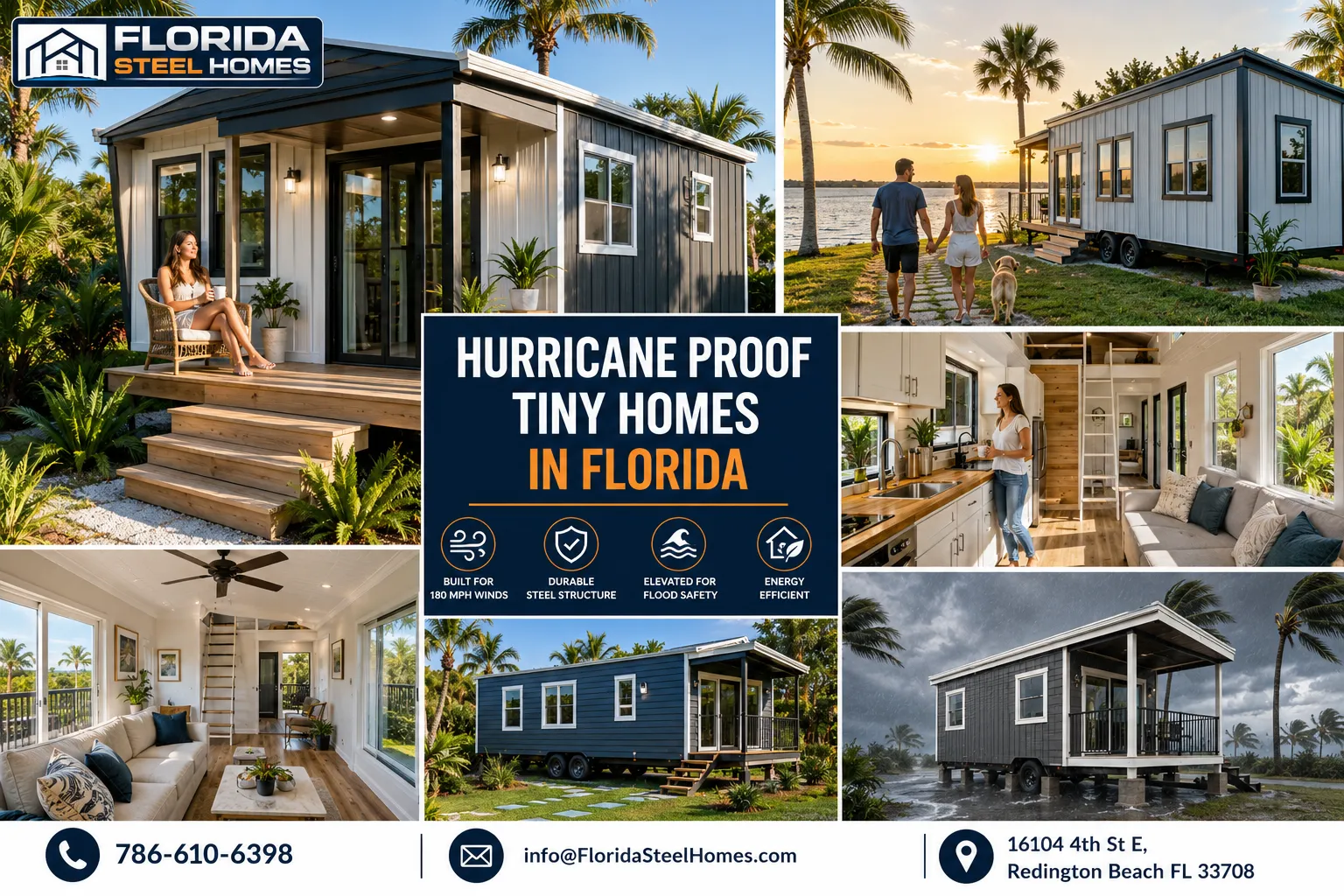
The short answer: yes, if it’s built right. And “built right” almost always means steel.
At Florida Steel Homes, we build hurricane-resistant tiny homes engineered specifically for Florida’s wind zones, flood requirements, and building codes. This guide walks through exactly what makes a tiny home hurricane-proof, what building codes require, and how steel construction outperforms wood-frame and traditional modular alternatives.
Thinking about building a hurricane proof tiny home in Florida? Call Florida Steel Homes at 786-610-6398 or email info@FloridaSteelHomes.com for a free site consultation. We’re based at 16104 4th St E, Redington Beach, FL 33708 and serve builders across the state.
Why Standard Tiny Homes Fail in Florida Hurricanes
Most tiny homes sold nationally are built on wood-frame trailers designed for mild climates. When a Category 3+ hurricane hits, three things typically fail first:
- Roof uplift — wood trusses and standard fasteners pull away under sustained wind loads above 111 mph.
- Wall racking — timber stud walls flex and shift, cracking siding and compromising the building envelope.
- Anchoring failure — many tiny homes on wheels or light foundations aren’t rated for FBC (Florida Building Code) wind-borne debris and uplift requirements.
A true hurricane-proof tiny home has to be engineered as a system — foundation, frame, walls, roof, and openings — not just built with “sturdy materials.”
What Makes a Tiny Home Truly Hurricane-Proof
1. Cold-Formed Steel Framing
Steel-framed tiny homes don’t rot, warp, burn, or attract termites — all common problems in Florida’s humid climate. More importantly, steel studs and trusses have far higher tensile strength than wood, allowing the structure to resist wind loads rated for 150–180+ mph, which covers even Category 5 hurricane conditions.
2. Engineered Roof-to-Wall Connections
The weakest point in most homes isn’t the wall — it’s where the roof meets the wall. Florida Steel Homes uses continuous steel load paths and hurricane strapping so wind forces transfer safely down into the foundation instead of tearing the roof off.
3. Impact-Rated Windows and Doors
The Florida Building Code (High-Velocity Hurricane Zone sections, Miami-Dade/Broward) requires impact-rated glazing or approved shutters for wind-borne debris regions. We install Miami-Dade NOA-approved impact windows and doors as standard, not an upsell.
4. Proper Foundation Anchoring
Whether your tiny home sits on a permanent concrete slab, piers, or an engineered chassis, it must be anchored per Florida’s uplift and flood elevation requirements. This is where most out-of-state tiny home manufacturers fall short — their designs simply aren’t engineered for FBC compliance.
5. Flood-Resistant Elevation
Many Florida counties require finished floor elevation above base flood elevation (BFE). We design steel pier and pile foundations that meet FEMA and local flood zone requirements without compromising the compact footprint of a tiny home.
Steel vs. Wood vs. ICF: Which Is Best for a Florida Tiny Home?
| Feature | Wood Frame | ICF (Insulated Concrete Form) | Steel Frame (Florida Steel Homes) |
|---|---|---|---|
| Wind resistance | Up to ~110 mph | 150–200+ mph | 150–180+ mph |
| Termite/rot resistance | Low | High | High |
| Weight (foundation cost) | Light | Very heavy | Light–moderate |
| Build speed | Fast | Slow | Fast |
| Best fit for tiny homes | Limited | Difficult (bulky walls) | Excellent |
| Long-term maintenance | High | Low | Very low |
Steel offers the best combination for tiny homes specifically because ICF walls are thick and heavy, which eats into a tiny home’s limited square footage and adds significant foundation cost. Steel framing keeps walls thin, keeps the structure light enough for efficient foundations, and still meets Florida’s toughest wind codes.
Want to compare options for your property? Our team at Florida Steel Homes can walk you through wind zone requirements for your specific address. Call 786-610-6398 or email info@FloridaSteelHomes.com — we respond within one business day.
Florida Building Code Requirements You Should Know
Before building anywhere in Florida, understand these baseline requirements:
- Wind speed design: Most of coastal Florida requires design wind speeds of 150–195 mph depending on Risk Category and location, per the Florida Building Code.
- Wind-Borne Debris Region: Homes near the coast typically require impact-rated windows/doors or code-approved shutters.
- Flood elevation: FEMA flood maps and local ordinances dictate minimum floor elevation, especially in coastal and low-lying counties.
- Permitting: Even tiny homes on permanent foundations generally require full building permits, engineering seals, and inspections — unlike some states where tiny homes fall under a lighter RV classification.
Building codes vary by county (Miami-Dade and Broward have the strictest High-Velocity Hurricane Zone rules in the country), so site-specific engineering matters more than a generic tiny home floor plan ordered online.
How Florida Steel Homes Builds a Hurricane-Proof Tiny Home
- Site & Wind Zone Assessment — We pull your county’s wind speed, flood zone, and setback requirements before any design work starts.
- Engineered Steel Design — Every home is designed with a Florida-licensed engineer to meet or exceed FBC wind and uplift loads.
- Off-Site Steel Fabrication — Framing is precision-cut and fabricated for faster, more consistent on-site assembly.
- Impact-Rated Envelope — NOA-approved windows, doors, and roofing assemblies installed as standard.
- Anchored Foundation — Piers, slab, or piling systems designed for your specific flood elevation requirement.
- Final Inspection & Permitting Support — We coordinate with local building departments through final CO (Certificate of Occupancy).
Frequently Asked Questions
Can a tiny home really survive a Category 5 hurricane? A properly engineered steel-framed tiny home built to Florida Building Code standards can be designed to withstand sustained winds of 150–180+ mph, which covers Category 4 and most Category 5 wind speeds, provided the foundation, roof connections, and openings are all rated to match.
Is a steel tiny home more expensive than a wood-frame tiny home? Material costs can run slightly higher upfront, but steel-framed tiny homes typically cost less over time due to lower insurance premiums, minimal maintenance, and no termite or rot damage — both are common in Florida’s climate.
Do hurricane-proof tiny homes qualify for insurance discounts? Many Florida insurers offer wind mitigation discounts for homes with impact-rated windows, engineered roof-to-wall connections, and hurricane straps — all standard in Florida Steel Homes builds. Ask your insurer for a wind mitigation inspection after construction.
Can I put a hurricane-proof tiny home on my existing property? In most cases, yes, provided your lot meets local zoning and setback requirements. Florida Steel Homes handles site assessment and permitting coordination as part of the build process.
How long does it take to build a hurricane-proof tiny home in Florida? Typical timelines range from 8–16 weeks depending on county permitting speed, site preparation, and foundation type, once engineering and design are finalized.
Build a Tiny Home That’s Ready for Hurricane Season
Florida hurricanes aren’t slowing down — but your home doesn’t have to be a liability every storm season. Steel construction gives you a smaller footprint, lower long-term costs, and a structure genuinely engineered for Florida’s wind and flood codes.
Florida Steel Homes designs and builds hurricane-proof tiny homes across Florida, from initial wind-zone assessment through final inspection.
📞 Call us: 786-610-6398
✉️ Email: info@FloridaSteelHomes.com
📍 16104 4th St E, Redington Beach, FL 33708
Reach out today for a free consultation and find out what a hurricane-proof steel tiny home would cost on your property.