When people in Florida think about building a stronger home, hurricanes are almost always the first thing that comes to mind — and rightly so. But hurricanes are only one piece of the puzzle. Florida homeowners also face flooding, high humidity and mould, termite damage, sinkholes, tornadoes spun off from storms, and even fire risk during dry seasons. A truly disaster-resistant home has to be engineered for all of these threats, not just the one that makes the evening news.
Disaster Resistant Homes Florida: 6 Threat-Proof
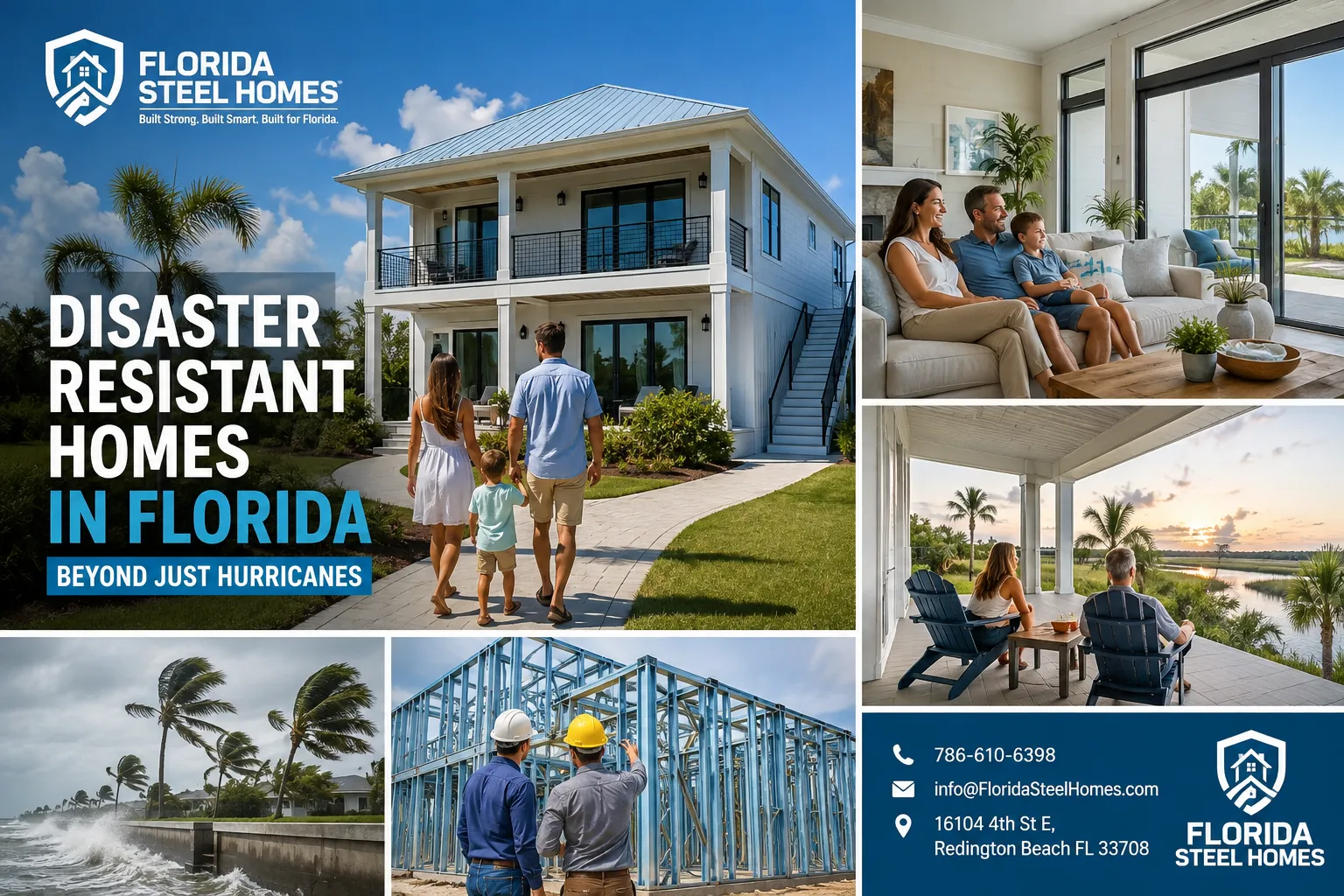
This is where steel-framed construction has quietly become the smarter choice for Florida homeowners — not as a hurricane add-on, but as a complete disaster-resistant building system.
Why “Hurricane Proof” Isn’t the Whole Story
Marketing terms like “hurricane proof” focus on wind resistance, and that’s important in a state that sees Category 3+ storms almost every season. But if you only build for wind, you can still end up with a home that:
- Floods from storm surge or heavy rainfall because the structural design didn’t account for water intrusion
- Develops mould and rot in wall cavities within a few humid summers
- Loses structural integrity to termites, which cause billions of dollars in damage across the Southeast every year
- Cracks or settles unevenly on Florida’s soft, sandy, sometimes sinkhole-prone soil
A genuinely disaster-resistant home is designed around the full risk profile of the region — wind, water, pests, heat, and ground movement together.
If you’re planning a build and want a structural assessment based on your specific lot and risk factors, Florida Steel Homes can walk you through what a full-risk design actually looks like — call 786-610-6398 or email info@FloridaSteelHomes.com.
The Full Range of Disasters Florida Homes Must Withstand
1. Hurricanes and High Wind
Steel-framed structures typically handle sustained winds far beyond what standard wood framing is rated for, because steel doesn’t flex, warp, or splinter the way lumber does under repeated stress. Combined with impact-rated windows and properly engineered roof-to-wall connections, a steel frame resists the kind of racking and uplift forces that tear conventional homes apart.
2. Flooding and Storm Surge
Steel doesn’t absorb water, so it doesn’t swell, warp, or rot after a flood the way wood framing does. That matters enormously in coastal Florida, where storm surge and heavy rain events are common even outside of a named storm.
3. Mould, Mildew, and Humidity Damage
Florida’s humidity is a slow-motion disaster for wood-framed homes. Because steel doesn’t provide organic material for mould to feed on, steel-framed walls are far less susceptible to the hidden mould growth that damages indoor air quality and structural framing over time.
4. Termites and Wood-Destroying Pests
Termites are one of the most under-discussed disaster risks in Florida. Subterranean and drywood termites are active nearly year-round in the state’s climate. Since steel isn’t a food source for termites, a steel frame effectively removes this entire category of risk from your home’s structure.
5. Fire Risk
Steel is non-combustible. While no home is entirely “fireproof”, a steel structural frame significantly reduces the chance of a fire spreading through the frame itself compared to traditional wood construction.
6. Sinkholes and Soil Movement
Florida sits on porous limestone, which makes parts of the state prone to sinkholes and ground settling. While no framing material can prevent a sinkhole, steel structures paired with proper foundation engineering distribute structural loads more predictably, which matters when soil conditions shift.
Curious how your specific area’s soil and flood zone data affects your build plan? Our team at Florida Steel Homes reviews site-specific risk before design even begins. Reach out at 786-610-6398 or info@FloridaSteelHomes.com.
Why Steel Framing Is the Backbone of True Disaster Resistance
| Risk | Wood Framing | Steel Framing |
|---|---|---|
| Hurricane-force wind | Prone to racking, uplift failure | Rigid, high wind-load capacity |
| Flooding | Absorbs water, warps, rots | Non-absorbent, dimensionally stable |
| Mould/humidity | Organic material feeds mould. | No organic material for mould growth |
| Termites | Primary food source for termites | Not a food source |
| Fire | Combustible | Non-combustible |
| Long-term settling | Can shift with moisture cycles | Consistent strength over decades |
Steel framing isn’t just “hurricane-resistant”—it’s engineered resilience against nearly every major disaster risk Florida presents at once.
Building for Florida’s Future, Not Just Its Last Storm
Insurance costs in Florida have climbed sharply, and one of the biggest factors insurers weigh is structural resilience. Homes built with steel framing and disaster-resistant design often qualify for better wind-mitigation credits, which can meaningfully lower long-term insurance premiums—an important consideration alongside the upfront build decision.
Beyond insurance savings, a steel-framed disaster-resistant home simply holds its value better. Buyers and appraisers increasingly recognise the difference between a home that merely “survived” a storm and one that was engineered from the ground up to handle Florida’s full range of natural threats.
Frequently Asked Questions
Are steel-framed homes actually hurricane-proof? No home is truly “hurricane proof,” but steel-framed homes are engineered to withstand significantly higher wind loads than standard wood-framed construction, and they resist the flooding, mold, and termite damage that often follow a storm.
Is steel framing more expensive than wood framing in Florida? Steel framing can carry a higher upfront material cost, but it typically reduces long-term expenses tied to pest control, mold remediation, storm repairs, and insurance premiums — often narrowing or reversing the cost gap over the life of the home.
Do steel-framed homes still need hurricane straps and impact windows? Yes. Steel framing is one part of a complete disaster-resistant system that also includes impact-rated windows, properly engineered roof connections, and code-compliant foundation design.
Can steel-framed homes handle Florida’s humidity? Yes. Because steel doesn’t absorb moisture or provide organic material for mould, it performs better than wood in Florida’s high-humidity climate over the long term.
Where does Florida Steel Homes build? Florida Steel Homes is based in Redington Beach, FL, and serves homeowners throughout the surrounding Florida coastal region.
Thinking About a Disaster-Resistant Build?
If you’re planning new construction or a rebuild in Florida, it’s worth asking your builder how they’re addressing every major risk — not just wind. Florida Steel Homes designs and builds steel-framed homes engineered for hurricanes, flooding, humidity, termites, fire, and shifting soil, all in one structural system.
📍 16104 4th St E, Redington Beach, FL 33708
📞 786-610-6398
✉️ info@FloridaSteelHomes.com
Reach out today for a consultation on what a truly disaster-resistant home looks like for your property.