Florida’s building codes are widely considered the strictest in the country — and in 2026, they’re getting stricter still. Between new legislative proposals, updated wind-speed standards, and the upcoming Ninth Edition of the Florida Building Code, homeowners who bought, built, or renovated even a few years ago may find their property no longer meets current expectations.
Florida Hurricane Building Codes
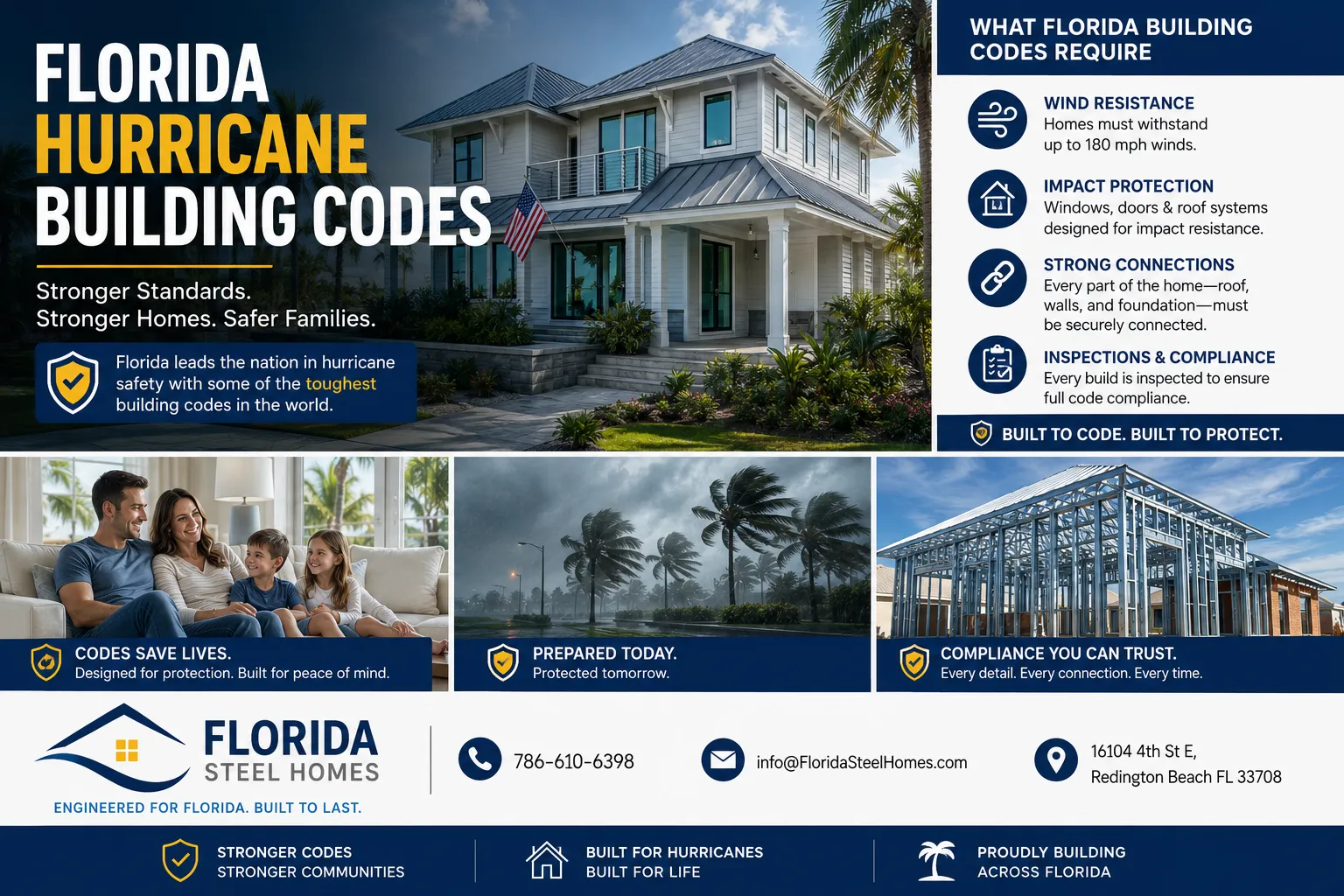
Here’s what’s actually changing this year, and what it means for your home, your insurance, and your safety.
Not sure where your home stands? Florida Steel Homes offers code-compliance evaluations for existing homes and fully engineered hurricane-rated new builds. Call 786-610-6398 or email info@FloridaSteelHomes.com.
Why Florida’s Codes Keep Getting Tougher
Florida’s building code framework was rewritten after Hurricane Andrew in 1992 exposed how poorly much of the state’s housing stock could withstand major storms. Since then, updates have arrived roughly every three years, each one incorporating lessons from the storms that came before it.
The 2026 update continues that pattern, but with added urgency. It draws on newer wind-speed data from the American Society of Civil Engineers, along with growing concern that hurricanes — while possibly less frequent — are becoming more intense due to warming ocean waters.
What’s New in the 2026 / Ninth Edition Code
A few key developments homeowners should track:
Stronger impact-resistance standards. Legislation filed in late 2025 (House Bill 911 and its companion Senate Bill 1218) proposes requiring certain buildings to have impact-resistant envelopes — exterior walls, doors, roofs, skylights, and glazing — capable of withstanding wind events of at least 160 mph. If enacted, these requirements would apply starting with the Ninth Edition of the Florida Building Code, expected to take effect December 31, 2026.
Updated wind speed maps and exposure categories. Revised ASCE calculations mean more precise, and often higher, wind-load requirements for how buildings must resist hurricane-force winds, particularly along the coast.
Changes to re-roofing rules. Notable proposals for the Ninth Edition include allowing partial roof recovery instead of full tear-off replacement in some cases, and potentially eliminating the long-standing rule requiring full roof replacement once 25% of it needs repair. This could change both the cost and scope of storm-damage repairs going forward.
Continued High-Velocity Hurricane Zone (HVHZ) requirements. Miami-Dade and Broward counties remain under the strictest tier of the code, with design wind speeds up to 175+ mph — the highest in the country. HVHZ requires Miami-Dade Notice of Acceptance (NOA) approval on windows, doors, roofing systems, garage doors, and other exterior products. Plywood shutters are not an acceptable substitute for impact-rated protection in this zone.
Building in Miami-Dade or Broward County? HVHZ compliance is non-negotiable and highly technical. Florida Steel Homes builds to full HVHZ standards from the ground up — reach out at 786-610-6398 for a project consultation.
Enforcement Has Real Teeth
This isn’t just paperwork. Non-compliance with current code can result in daily fines of up to $15,000 under Chapter 162 of the Florida Statutes, property liens, voided insurance coverage, and, in the case of condo or HOA properties, potential personal liability for association board members. That last point matters enormously post-Surfside — the 2021 Champlain Towers South collapse in Surfside, which claimed 98 lives, has directly shaped how aggressively the state now enforces structural compliance.
Flood Zone Requirements Layer on Top
If your property sits in a FEMA-designated Special Flood Hazard Area, you’re dealing with a second set of rules on top of wind requirements. Under the Florida Building Code and ASCE 24 standards, this typically means:
- Finished floor elevations must meet or exceed base flood elevation (BFE), often plus a foot or more of additional freeboard
- Flood-resistant materials required below the base flood elevation line
- Breakaway wall and foundation requirements in Coastal A-Zones and V-Zones
- Separate state permitting for any construction seaward of the Coastal Construction Control Line (CCCL)
What This Means If You’re Buying, Building, or Renovating
Buying a home? Ask directly whether the home has documented proof of code compliance — this affects both safety and insurance eligibility. Many insurers now require compliance documentation before issuing or renewing a policy.
Renovating? Even modest projects can trigger code review. As of 2026, local governments are required to exempt single-family residential work valued at $7,500 or less from building permit requirements, which speeds up small jobs — but anything beyond that threshold, especially roofing or window work, should be assumed to fall under current standards.
Building new? You’re in the best position. New construction is designed to meet the latest code from day one, and building with materials engineered specifically for these updated wind and impact standards — like properly connected steel framing — means you’re not retrofitting later.
Planning a new build or major renovation? Florida Steel Homes designs every project to meet — and often exceed — the latest Florida Building Code requirements, so you’re never playing catch-up with the next update. Call 786-610-6398 or email info@FloridaSteelHomes.com to start the conversation.
Why Steel Framing Fits Where the Code Is Heading
As wind-speed requirements climb and impact standards tighten, the materials used in a home’s structure matter more than ever. Steel framing offers consistent, engineered connection points for hurricane straps and continuous load paths — the exact features regulators are pushing harder on with each code cycle. Unlike wood, steel doesn’t warp, rot, or lose structural integrity over time in Florida’s humidity, which means the strength built in on day one stays intact for decades.
The Insurance Payoff
Homes that meet or exceed current wind mitigation standards can qualify for meaningful insurance discounts — often cited in the 30-45% range for features like hurricane straps, impact-rated openings, reinforced roof-to-wall connections, and secondary water resistance systems. As codes tighten, insurers are increasingly asking for proof of compliance before issuing or renewing coverage, making code-compliant construction a financial decision as much as a safety one.
Bottom Line for 2026
Florida’s building codes aren’t static, and “hurricane proof” isn’t a permanent label — a home built to code five or ten years ago may not meet 2026 standards. Whether you’re buying, renovating, or building new, the smartest move is getting a professional evaluation now, before storm season forces the issue.
Ready to Build or Verify a Hurricane-Ready Home?
Florida Steel Homes specializes in engineered, fully code-compliant steel-framed construction across Florida, including HVHZ-compliant builds for Miami-Dade and Broward.
📍 16104 4th St E, Redington Beach, FL 33708
Contact us for a home evaluation or new-build consultation.