When people picture hurricane-resistant construction, they usually imagine thick concrete walls, impact-rated windows, or steel framing. Few people picture a small metal bracket that costs less than a cup of coffee. But that little bracket — the hurricane strap — is often the single most important connection standing between your roof and a Category 3 storm.
Hurricane Straps 101: Save Your FL Roof Now
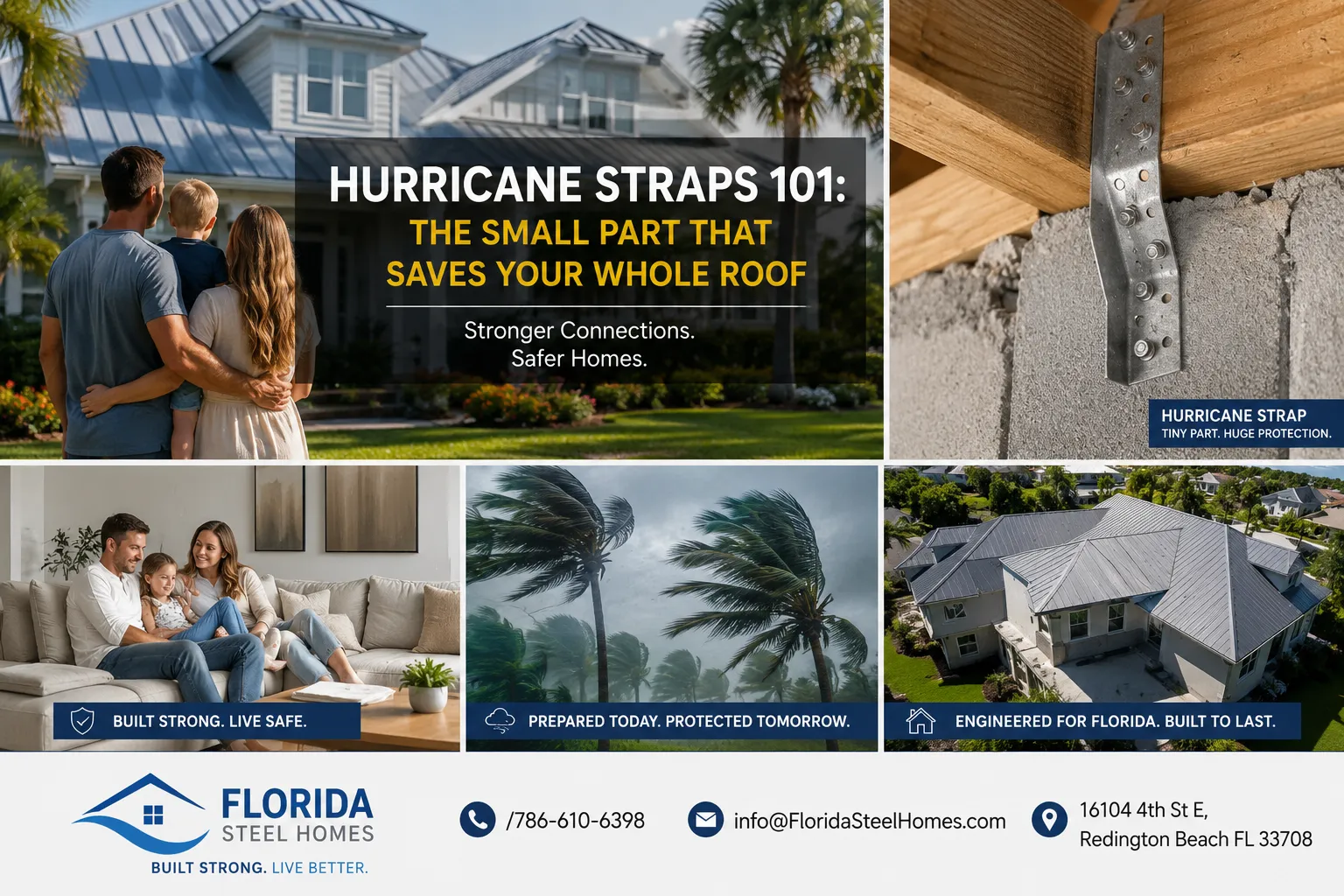
If you’re building or buying a home in Florida, understanding hurricane straps isn’t optional. It’s the difference between a roof that stays put and one that becomes debris in your neighbour’s yard.
Building or renovating in Florida? Florida Steel Homes designs and builds hurricane-rated steel homes engineered for exactly this — call 786-610-6398 or email info@FloridaSteelHomes.com for a free consultation.
What Is a Hurricane Strap, Exactly?
A hurricane strap (also called a hurricane tie or hurricane clip) is a galvanised or stainless-steel connector that physically ties your roof trusses or rafters to the wall framing below. Instead of relying on nails alone to hold the roof down, the strap wraps over or around the truss and fastens securely to the top plate of the wall, creating a continuous load path from the roof all the way down to the foundation.
Think of it as a seatbelt for your roof. Nails hold things together under normal conditions, but under the intense uplift pressure of hurricane-force winds, nails alone can pull straight out. Straps are engineered specifically to resist that uplift force.
Why Roofs Actually Fail in Hurricanes
Most people assume roofs fail because shingles blow off or debris punches a hole through the decking. In reality, catastrophic roof failure usually starts with uplift — wind moving over and around a roof creates a pressure difference that literally tries to lift the entire roof structure off the walls, like an aeroplane wing generating lift.
Once wind gets underneath a roof edge or through a single weak connection point, the entire roof can peel away in seconds. From there, the home’s walls lose lateral support, and the structure is exposed to wind-driven rain, which causes the majority of hurricane-related property damage.
Hurricane straps interrupt this failure chain at the exact point where it usually starts.
Steel Homes and Hurricane Straps: A Natural Match
Florida’s shift toward steel-framed homes has made hurricane strapping even more effective. Where wood framing can split, rot, or weaken over time — reducing the strap’s holding power — steel studs and trusses provide a stable, corrosion-resistant surface for strap connections that doesn’t degrade the same way.
In a steel home, hurricane straps are typically the following:
- Bolted or screwed into pre-engineered connection points rather than just nailed
- Matched load-for-load to the specific wind uplift ratings required by Florida Building Code for that region
- Paired with continuous steel load paths running from the roof trusses through the wall studs to the foundation anchors
This creates what engineers call a “continuous load path” — an unbroken chain of connections strong enough to transfer hurricane-force wind loads safely into the ground, instead of letting any single weak point become a failure point.
Florida Building Code Requirements
Since Hurricane Andrew devastated South Florida in 1992, the state has adopted some of the strictest building codes in the country. The Florida Building Code (FBC) now requires:
- Hurricane straps or approved connectors at every roof-to-wall connection in High-Velocity Hurricane Zones (HVHZ) like Miami-Dade and Broward counties
- Specific uplift capacity ratings depending on wind speed zone, roof shape, and building height
- Products tested and approved under Miami-Dade County’s Notice of Acceptance (NOA) or Florida Product Approval system
If you’re in coastal or high-wind-zone counties, your straps need to meet these ratings — not just any generic hardware-store bracket will do.
Not sure if your home meets current code? Florida Steel Homes can inspect your roof-to-wall connections and confirm code compliance. Reach us at 786-610-6398 or info@FloridaSteelHomes.com.
Signs Your Home Might Be Missing Proper Strapping
Many older Florida homes, especially those built before the mid-1990s code updates, were never retrofitted with hurricane straps. Warning signs include:
- Home built before 1994 with no documented retrofit
- Visible gaps between roof trusses and top wall plate from the attic
- No visible metal connectors when inspecting the attic framing
- Roof structure held only by toe-nailing (nails driven at an angle)
A licensed contractor or wind mitigation inspector can check this in under an hour, and it’s one of the most valuable inspections a Florida homeowner can get — both for safety and for insurance discounts.
The Insurance Angle
Florida’s wind mitigation inspection programme directly rewards homes with proper hurricane strapping. Insurers offer meaningful premium discounts for:
- Roof-to-wall connections using clips or single/double wrap straps
- Secondary water resistance (SWR) roof underlayment
- Reinforced gable ends
- Impact-rated openings
For steel-framed homes built to current code, this often means significantly lower annual premiums compared to older wood-framed construction – making hurricane straps not just a safety feature but a financial one.
The Bottom Line
Hurricane straps are inexpensive, unglamorous, and easy to overlook — which is exactly why they matter so much. A home can have the strongest steel frame, the most impact-resistant windows, and a beautifully engineered foundation, but if the roof isn’t physically tied down at every connection point, none of that matters once uplift takes hold.
For Florida homeowners and builders, the small strap is the detail that keeps the big structure standing.
Thinking about building or retrofitting a hurricane-resistant steel home in Florida? Ask your builder or inspector specifically about roof-to-wall connection ratings and continuous load path design — it’s one of the most important questions you can ask before signing off on construction.
Get a Hurricane-Ready Steel Home in Florida
Florida Steel Homes specialises in engineered, code-compliant steel-framed construction built to withstand Florida’s toughest storms — from roof-to-wall strapping and continuous load paths to full HVHZ-compliant builds.
📍 16104 4th St E, Redington Beach, FL 33708
Contact us today for a consultation on building or retrofitting your hurricane-resistant steel home.