If you live anywhere along the Gulf Coast or the Atlantic seaboard, you already know your homeowners insurance bill is one of the biggest line items in your budget. What a lot of homeowners don’t realize is how much control they actually have over that number. Hurricane-resistant upgrades—impact windows, a reinforced roof, hurricane straps, and storm shutters—don’t just protect your house during a storm. They can trigger real, mandated discounts on your premium, sometimes cutting the windstorm portion of your bill by half or more.
Here’s what the data actually shows, what upgrades matter most, and how to make sure you’re getting every discount you’re entitled to.
Hurricane Proof Home Florida: Ultimate 2026 Guide
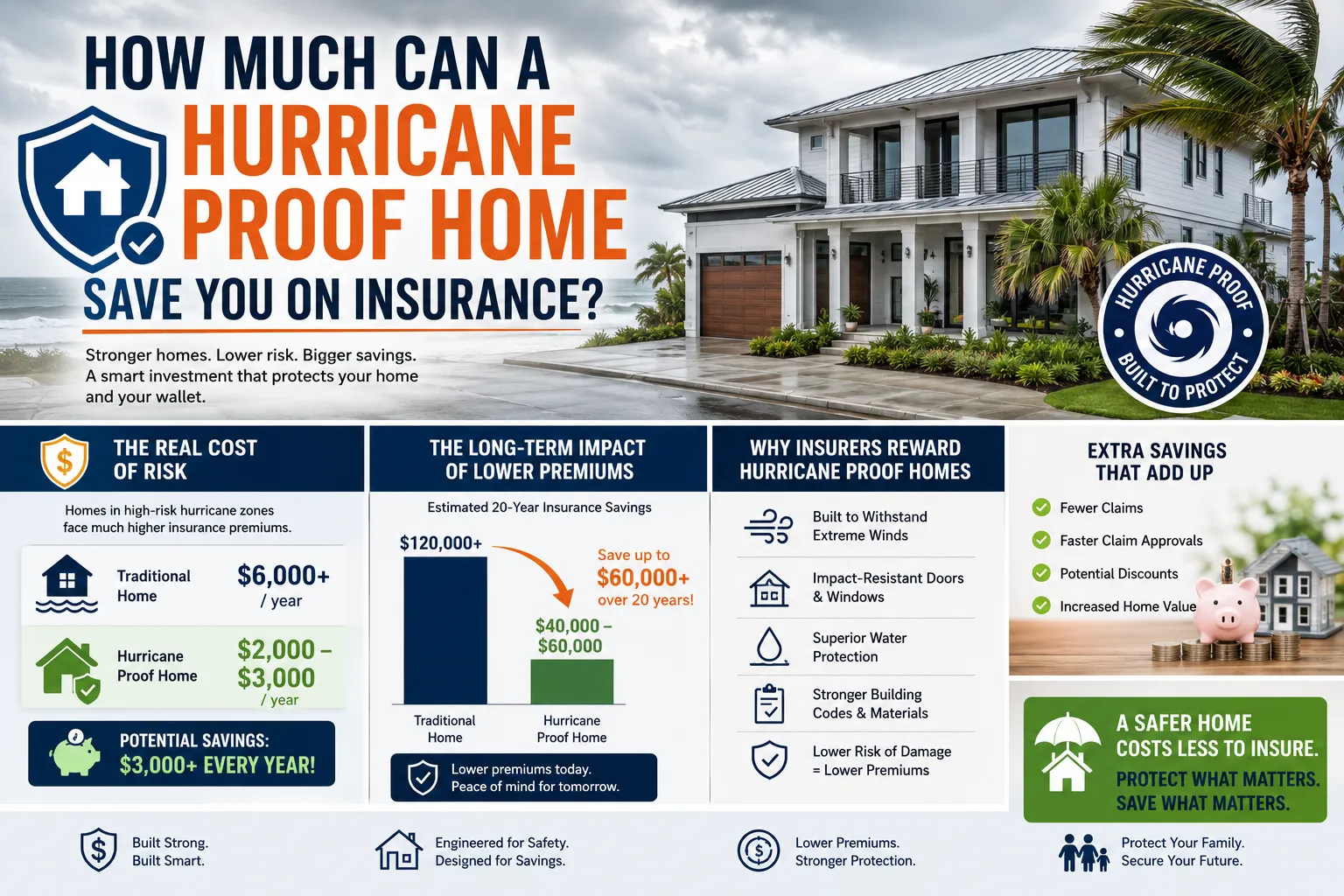
Most homeowners who invest in hurricane mitigation save somewhere between 10% and 45% on the windstorm portion of their premium, with some combinations of upgrades and some state programs pushing savings as high as 50–55%. Because the windstorm or “wind” portion of a coastal policy often makes up 30% to 70% of the total bill, that discount can translate into hundreds or even thousands of dollars a year.
A few real-world data points make this concrete:
- In Louisiana, homeowners who used a state grant to install a certified FORTIFIED roof saw their median annual premium drop from roughly $5,625 to $4,375 — a savings of about $1,250 a year, or roughly 22%.
- In Mississippi, some insurers offer FORTIFIED-standard discounts as high as 55% off the wind portion of a policy.
- In Florida, homes built to the state’s post-2001 hurricane building code (or the 1994 South Florida code in Miami-Dade and Broward counties) can qualify for a minimum 68% discount on the windstorm portion of their premium.
- In North Carolina, FORTIFIED Roof discounts typically run 10% to 25%, which on a $3,000 annual premium works out to roughly $300–$750 back in your pocket every year.
The exact number depends heavily on where you live, which insurer you use, and which upgrades your home actually has documented and verified.
Why Hurricane-Resistant Homes Get Discounts at All
Insurance pricing comes down to risk. A home with a sealed roof deck, hurricane straps, and impact-rated windows is statistically far less likely to suffer a total loss — or even a partial loss — in a wind event. Insurers have decades of claims data showing this, and in several coastal states, the law actually requires them to pass some of that reduced risk back to you in the form of a discount. You’re not asking for a favor; you’re asking your insurer to follow the numbers.
The Upgrades That Actually Move the Needle
Not every “hurricane-proof” feature carries the same weight with insurers. Here’s roughly how they rank:
Roof age and construction. This is often the single biggest factor. A roof under 10–15 years old, built or rebuilt to a recognized wind-resistance standard, can unlock the largest discounts on the list. Key features insurers look for:
- A sealed roof deck with a secondary water barrier (so if shingles are lost, water still can’t get in)
- Enhanced nailing patterns (ring-shank nails instead of smooth-shank, spaced tighter than code minimums)
- A hip roof shape rather than a gable roof (hip roofs perform significantly better in high wind)
- Reinforced roof-to-wall connections, typically metal hurricane straps or clips
Opening protection. Impact-rated windows and doors, or code-approved storm shutters covering every exterior opening, protect against both wind-borne debris and the pressure changes that can blow a roof off from the inside. This category alone can be worth 25–45% off a wind premium in high-exposure markets.
Roof-to-wall and wall-to-foundation connections. Continuous load paths — the engineering term for a house that’s essentially strapped together from roof to slab — reduce the odds of structural failure in extreme wind.
Secondary water resistance and roof shape. Even modest upgrades here, like sealing the roof deck during a routine re-roof, can bump you into a better discount tier for relatively little added cost.
The FORTIFIED Standard: A National Benchmark
The most widely recognized third-party certification for hurricane resilience is the FORTIFIED program, developed by the Insurance Institute for Business and Home Safety (IBHS). It has three tiers:
- FORTIFIED Roof—the entry point, focused entirely on making the roof system itself wind- and water-resistant
- FORTIFIED Silver—adds protection for openings (windows, doors, garage doors)
- FORTIFIED Gold — the most comprehensive tier, covering the full structural load path from roof to foundation
A certified evaluator inspects and documents the home, and IBHS issues a designation valid for five years. That certificate is what you hand to your insurance agent to unlock the discount — insurers won’t apply it based on your word alone. In states like Alabama, Mississippi, Louisiana, and the Carolinas, this designation is tied to some of the most generous discounts available, in a few cases as high as 55% off the wind portion of the premium.
Florida’s Wind Mitigation Inspection
If you’re in Florida, the mechanism looks a little different but works the same way. State law requires every insurer to offer discounts based on a standardized wind mitigation inspection form (currently the OIR-B1-1802, updated as recently as April 2026). A licensed inspector spends about 30 minutes documenting seven specific wind-resistance features—roof covering, roof deck attachment, roof-to-wall connections, roof shape, secondary water resistance, opening protection, and the year/code your home was built under.
That report is submitted to your carrier, and by law, they have to apply the corresponding discount. Because Florida’s windstorm coverage can represent up to 70% of a total premium, this single inspection is often the highest-leverage move a Florida homeowner can make—commonly worth 20% to 45% off the wind portion and, in some cases, considerably more for older, well-built homes. Reports are valid for five years, so if yours has expired or you’ve replaced a roof, windows, or doors since your last one, it’s worth getting a new inspection.
What About States Outside the Gulf and Southeast?
Wind mitigation credits aren’t exclusive to Florida and Louisiana. South Carolina, for example, requires insurers to offer discounts for impact-rated windows and other documented improvements, with homeowners in coastal areas like Charleston reporting 25–45% reductions and grant programs (like SC Safe Home) helping offset upgrade costs. Oklahoma, despite being nowhere near a coastline, has FORTIFIED discounts available too, since straight-line and tornado winds create similar structural risks to hurricanes.
The takeaway: If your state has meaningful wind, hail, or hurricane exposure, it’s worth asking your agent directly whether a wind mitigation or FORTIFIED discount is available—many homeowners never ask, and the discount is never volunteered.
Don’t Forget the Grants
Because hurricane-resistant upgrades can cost real money upfront, several states now offer grant programs to help cover the cost of qualifying improvements:
- Florida’s My Safe Florida Home Program has offered matching grants up to $10,000 for impact windows, doors, and roof upgrades on qualifying homes.
- Louisiana’s Fortify Homes Program provides grants up to $10,000 toward FORTIFIED roof upgrades.
- South Carolina’s Safe Home program offers grants up to $5,000 for wind-mitigation improvements in participating coastal counties.
These programs typically have income limits, home value caps, or first-come-first-served funding, so it’s worth checking current eligibility directly rather than assuming your home qualifies.
Putting the Numbers Together: A Realistic Example
Take a coastal home paying $4,000 a year in total premium, where the windstorm portion accounts for half the bill ($2,000):
- A 25% wind mitigation discount saves $500/year
- A 40% discount saves $800/year
- A 55% discount (achievable in some states with a full FORTIFIED designation) saves $1,100/year
Over 10 years, even the conservative end of that range adds up to $5,000–$11,000 in avoided premium costs—often more than covering the cost of the upgrades that earned the discount in the first place, especially when a grant offsets part of the installation cost.
How to Actually Claim These Discounts
- Get a wind mitigation or FORTIFIED inspection from a licensed, certified professional. Self-reported upgrades typically won’t qualify you for anything — insurers need third-party verification.
- Submit the report or certificate to your insurance carrier. The discount doesn’t apply automatically; someone has to send in the paperwork.
- Ask about midterm endorsements. Some carriers will apply the discount immediately; others wait until your policy renews.
- Track your certification’s expiration date. Most reports and FORTIFIED designations are valid for five years. Letting one lapse can mean losing the discount even if the home hasn’t changed at all.
- Shop around. Not every insurer weighs the same features the same way. If your current carrier offers a lukewarm discount, it’s worth getting quotes from carriers known for rewarding mitigation more generously in your state.
The Bottom Line
Hurricane-resistant construction pays you twice: once by reducing the odds of catastrophic damage when a storm actually hits, and again, every single year, in the form of a lower insurance bill. The size of the discount varies by state, insurer, and how thoroughly your home is documented—but in nearly every hurricane-prone market, a proper wind mitigation inspection or FORTIFIED certification is one of the highest-return investments a homeowner can make. If you haven’t had your home evaluated, that’s the first call worth making before your next renewal.
Insurance discounts, program funding, and building code requirements change frequently and vary by state and carrier. Confirm current figures and eligibility with your insurance agent or your state’s department of insurance before making upgrade decisions.