If you live anywhere near the Gulf Coast, the Atlantic Seaboard, or basically any zip code that shows up in a hurricane forecast cone every summer, you’ve probably had this conversation at least once: “Should we build with concrete or steel?”
Concrete vs Steel: Which Truly Wins in 2026?
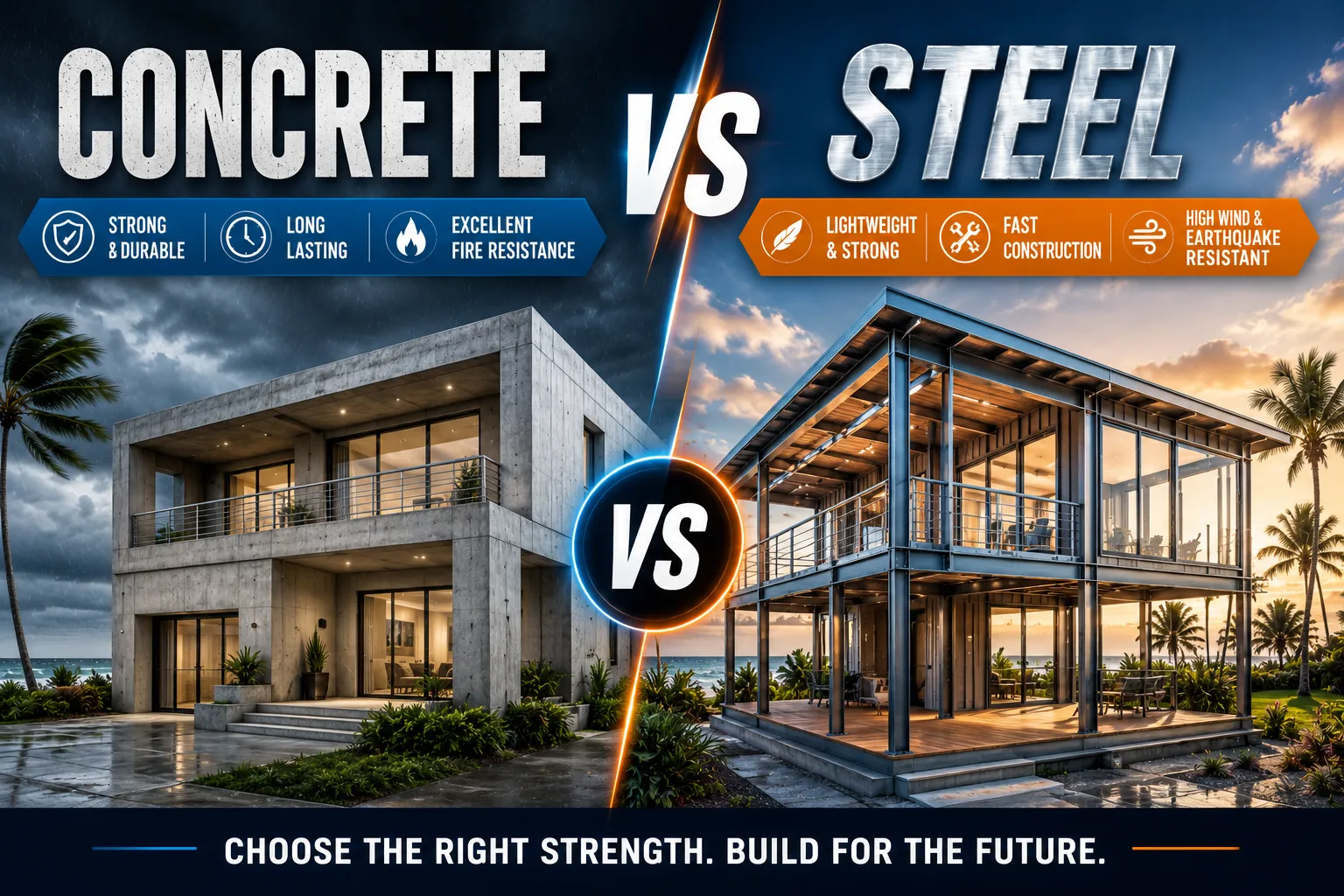
It’s not a small decision. Your home’s structural bones are what stand between your family and 150 mph winds, flying debris, and storm surge. So let’s skip the sales pitches and get into what actually matters – how concrete and steel perform when a hurricane is bearing down on your house, what they cost, and which one makes more sense for your specific situation.
Why This Debate Even Exists
Wood-frame construction has been the default in American homebuilding for decades, mostly because it’s cheap and fast. But if you’ve watched news footage of a Category 4 hurricane flattening entire neighbourhoods while a handful of homes stand untouched, you already know why concrete and steel have become the go-to options for anyone serious about building storm-resistant.
Both materials outperform wood by a wide margin in wind resistance. The real question isn’t “concrete or wood” anymore — it’s concrete versus steel, and that’s a much closer fight.
Concrete Homes: The Case For
Insulated Concrete Forms (ICF) and Poured Concrete
Most modern concrete hurricane homes aren’t just cinder blocks stacked on top of each other. They’re built using Insulated Concrete Forms — essentially foam blocks that get filled with reinforced concrete, creating a wall system with a rigid, continuous structure and built-in insulation.
Where concrete shines:
- Mass and inertia. A poured concrete wall doesn’t flex or flutter in high wind the way lighter materials can. It just sits there, heavy and immovable, which is exactly what you want when a gust is trying to peel your roof off.
- Debris resistance. A 2×4 travelling at 100 mph is basically a wooden missile during a hurricane. Concrete walls (typically 6-8 inches thick with ICF) shrug this off. Steel studs, without additional reinforcement, can dent or puncture.
- Fire resistance. Concrete doesn’t burn. If wildfire risk is also on your radar, this is a nice bonus.
- Energy efficiency. ICF construction has an insulation layer baked right into the wall assembly. Homeowners often report noticeably lower cooling bills, which matters a lot in hurricane-prone southern climates where AC runs nonstop.
- Sound dampening. Not hurricane-related, but worth mentioning — concrete homes are remarkably quiet.
Where Concrete Falls Short
- Weight and foundation demands. Concrete is heavy. That means a more robust (and expensive) foundation is required to support it.
- Cracking risk. Concrete can crack under certain conditions — shifting soil, temperature swings, or foundation settling. Cracks compromise the very integrity you’re paying for.
- Labour and expertise. Not every contractor knows how to pour ICF correctly. A poorly executed pour can leave voids or weak points you won’t discover until it’s too late.
- Renovation headaches. Want to add a window or knock out a wall in ten years? Good luck — concrete doesn’t forgive design changes cheaply.
Steel Homes: The Case For
Cold-Formed Steel Framing
Steel-framed homes typically use galvanised steel studs in place of wood, sometimes paired with steel roof trusses and structural steel connectors bolted straight into the foundation.
Where steel shines:
- Strength-to-weight ratio. Steel is incredibly strong for how light it is. A steel frame can handle significant wind loads without the massive foundation concrete demands.
- Consistency. Steel doesn’t warp, rot, shrink, or get eaten by termites. Every stud is exactly as strong as the last one — no natural variability like you get with timber.
- Flexibility that works with you, not against you. Steel has a degree of engineered flex, allowing it to absorb and redistribute wind loads rather than taking the full hit rigidly. Properly engineered steel connections (hurricane straps and moment connections) transfer load down to the foundation instead of concentrating stress at weak points.
- Faster construction. Steel framing typically goes up faster than a concrete pour-and-cure cycle, which can mean lower labour costs.
- Design flexibility. Steel allows for longer spans and more open floor plans without load-bearing walls interrupting your layout — something concrete struggles to match.
Where Steel Falls Short
- Corrosion risk. This is the big one, especially near saltwater. Coastal humidity and salt air can corrode steel over time if it isn’t properly galvanised or coated. Skimp here, and you’re looking at structural problems decades down the line.
- Thermal conductivity. Steel transfers heat and cold far more efficiently than concrete or wood, which can create “thermal bridging” and drive up energy bills unless insulation is designed carefully around it.
- Cost of skilled labour. Not every framing crew is steel-certified. Finding contractors experienced in structural steel residential builds can be harder (and pricier) in some regions.
- Perceived resale friction. Some buyers and appraisers are simply less familiar with steel homes, which can (unfairly) affect resale value in certain markets.
Head-to-Head: What the Numbers Say
| Factor | Concrete (ICF) | Steel Frame |
|---|---|---|
| Wind resistance | Excellent (up to 200+ mph with proper design) | Excellent (up to 170-200 mph with proper design) |
| Debris/impact resistance | Very high | High, but can dent without reinforcement |
| Corrosion/rust risk | None | Moderate to high near saltwater if uncoated |
| Energy efficiency | Very high (built-in insulation) | Moderate (needs added insulation strategy) |
| Termite/rot resistance | Complete | Complete |
| Upfront cost | Higher (10-20% more than wood, foundation-heavy) | Moderate (comparable to or slightly above wood) |
| Construction speed | Slower (curing time) | Faster |
| Fire resistance | Excellent | Good (steel can weaken under extreme heat) |
| Design flexibility | Limited once built | High |
Both materials, when engineered correctly and paired with hurricane-rated roofing, impact windows, and proper foundation anchoring, can meet or exceed Miami-Dade’s notoriously strict building codes – widely considered the toughest hurricane standards in the U.S.
So… Which One Actually Wins?
Here’s the honest answer: it depends on where you live and what you value.
Choose concrete if:
- You’re building directly on the coast, where storm surge and airborne debris are the biggest threats
- You want maximum quiet, fire resistance, and energy efficiency in one package
- You’re not planning major renovations down the road
- You have (or can secure) a contractor experienced specifically in ICF construction
Choose steel if:
- You want more flexibility in your floor plan now or in future renovations
- You’re building slightly inland, where corrosion risk is lower
- You want a faster build timeline
- You’re willing to invest in proper galvanization and coating to protect against rust
A lot of high-performing hurricane homes actually combine both: steel roof trusses and connectors anchored into a concrete or ICF wall system. You get the mass and debris resistance of concrete on the vulnerable lower walls, plus the strength-to-weight benefits of steel where it matters most, like roof framing.
The Part Nobody Talks About: It’s Not Just the Material
Here’s the truth that both concrete and steel salespeople tend to gloss over — the materials are only half the story. A concrete home with a cheap roof, unprotected windows, and poor anchoring will still lose its roof in a Cat 3. A steel-framed home with hurricane straps, impact-rated glazing, and a properly engineered continuous load path can outperform a mediocre concrete build.
Before you fall in love with a material, ask your builder these questions:
- Is the roof-to-wall connection engineered with hurricane straps or clips, not just nails?
- Are the windows and doors impact-rated (not just “hurricane shutters as an afterthought”)?
- Is there a continuous load path from the roof to the foundation?
- Has the design been reviewed against your local wind zone requirements, not generic code minimums?
- What’s the contractor’s actual track record with this specific material in this specific climate?
Final Thoughts
There’s no universal “winner” here — just the right fit for your budget, your coastline, and your long-term plans. Concrete gives you brute-force resilience and quiet, energy-efficient living. Steel gives you strength, speed, and flexibility without the corrosion-free guarantee.
If you’re still torn, talk to a structural engineer familiar with your specific region’s wind and flood zones. The best hurricane-resistant home isn’t necessarily the one built from the “strongest” material — it’s the one where every component, from the foundation bolts to the roof shingles, was designed to work together when it matters most.