If you’ve lived through even one bad hurricane season in Florida, you already know the feeling: watching the forecast, boarding up windows, and hoping your house holds. That uncertainty is exactly why more homeowners are asking a simple question — is a hurricane-proof home actually different from a traditional home, or is it just a marketing term?
The short answer: the difference is real, measurable, and shows up long before a storm ever makes landfall. Here’s a clear, side-by-side look at what separates a hurricane-proof home from a traditional wood-frame house.
Hurricane Proof Home vs Traditional Home
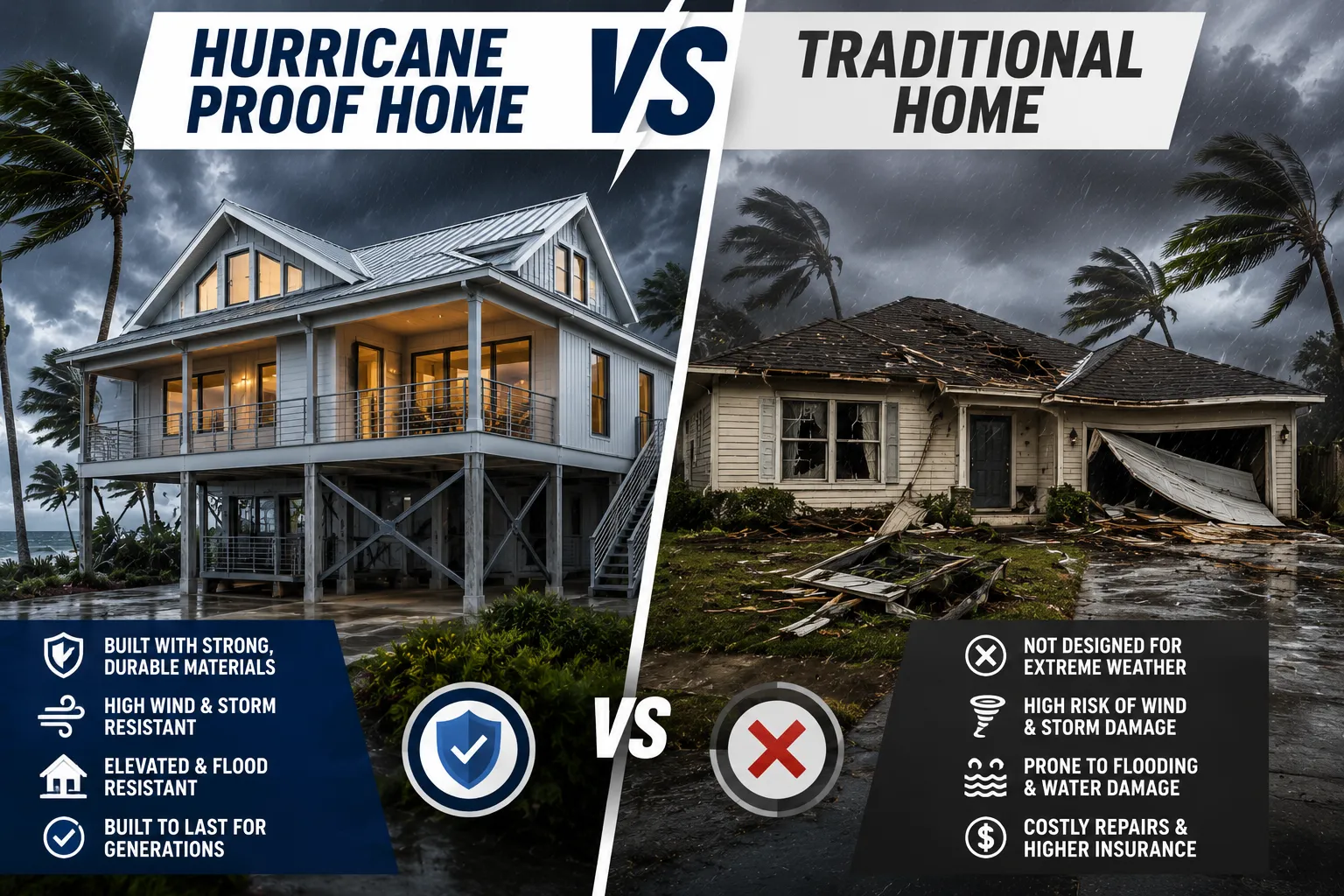
What is a hurricane-proof home?
A hurricane-proof home is built with structural steel framing and engineered systems designed to meet or exceed local wind-load requirements — often rated to withstand winds of 180 mph or higher. Key components typically include:
- Steel structural framing instead of wood studs
- Reinforced roof systems with continuous load paths
- Hurricane straps and anchors tying the roof to the foundation
- Impact-resistant windows and doors
- Elevated foundations in flood-prone areas
A traditional home, by contrast, is usually built with wood or concrete block framing to standard local building code minimums — code-compliant, but not necessarily engineered for the higher wind speeds a major hurricane can produce.
Key Differences at a Glance
| Feature | Hurricane Proof Home | Traditional Home |
|---|---|---|
| Framing material | Structural steel | Wood or concrete block |
| Wind resistance | Engineered for 180+ mph | Meets minimum local code |
| Termite resistance | Steel cannot be eaten by termites | Wood is vulnerable |
| Moisture/mold resistance | Steel doesn’t absorb water | Wood can rot and grow mould. |
| Fire resistance | Non-combustible steel frame | Wood contributes fuel to the fire |
| Structural lifespan | 150+ years | Shorter, with more repairs |
| Maintenance | Low — no rot, warping, or pests | Higher — ongoing wood upkeep |
| Insurance premiums | Often qualifies for discounts | Typically standard rates |
| Energy efficiency | Higher when paired with solar/insulation | Varies by build quality |
1. Structural Strength During a Storm
The biggest difference shows up when the wind actually picks up. Steel framing has one of the highest strength-to-weight ratios of any building material, which helps a hurricane-proof home resist roof uplift, wall failure, and structural movement during a major storm. Traditional wood-frame homes can perform well in moderate storms, but they’re more vulnerable to catastrophic failure once wind speeds climb into Category 4 or 5 territory.
2. Long-Term Durability and Maintenance
Wood framing is a living material—it can rot, warp, crack, and attract termites over time, especially in Florida’s humidity. Steel doesn’t share any of those weaknesses. A hurricane-proof home built on a steel frame is engineered for a structural lifespan of 150+ years, with far less ongoing maintenance than a traditional home requires over the same period.
3. Termite, Moisture, and Fire Resistance
Florida’s warm, humid climate is ideal for termites and mould — two of the most common (and expensive) problems traditional homeowners deal with. Steel framing simply removes both risks: termites can’t eat it, and it doesn’t absorb moisture the way wood does. Steel is also non-combustible, adding a layer of fire resistance that traditional wood framing doesn’t have.
4. Insurance and Long-Term Costs
Many insurers offer premium discounts for homes with certified hurricane-resistant construction, since the risk of a major claim is statistically lower. Combined with reduced maintenance costs (no termite treatments and no wood rot repairs) and a longer structural lifespan, a hurricane-proof home often costs less to own over time — even if the upfront investment is comparable to a traditional build.
5. Energy Efficiency
Modern hurricane-proof homes are frequently designed with energy performance in mind: advanced insulation, energy-efficient windows, and solar-ready systems. When paired with solar panels, some homeowners bring monthly electricity costs down significantly while maintaining backup power capability during storm-related outages – something a standard traditional home typically isn’t set up for.
So, Which One Is Right for You?
If you’re building in a coastal or hurricane-prone part of Florida, the case for a hurricane-proof home comes down to a straightforward trade-off: comparable upfront cost against dramatically better storm performance, lower long-term maintenance, and potential insurance savings. A traditional home may still make sense in lower-risk inland areas or for buyers prioritising the lowest possible initial price — but it’s worth going in with clear eyes about the added maintenance and storm exposure that come with it.
Frequently Asked Questions
Is a hurricane-proof home more expensive to build than a traditional home? Initial construction costs are often comparable. The financial advantage of a hurricane-proof home shows up over time, through lower maintenance, fewer storm-related repairs, and potential insurance discounts.
Can a hurricane-proof home really survive a Category 5 hurricane? No home can guarantee survival in every possible storm scenario. Properly engineered, Category 5-rated steel homes are designed to perform significantly better than traditional wood-frame construction during extreme wind events.
Does a hurricane-proof home need less maintenance than a traditional home? Yes. Steel framing resists termites, moisture, rot, and warping — the most common sources of ongoing maintenance in a traditional wood-frame home.
Ready to see the difference for yourself? Florida Steel Homes builds Category 5-certified hurricane-proof homes across Florida, with free solar panels and transparent, budget-first pricing. Call 786-610-6398 to schedule a consultation.