New homes built in Florida after 2002 must meet strict hurricane-resistant building codes, making them significantly stronger than older homes. But “hurricane proof” is not the same as “hurricane resistant”—no home is completely immune. Knowing the difference could save your home, your finances, and your peace of mind.
Are New Homes in Florida Hurricane Proof? The Honest Truth
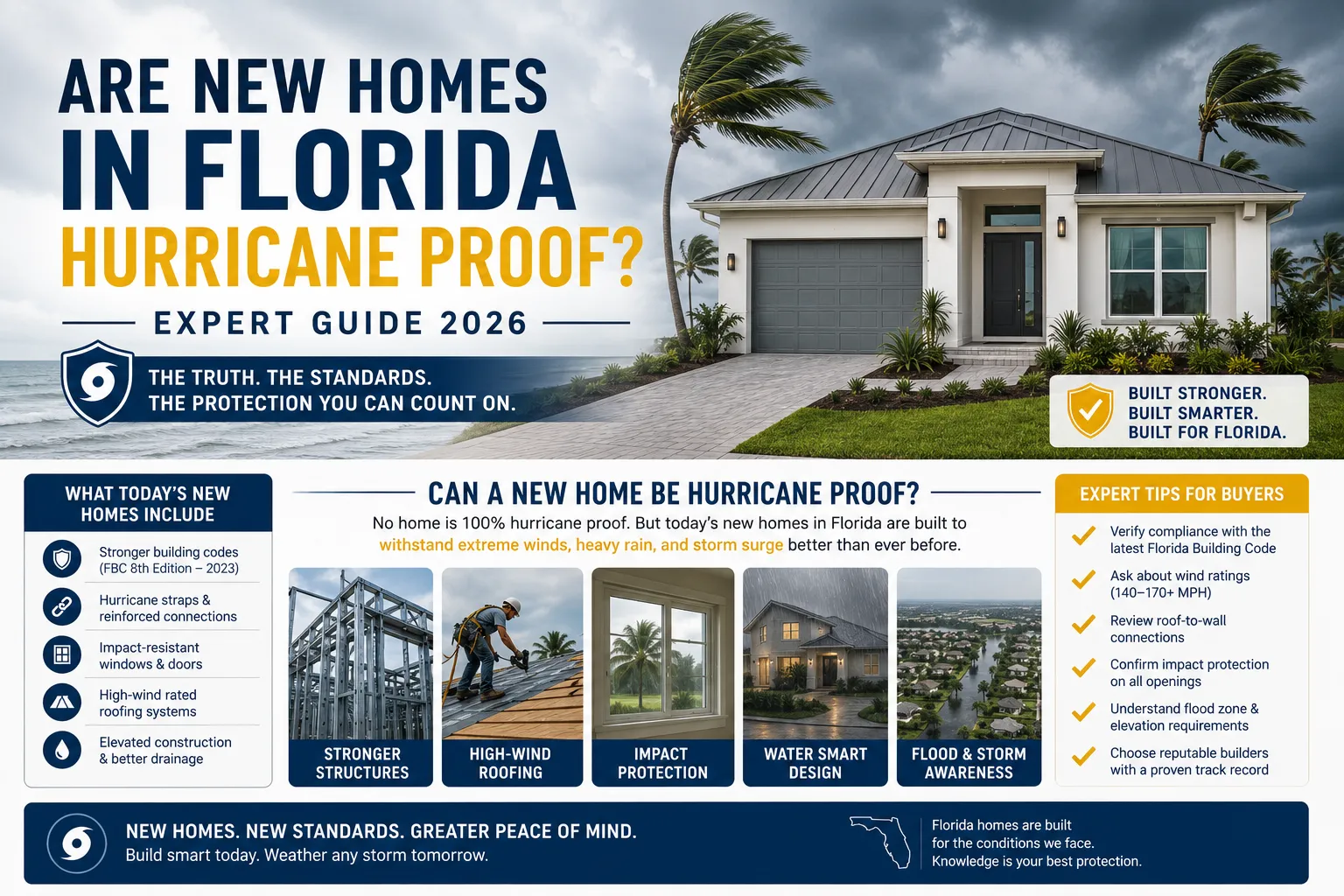
If you’re thinking about buying or building a home in Florida, this question has probably kept you up at night. Are new homes in Florida hurricane proof? It’s not just a fair question—it’s the right question.
Florida is one of the most hurricane-prone states in the country. And after the devastation of Hurricanes Irma, Ian, and Idalia, more people are demanding real answers — not just reassuring sales pitches.
Have more questions? Florida Steel Homes specializes in hurricane-resistant steel construction. 📧 info@FloridaSteelHomes.com 📍 16104 4th St E, Redington Beach FL 33708
What Do Florida’s Building Codes Actually Require?
After Hurricane Andrew tore through South Florida in 1992 and exposed how vulnerable homes really were, Florida overhauled its building codes—dramatically. The Florida Building Code (FBC), last updated in 2023, is now considered one of the most rigorous in the United States.
Wind Speed Requirements
New homes in Florida must be designed to withstand specific wind speeds depending on location. Coastal areas, especially along the Gulf Coast and Atlantic shoreline, require homes to be built for 130 to 180+ mph winds. Inland areas have slightly lower thresholds but are still held to high standards.
Impact-Resistant Windows and Doors
All new construction in high-velocity hurricane zones (HVHZs) — which covers Miami-Dade and Broward counties — must use impact-resistant windows and doors or install hurricane shutters. This is not optional. These openings are the most vulnerable points during a storm, and the current code takes that seriously.
Roof-to-Wall Connections
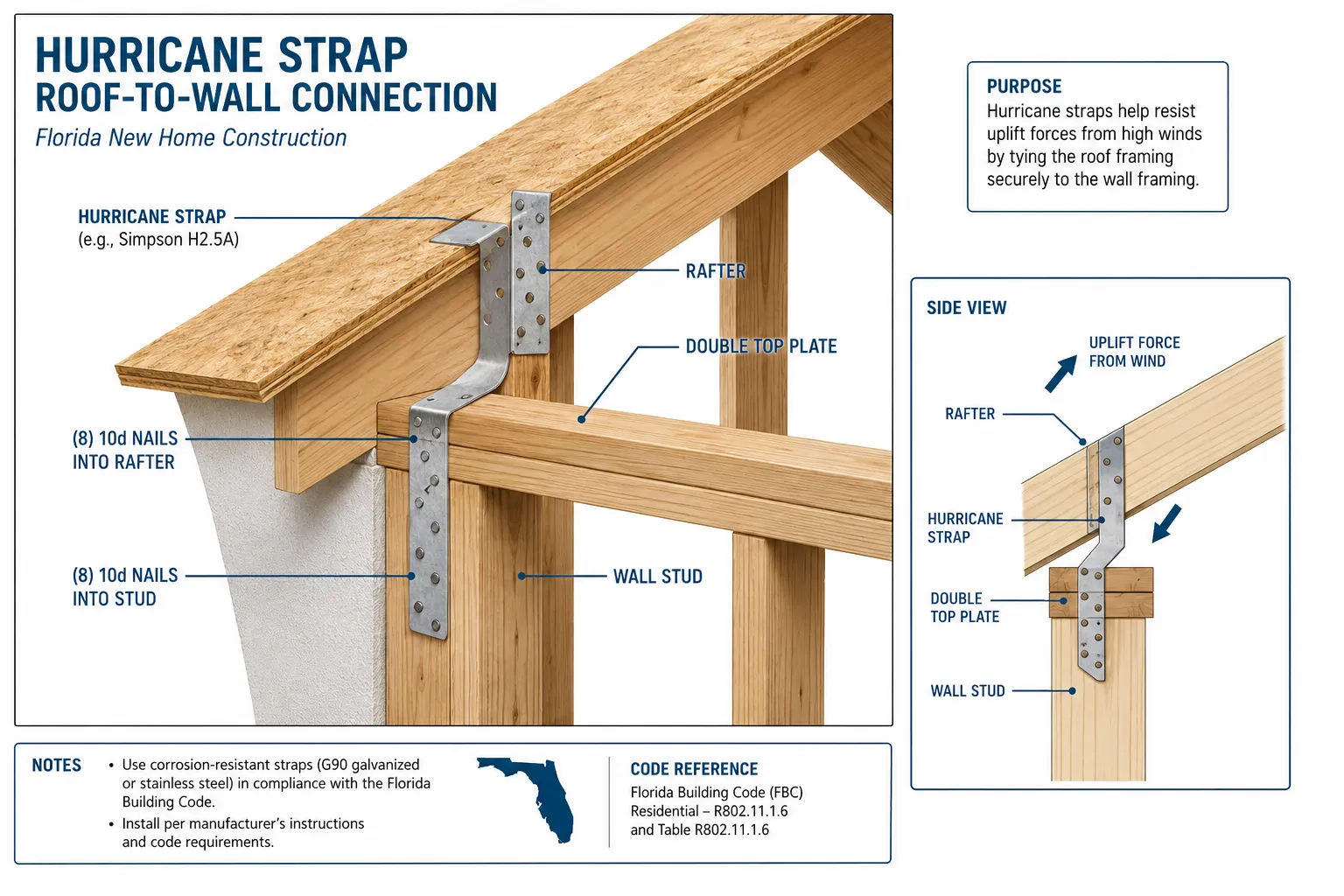
One of the biggest lessons from past storms: roofs don’t fail because of wind hitting them from above. They fail because of uplift—wind getting underneath and ripping them off. Florida now requires hurricane straps or clips at every rafter-to-wall connection, making modern roofs far harder to lose.
Hurricane Resistant vs. Hurricane Proof — A Critical Difference
Here’s something most articles won’t tell you plainly: no home in Florida is truly hurricane-proof.
What modern Florida homes are—when properly built—is hurricane resistant. That means they’re engineered to minimize damage, protect occupants, and maintain structural integrity during most major storms. But a direct hit from a Category 5? Every structure has limits.
The distinction matters because it affects your expectations, your insurance planning, and your evacuation decisions. A hurricane-resistant home gives you a fighting chance. It doesn’t give you a bunker.
What Makes a New Florida Home Stronger Against Storms
Steel-Frame Construction
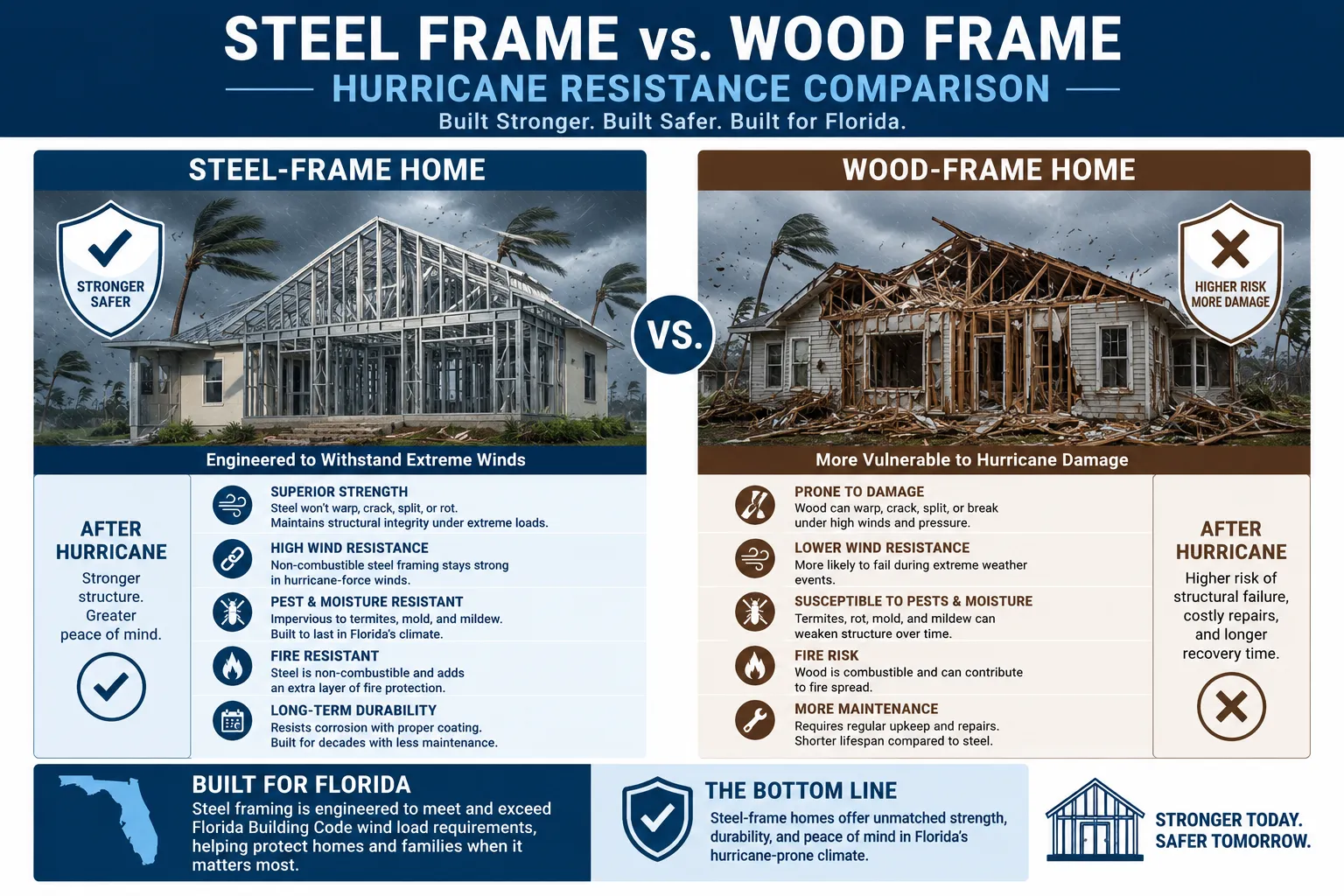
Traditional wood-frame homes flex and can fail under extreme wind loads. Steel-frame construction offers dramatically better rigidity and resistance to both wind and water damage. Steel doesn’t warp, rot, or get eaten by termites—all of which weaken wood-frame homes over time and make them more vulnerable when a storm hits.
Elevated Foundations
In flood-prone coastal areas of Florida, new homes are increasingly built on elevated pilings or stem walls that raise the living area above base flood elevation. This reduces storm surge damage, which often causes more destruction than wind alone.
Continuous Load Path Design
Modern Florida homes are built with a continuous load path — meaning structural loads from the roof travel through the walls and into the foundation in one unbroken chain. This approach, required under current FBC standards, is what keeps a home intact when hurricane-force winds try to pull it apart at every joint.
Pros & Cons of New Construction in Hurricane Zones
| Pros | Cons |
|---|---|
| Built to current FBC hurricane standards | Higher upfront construction cost |
| Impact windows and doors included | “Hurricane resistant” ≠ “hurricane proof” |
| Hurricane straps and clips at every connection | Insurance still required and can be expensive |
| Stronger roof systems and materials | Location still matters — coastal = higher risk |
| Eligible for lower insurance premiums | Older neighborhoods may have mixed-age homes nearby |
| Steel options offer superior long-term durability | Not all builders apply code equally — inspections matter |
Comparison: New Homes vs. Older Homes in a Hurricane
| Feature | New Homes (Post-2002) | Older Homes (Pre-2002) |
|---|---|---|
| Wind resistance | 130–180+ mph (code required) | Often 90–110 mph or less |
| Roof connections | Hurricane straps/clips required | Toe nails only in many cases |
| Windows/Doors | Impact-rated or shutters required | Often single-pane, no protection |
| Flood elevation | Often elevated per FEMA maps | Frequently at or below flood zone |
| Insurance cost | Generally lower premiums | Often significantly higher |
| Structural integrity | Continuous load path design | May lack modern engineering |
The difference isn’t subtle. During Hurricane Ian in 2022, newer homes in Fort Myers and Cape Coral that met post-2002 codes fared noticeably better than surrounding older structures — even in the same neighborhoods.
What to Ask Before Buying a New Home in Florida
Not every new home is created equal. Here’s what to actually ask your builder or agent:
- What wind speed rating is this home designed for? Get the number — not a vague answer.
- Is this home in a HVHZ (High-Velocity Hurricane Zone)? If yes, standards are even stricter.
- What type of roof-to-wall connections are used? Clips are good. Wraps are better.
- Is the framing wood or steel? Steel-frame construction outperforms wood in most storm scenarios.
- What’s the flood zone designation? FEMA’s flood maps are updated regularly — always verify.
- Has this home passed all required inspections? Ask for documentation.
Ready to Build a Home That Can Take What Florida Throws at It?
Florida Steel Homes builds steel-frame, hurricane-resistant homes designed specifically for Florida’s climate and storm conditions. If you’re serious about protecting your investment—and your family—let’s talk.
📧 info@FloridaSteelHomes.com 📍 16104 4th St E, Redington Beach FL 33708
Don’t settle for a home that just meets the minimum. Build one that’s genuinely ready for whatever storm season brings.