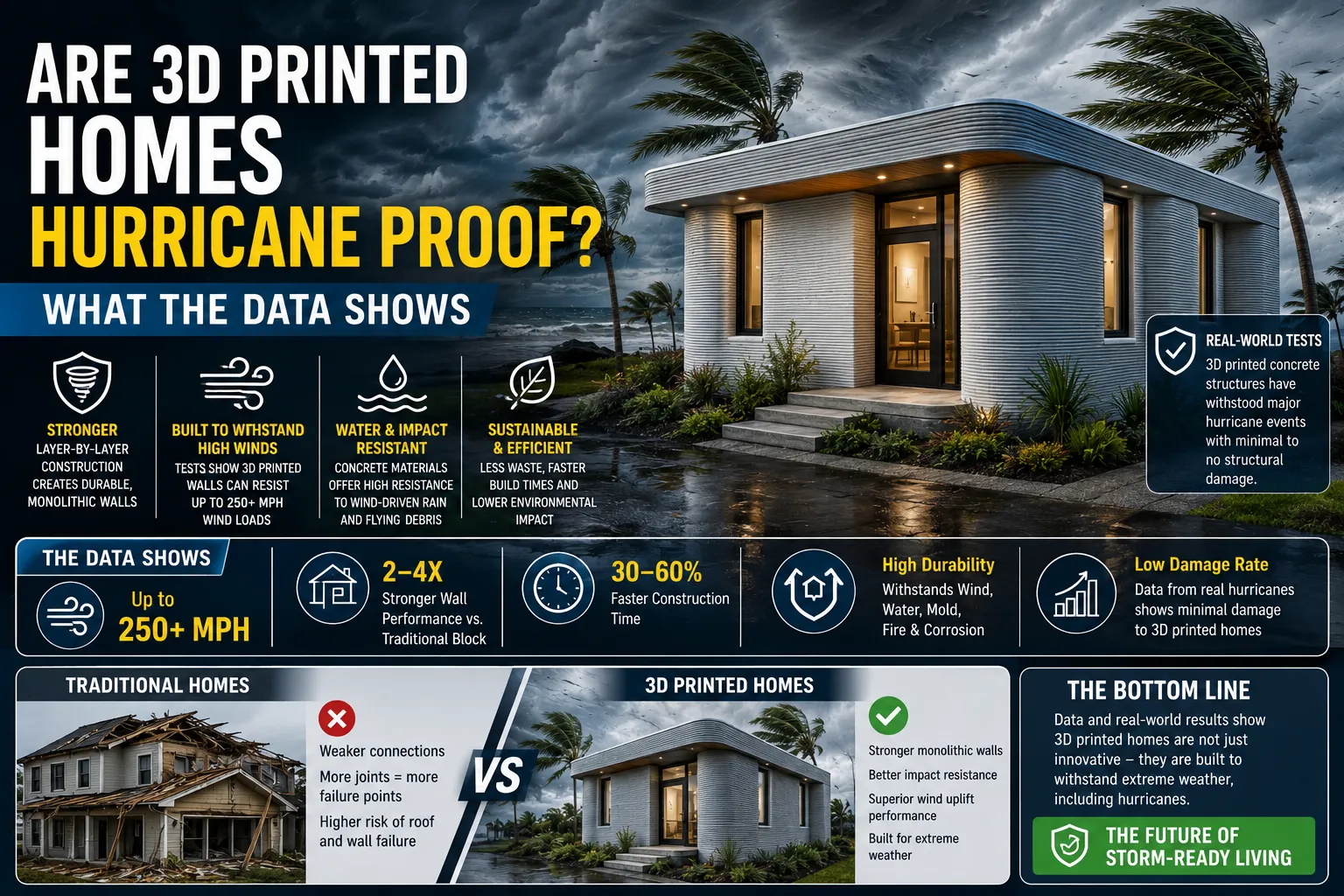
No home is truly hurricane-proof, and 3D-printed homes are no exception. But the data so far is promising. Printed concrete walls have passed lab tests for winds well above Florida’s building code minimums, including missile-impact and cyclic-pressure tests originally designed for tornado shelters. What’s missing is something more basic: a large enough number of 3D-printed homes have actually taken a direct hurricane hit for anyone to say how they perform outside a lab.
If you’re in Florida weighing a 3D-printed build against a conventional one, here’s what the testing, the building codes, and the handful of real-world examples actually tell us.
Are 3D Printed Homes Hurricane Proof? What the Data Shows
What “hurricane-proof” actually means in construction
Nobody in the building industry uses “hurricane-proof” as an engineering term, because it isn’t one. What they test for is wind resistance up to a specific speed, plus the ability to survive impact from flying debris without a breach. That’s the standard your roof, windows, and walls are held to, whether the house was built by hand or by a robotic printer.
The relevant tests for coastal Florida construction include:
- ASTM E330 measures how much static wind pressure a wall or window assembly can take before it fails structurally.
- ASTM E1886 and E1996 — the “missile test.” A 2×4 or similar object is fired at the assembly at high speed, and then the wall is subjected to repeated pressure cycling to simulate sustained hurricane winds to see if the impact point fails afterward.
- ICC 500 — originally written for tornado shelters, it pushes pressures and debris speeds even higher than hurricane testing, up to a 100 mph 2×4 impact.
A home that clears these tests at high wind ratings, combined with impact-rated windows and doors, can qualify for the Insurance Institute for Business & Home Safety’s FORTIFIED Gold rating — the closest thing the industry has to a hurricane-resilience seal of approval and one insurers increasingly recognise with premium discounts.
What the lab testing shows for 3D printed walls
ICON, the Texas-based company behind most of the large-scale printed homes in the U.S., has run its printed wall systems through this exact battery of tests. Its printed walls have passed the ICC 500-2020 standard, which increases hurricane-level pressures and impact forces up to tornado speeds, including a 2×4 “missile” fired at 100 mph. Combined with impact-rated doors and windows, ICON says homes built this way can meet the requirements for IBHS’s FORTIFIED Gold rating.
Separately, the company’s load-bearing printed wall system has also achieved a 2-hour fire rating, which matters in wind-driven fire scenarios during storm recovery, even though fire and wind are usually discussed separately.
There’s a structural reason printed concrete tends to test well: it’s poured (or rather, extruded) as one continuous form. Unlike a wall built from studs, sheathing, and siding that is assembled piece by piece, a printed wall has no seams or joints — and joints are usually where conventional walls fail first under wind pressure. Add rebar reinforcement, which most printed wall systems include for exactly this reason, and you get a wall that resists both bending and racking forces better than a typical stick-built one.
Other companies in the space report similar or higher numbers. One competitor, using a concrete-like print material called Lavacrete, claims its structures exceed storm-related building code requirements by more than 300%, though independent third-party verification of that specific figure is harder to find than the ICC/ASTM results above.
The gap: lab tests aren’t storm tests
Here’s the honest caveat. Passing ASTM E330 in a controlled chamber and surviving an actual Category 4 hurricane — with hours of sustained load, wind-driven rain intrusion, storm surge, and unpredictable debris — are related but not identical things. There’s still relatively little published data on how 3D-printed houses actually perform during real hurricanes and other severe weather, mostly because there simply aren’t many printed homes old enough, or in exposed enough locations, to have taken a direct hit yet.
That’s not a knock on the technology so much as a fact about its age. Widespread 3D-printed home construction in hurricane zones only ramped up in the last few years, and most FORTIFIED-style ratings and code approvals still rest primarily on lab and wind-tunnel data rather than post-storm damage surveys, which is also how most new building products get approved before there’s a large enough sample size to study.
For comparison, researchers are still gathering this kind of ground-truth data even for well-established building types. Florida International University, working with the University of Kansas, has been testing prefabricated homes against winds up to 150 mph at FIU’s “Wind Wall,” an eight-year research effort meant to update federal building codes for manufactured housing — a category of home that’s existed for decades. If that data is still being collected for manufactured homes, it’s reasonable to expect it will take time for 3D printed construction too.
Florida-specific numbers to know
If you’re building (or buying) in Florida, the printed wall’s lab rating is only half the picture — the state’s own building code sets the floor.
- High-Velocity Hurricane Zone (HVHZ): Miami-Dade and Broward counties require the strictest wind design standards in the country, generally built around 175+ mph design winds, depending on exposure category and location.
- Coastal wind zones statewide: Under ASTM E1996, Florida properties are classified into wind zones based on basic wind speed — Zone 1 (130–139 mph), Zone 2 (140–149 mph), and Zone 3 (150 mph or greater, which includes anything within a mile of the coast). The current version of this standard, ASTM E1996-17, is what’s referenced in the 2023 Florida Building Code.
- Missile impact requirements: In these zones, windows and door assemblies (printed or not) must pass large-missile impact testing unless the home uses code-compliant shutters instead.
A printed home that clears ICC 500 at a 100 mph missile speed is testing well above what most inland Florida wind zones require, but homeowners right on the coast or in the HVHZ should ask specifically whether the printer’s wall system, plus the windows and doors actually installed, have documented approval for their exact wind zone – not just a general hurricane-resistance claim.
Real 3D printed homes in Florida
A few printed projects are now standing in Florida, giving an early look at how the technology is being applied locally rather than just tested in a lab:
- Palm Beach Gardens: A home built using ICON’s Vulcan printer, using a specialised concrete mixture extruded in thick, seamless layers rather than a timber frame. The thick concrete walls also add thermal mass, which helps the interior hold temperature during power outages — a practical bonus during post-storm recovery, not just a wind-resistance feature.
- A statewide printer arrival: A large-scale house-and-seawall printer arrived in Florida in late 2024, aimed at both reducing hurricane impacts and building up the local construction workforce.
- Habitat for Humanity partnerships: Nonprofit builders have started using printed concrete for affordable housing in the Tampa area, with reported construction savings alongside the durability pitch, though these projects are aimed primarily at cost and speed rather than being marketed as hurricane-specific builds.
None of these homes has yet been tested by a direct major hurricane strike as of this writing, so their real-world performance is still an open question, not a confirmed result.
How printed homes compare to other “storm-resistant” designs
3D printing isn’t the only approach Florida builders use to fight wind. It’s worth knowing how it stacks up against the track record of designs that do have storm history behind them:
- Round and dome homes: Builders like Deltec have been building rounded homes for decades, specifically because round shapes shed wind more efficiently than flat walls and sharp corners. Deltec has built more than 5,500 round homes, with only one sustaining any wind damage — an unusually strong real-world record. Some geodesic dome homes, however, have failed for reasons unrelated to wind — one dome home off the Florida coast, designed to withstand gale-force winds and storm surge, was ultimately lost to Hurricane Ian because of sea-level rise undermining its foundation, a reminder that wind resistance and flood/surge resistance are separate engineering problems.
- Post-1994 manufactured homes: After Hurricane Andrew, HUD tightened manufactured-home construction standards significantly. A University of Florida study found that not a single manufactured home built after the 1994 code changes was destroyed by any of the four hurricanes that hit Florida in 2004, a genuinely strong real-storm data point that printed homes haven’t had time to accumulate yet.
- 3D printed concrete: Strong lab numbers, a joint-free wall structure that removes a common failure point, and growing code recognition — but still without a comparable real-storm track record.
In other words, printed homes are entering a field where some competing approaches already have 20-plus years of actual hurricane seasons behind them. That’s not a reason to dismiss the technology, but it’s context for how much weight to put on “hurricane-resistant” marketing claims versus documented storm outcomes.
The bottom line
3D printed homes aren’t hurricane-proof, because no home is. But the engineering case for them is legitimate: seamless, rebar-reinforced concrete walls that have cleared missile-impact and pressure-cycling tests at levels above most Florida wind zone minimums, plus growing eligibility for insurance-recognised resilience ratings like FORTIFIED Gold. What’s still missing is a large body of real storm outcomes to confirm the lab results, simply because the technology hasn’t been in the ground, in hurricane country, for very long.
If you’re evaluating a printed home in Florida, the practical move is to ask for the specific wind zone rating and test documentation for the exact wall, window, and door system being installed — not just a general claim that the home is “built for hurricanes”.
FAQ
Can a 3D-printed home withstand a Category 5 hurricane? No home, printed or conventional, is guaranteed to withstand a Category 5 storm. Printed concrete walls have passed lab tests simulating tornado-level winds and debris impact, which exceed most Category 5 wind speeds on paper, but there’s no confirmed real-world case yet of a printed home taking a direct Cat 5 hit.
Are 3D-printed homes cheaper to insure in Florida? It depends on the specific insurer and whether the home qualifies for a resilience rating like FORTIFIED Gold. A printed wall system alone doesn’t automatically lower premiums — the full assembly, including windows, doors, and roofs, needs to be documented and rated.
Do 3D-printed homes meet the Florida Building Code? Several printed wall systems, including ICON’s, have been engineered and tested to meet or exceed Florida’s wind load and impact requirements outside the High-Velocity Hurricane Zone. Homes built in Miami-Dade or Broward County need additional HVHZ-specific approval, which not every printer or wall system currently has.
Why are 3D-printed walls considered strong against wind? Mainly because they’re printed as one continuous, seamless structure rather than assembled from separate framed pieces, removing the joints where conventional walls typically fail first. Most systems also add rebar reinforcement for additional bending and racking resistance.
Sources: ICON Build testing documentation; Florida International University / University of Kansas WiSH Wind Wall project; ASTM International (E330, E1886, and E1996 standards); 2023 Florida Building Code; IBHS FORTIFIED program; University of Florida post-hurricane manufactured housing study; and news coverage from Scientific American, BGR, and WUSF.