If you live anywhere along the Gulf Coast or Atlantic seaboard, hurricane season isn’t an abstract risk — it’s a recurring line item on your calendar. And while you can’t control where a storm goes, you can control how well your home stands up to it.
A truly hurricane resistant home isn’t the result of one big upgrade. It’s a system: roof, walls, windows, doors, and drainage all working together so that wind and water can’t find a weak point to exploit. Below are the ten features that matter most, based on what actually holds up when storms make landfall.
10 Features Every Hurricane Resistant Home Needs: Expert Guide
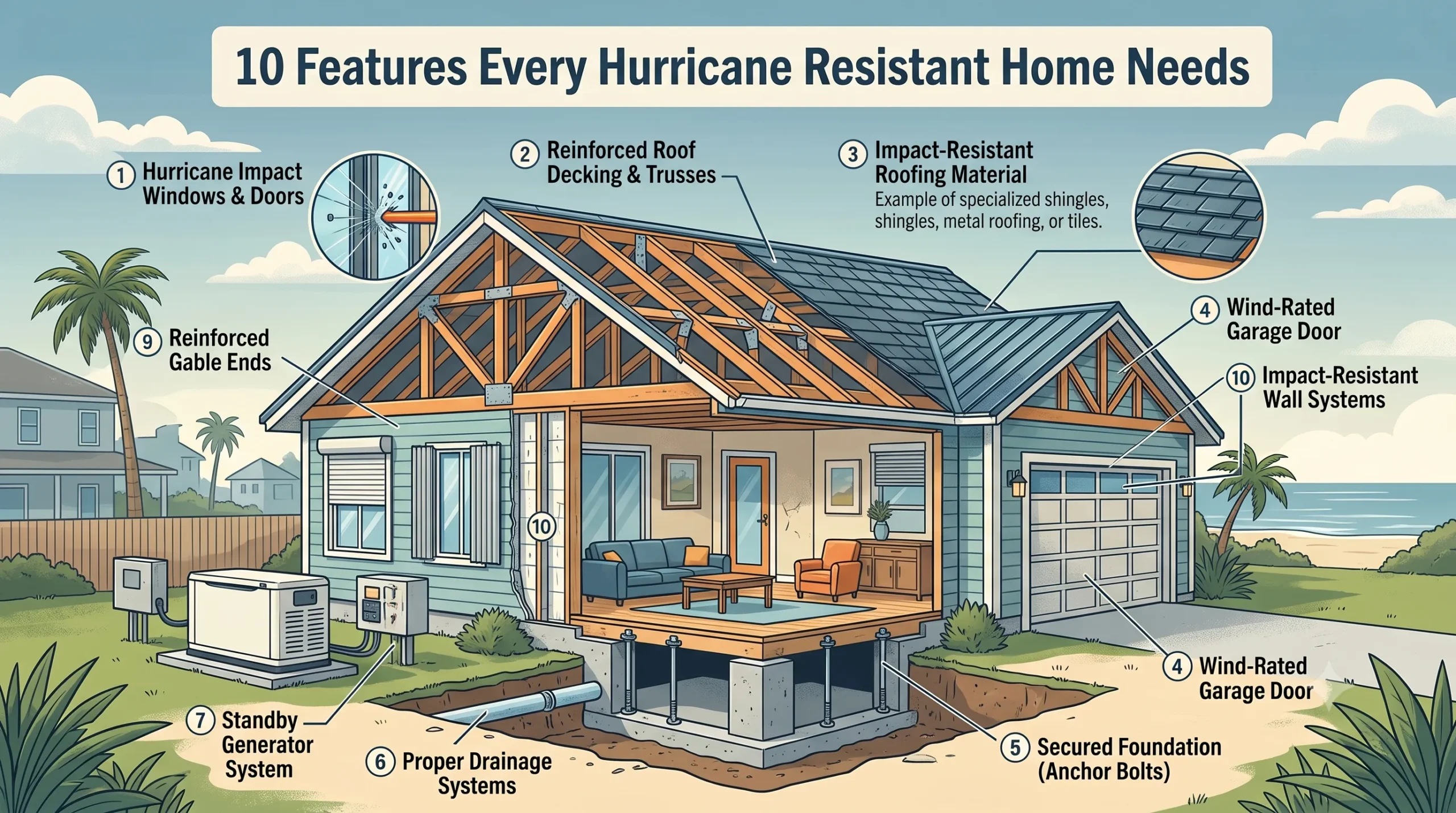
1. A Roof Rated for High Wind Uplift
The roof is usually the first thing a hurricane goes after. Wind doesn’t just push on a roof — it creates uplift, literally trying to peel it off from the edges in.
What to look for:
- Hip roofs over gable roofs. Hip roofs (sloped on all four sides) perform significantly better in high winds because they have no flat vertical face for wind to catch.
- Impact-rated shingles or metal roofing, rated to withstand sustained winds of 130+ mph.
- Secondary water barrier (SWB), a sealed underlayment that keeps water out even if shingles are torn away.
2. Hurricane Straps and Reinforced Roof-to-Wall Connections
Even a well-built roof is only as strong as its connection to the walls beneath it. Hurricane straps (also called hurricane clips or ties) are metal connectors that tie the roof trusses directly to the wall framing, distributing wind load down through the structure instead of letting it concentrate at the roofline.
Homes built before the mid-1990s in many hurricane-prone states often lack these entirely — retrofitting them is one of the highest-value upgrades a homeowner can make, and it’s frequently eligible for insurance discounts.
3. Impact-Resistant Windows and Doors
Flying debris breaking a single window can be catastrophic — once wind gets inside a home, it pressurises the structure from within and can blow the roof off from the inside out.
Impact-resistant windows use laminated glass (similar to a car windscreen) that may crack but stays intact. Look for:
- Windows and doors rated to Miami-Dade County standards or ASTM E1996, the toughest impact codes in the U.S.
- Reinforced garage doors — garage doors are one of the most common failure points because of their large surface area.
- If impact glass isn’t in the budget, code-rated storm shutters are the next-best line of defence.
4. A Continuous Load Path
This is the engineering concept that ties everything above together. A continuous load path means every part of the structure — roof, walls, floor, and foundation — is physically connected and reinforced so wind forces transfer safely down to the ground instead of tearing the building apart piece by piece.
You won’t see a “continuous load path” listed on a spec sheet, but you can ask a builder or inspector directly whether the home has one. It’s the difference between a house that loses shingles and one that loses its roof entirely.
5. Reinforced Concrete or Masonry Construction
Wood-frame homes can absolutely be built to withstand hurricanes, but reinforced concrete masonry (CMU block filled with steel-reinforced concrete) or poured concrete walls offer a structural head start. They resist wind pressure, flying debris, and water intrusion better than standard wood framing.
In newer construction, Insulated Concrete Forms (ICFs) have become popular — they combine concrete strength with better energy efficiency, a nice two-for-one benefit.
6. Elevated Foundation and Flood-Vent Design
Wind gets the headlines, but storm surge and flooding cause the majority of hurricane-related property damage. In flood-prone zones, homes should be:
- Elevated above the Base Flood Elevation (BFE) on pilings, piers, or a raised foundation.
- Equipped with flood vents in any enclosed area below the living space, allowing water to flow through rather than build pressure against the walls.
- Built with flood-resistant materials (like closed-cell insulation and treated lumber) below the flood line.
7. Proper Site Grading and Drainage
A hurricane-resistant home isn’t just about the structure — it’s about the land around it. Poor grading lets water pool against the foundation, leading to seepage, erosion, and long-term structural damage even after the storm passes.
Effective setups include grading that slopes away from the foundation, French drains or swales to redirect water, and permeable landscaping that reduces runoff instead of channelling it straight at the house.
8. Backup Power and Water Systems
Structural resilience keeps the home standing; backup systems keep it liveable afterward. Extended power outages are the norm, not the exception, after a major hurricane.
Worth having:
- A whole-home or portable generator with proper transfer switch installation.
- Battery backup systems (increasingly paired with solar) for quieter, longer-term power.
- A backup water supply or well pump generator hookup, since municipal water systems can go down along with the grid.
9. Wind-Rated Garage Doors and Reinforced Entry Doors
It’s worth calling this out separately from Windows because garage doors fail at a disproportionately high rate in hurricanes — and once a garage door fails, the whole home is compromised. Look for garage doors specifically rated for wind pressure (not just “heavy duty”), along with three-point locking systems on entry doors and reinforced door frames, not just reinforced doors.
10. Smart Home Monitoring and Early-Warning Systems
The newest addition to hurricane-resistant design isn’t structural at all – it’s informational. Smart leak detectors, structural sensors, and weather-integrated monitoring systems can alert homeowners to water intrusion, pressure changes, or power loss in real time, even when they’ve evacuated.
This won’t stop a storm, but it can mean the difference between catching a problem in hour one versus discovering it a week later when the damage has spread.
No home is 100% hurricane-proof, but the gap between a home that survives a major storm intact and one that doesn’t usually comes down to these ten features. If you’re building new, insist on all of them from day one. If you’re retrofitting an older home, start with the roof-to-wall connections and impact-rated openings; they offer the biggest resilience gain for the money and are often the fastest path to lower insurance premiums as well.